“Loud case”: the killer of a loving polkanny found after 24 years
The killer of a loving polkanny was found after 24 years, only she did not suffer punishment: life itself punished the criminal. Is it possible to attract ...
The killer of a loving polkanny found after 24 years, only she did not suffer punishment: life itself punished the criminal
Is it possible to prosecute a murderer who no longer exists? How to prove the guilt of a person whose version of events you can not verify? The answer seems obvious: no. However, the criminal police department of the Polotsk ROVD proved the opposite. They were able to establish the truth 24 years after the crime and called the name of the killer, although she was already dead.

Collage of Elizaveta Lesko House with a bad reputation November 12, 2002 about three o'clock in the afternoon in the abandoned house No. 12 on 2nd lane Frunze in Polotsk found the body of a man. The dead was 32-year-old Sergei Kovalevsky* – a local resident, occasionally worked in the construction team, twice convicted and abused alcohol. His father found the body. His dead son was lying in one of the rooms across the mattress face down.
During the initial examination, no visible damage was found, only minor abrasions on the forehead and nose, characteristic of a fall. However, forensic examination put everything in place: Polochan died of mechanical suffocation. The marks on the neck eloquently indicated that the loop was thrown from behind and tightened. In the blood of the deceased found a high concentration of alcohol. The abandoned house on 2nd Lane Frunze was not a random place. Nearby, Kovalevsky built his own cottage with the support of his parents, and used the dilapidated building for meetings. Here he brought women to drink together. Locals knew that the building has long been chosen by marginal companies for noisy gatherings.
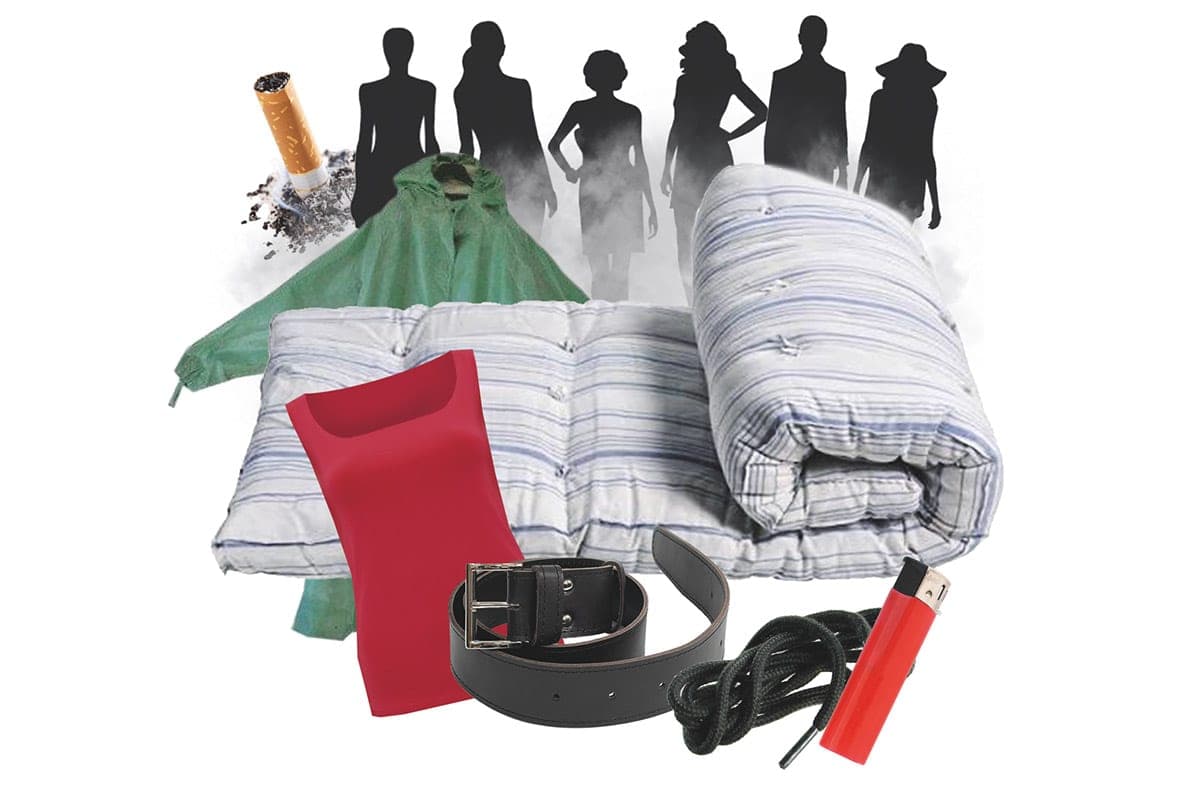
Kovalevsky himself was a man of conflict: in a state of intoxication he became aggressive and rude. There are two convictions, including for beating his ex-wife. The partners in his life changed often. Since 2002, he has been living with the woman who supported him. There were others before that. In short, the circle of contacts was extensive, which became the main problem for the investigation. Seven clues and dozens of versions When a detailed examination surfaced too many oddities. Abrasions on the face are mild. Traces of the struggle were completely absent, which excluded the option of a drunken brawl. Many items were seized from the scene: mattress upholstery, a women's top jersey, a cloak found under the bed, a black belt, a lace and a lighter. The footprints were fuzzy.
The main evidence was cigarette butts. At the beginning of the zero possibilities of genetic examination were limited, but the samples were preserved and preserved in evidence. The examination identified several biological profiles: part belonged to Kovalevsky, another to an unknown man, the third to an unknown woman.
The investigation began to methodically work out everyone who could be associated with the deceased. The list turned out to be huge: for a comparative study, samples were taken from acquaintances, cohabitants, former wives and random women whom Kovalevsky brought to that house. More than 30 people were checked, but none of the profiles matched. Investigators worked out version after version, checked on a polygraph, worked out operationally. The case was overgrown with volumes of examinations and certificates, but there was no result. Months and years passed. The materials were archived, but not closed: they were periodically raised, checked with new databases, but everything remained in vain. The situation began to change in 2015, when the leadership of the Polotsk ROVD changed. On the post of chief of criminal police came Lieutenant Colonel of police Maxim Krotenok. As befits an experienced operative, he began to carefully study old unsolved cases, which were listed as especially serious.
- When I came to a new job, first of all, I again raised cases against the person: murders, grave bodily, resulting in death, robberies. In the case of Kovalevsky remained a clue – the genomes of unknown men and women, there was something to work with. There is a lot of biological material on cigarette butts, Maxim Krotenok clarifies especially for correspondents of Rural Gazeta. We identified samples, identified who was in the house that weekend, all living in Polotsk we went, but no one came. It was worth expanding the investigation to nearby villages and agro-towns.
In detective work, it often happens this way: months of routine work are crossed out by one household accident. Once Maxim Petrovich came to visit his mother-in-law, in the town of Disna, Miorsky district. Over tea, they talked about the past, and the woman remembered: once she had a strong girl with a difficult fate. And one day, many years ago, in a private conversation, she admitted that she had strangled someone.
The head of the criminal police became wary and began to question in more detail. Mother-in-law said that the girl said that strangled a man somewhere in Polotsk. But it was a long time ago.
- I, frankly, could not move away from the shock, recalls Maxim Krotenok. - Got here, got the case. Looking: 2002. And I understand that this may be the lead to the very case. He started checking. The suspect was named Ekaterina Melnik, born in 1983, a native of the Miorsky district. She was only 19 at the time of the murder. She worked in the same construction team as Kovalevsky and lived in Disney. The check confirmed the worst fears: the profile highlighted from the cigarette butts coincided with Melnik's profile. But when investigators started looking for the suspect, it turned out she was... dead. And the death of the girl was very tragic: she was strangled by a former cohabitant. By the time the database was checked, it had been several months since her death.
- I knew her, says Maxim Petrovich. - I've seen her a couple of times. I didn't believe it right away, but facts are a stubborn thing. The case went viral. Investigators went to the correctional facility to talk with Melnik's partner. The man, who served time, was at first wary, but, realizing that it was impossible to hide the past, gave detailed testimony. He confirmed that he lived with Catherine and knew about her meetings with Kovalevsky. One day she returned home alarmed, and later confessed: strangled Sergei tights.
She said she was not alone that night. With her was a friend named Vitaly – the one whose profile was isolated from cigarette butts. Vitaly was found and checked. He confirmed he was in the house drinking with them but left early. What happened next, does not know, and about the death of Kovalevsky learned later. He didn't go to the police. To establish the truth, the man was even interviewed on a lie detector, but his version was confirmed.
Restoring the picture, the investigators came to the conclusion: that evening Sergei Kovalevsky, Ekaterina Melnik and Vitaly Ostapchuk gathered in the abandoned house. They drank alcohol, and then Vitaly left. Between Sergei and Catherine there was a quarrel.
According to the investigation, Kovalevsky began to show signs of attention to the woman, if to speak simply – to molest. She was not categorically against, but, sharply remembering her roommate, decided to fight back: she took off her capron tights, threw an improvised loop around Sergei’s neck and tightened it. The drunken womanizer did not expect such resistance and could not defend himself. Death came quickly. Dot over the "i" The murder of Sergei Kovalevsky was officially resumed.
In 2019, the Polotsk Interdistrict Department of the Investigative Committee of the Republic of Belarus issued a resolution to terminate the preliminary investigation in connection with the death of the defendant. Later, in 2020, the criminal prosecution against Ekaterina Melnik was stopped because of the inability to prove her guilt in court without her participation, and the production itself was suspended.
- There was a version that the third one was involved in the murder - the same Vitaly, explains the head of the criminal police Maxim Krotenok for the SG. There is no direct evidence of his involvement. He left early. What happened between Sergei and Catherine, only she knew, and she died. We collected everything we could: the testimony of a cohabitant, a witness, the results of examinations. But by law, if a person is dead, they cannot be held accountable. The final point in the investigation was set in 2026, 24 years after the tragedy. At the moment when the latest evidence was collected and Vitaly’s guilt completely excluded.
- This case is an example of how important it is not to give up to find the truth, says Maxim Krotenok. - And that's significant. Unsolved cases never stop working. Investigators are constantly checking old materials against databases. New technologies and opportunities are emerging. The research has come a long way and it has yielded results. That’s why I always tell young employees: don’t rush to close old cases. Work. Sooner or later, the truth will come out. * Names and surnames have been changed for ethical purposes.
chargaziya@sb.by