
Mercury turns into raisins. Does it threaten the Earth and other planets
Mercury’s slow decrease in size due to cooling of the core is a natural geological process. The same thing happens with Mars and the Moon, but the Earth’s processes are completely different
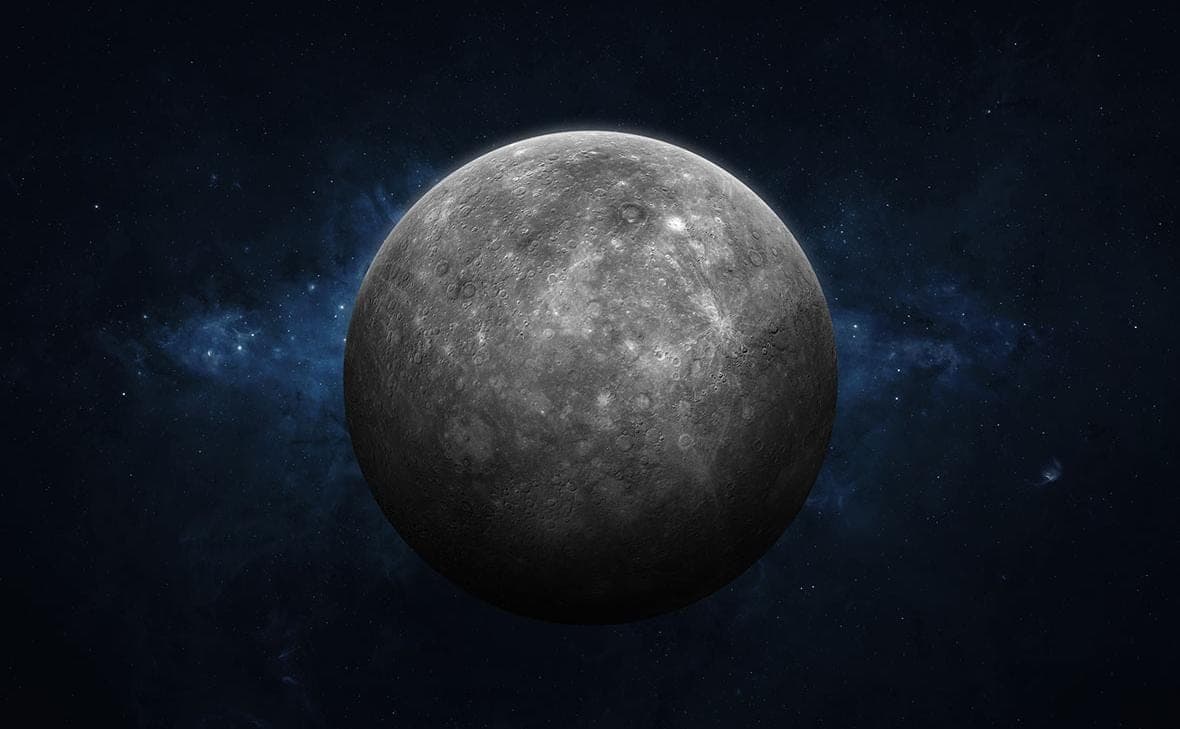
Scientists from the Institute for Space Research of the German Center for Aviation and Cosmonautics published a study in September, according to which the decrease of Mercury over 4.5 billion years was greater than previously thought - its diameter decreased by 23 km. This suggests that the planet is gradually shrinking “like grapes wrinkling under the sun and turning into raisins.” Russian scientists interviewed by RBC assessed what happens to the first planet from the Sun and how serious it is.
Is Mercury Really Compressing
As the director of the Astronomical Observatory of Irkutsk State University Sergey Yazev said, the appearance of refined information that differs from the original is “a completely normal, natural situation.” “Don’t take it literally that something catastrophic is happening there,” he said.
Mercury’s shrinking size is a normal geological process associated with cooling the planet, Yazev explained. He also noted that due to its characteristics, Mercury cools faster than larger planets, such as Venus or Earth.
Alexander Ivanov, head of the astrophysical optical observatory of the Kuban State University, is also sure that the “reduction” of the diameter of Mercury by 23 km is only a consequence of more accurate data.
Mercury's diameter was determined - it was preliminary compared to what was theoretically built earlier, was 23 km less. It is not decreasing, but determined that Mercury has a smaller size. It has nothing to do with the sun. Here they simply measured that huge asteroids knocked out the soil from the surface of Mercury, which returned back, the scientist said.
The clarification of the information was also indicated by senior researcher at the Department of Nuclear Planetology IKI RAS Alexander Kozyrev.
“It is not that its cooling rate has suddenly increased. This is not a new observation of the current process, but a methodical rethinking of existing data. So the planet is not globally threatened, but for scientists who build models of its internal structure and thermal history, this is a very important and significant amendment.
At the same time, he also noted that the very slow process of reducing the planet does take place - Mercury has a very large iron core, and as it cools, the volume of the celestial body decreases.
“Mercury has a single, global lithosphere, not like Earth, but like a single shell. And as soon as the internal volume decreases slightly, this shell begins not to crack, but to crumple: parts of the crust seem to fit on each other, and tectonic structures of compression, or, roughly speaking, ledges, are formed on the surface, Kozyrev said.
The scientists interviewed by RBC agree that the Sun and solar activity are not directly related to the process of cooling the core of Mercury and reducing its size.
Are other planets shrinking in size
Astronomers noted that the cooling of the nuclei and the decrease in the volume of planets is a natural and ubiquitous geological process, but its speed and features depend on the individual parameters of each celestial body.
“Because the dimensions are different, and the initial temperature is different, and the composition is different. That is, if everything is covered with ice on the surface, of course, it will look different. And in a good way, if you think about it, Venus should also, so to speak, decrease slightly as it cools. But there's a little bit of [the process] going on. And the same thing should happen with the Earth, Yazev explained.
Kozyrev cited similar Mercurian processes on the Moon and Mars, which, he said, are also cooling "single plate" (having a solid and continuous lithosphere) bodies.
“And on Earth, it should be, but we have lithospheric plates that move constantly, at a rate of centimeters per year.” Even if global compression does occur, it is processed by plate movement. Therefore, on Earth, we clearly do not see such an effect, he said.


