Agronom told what benefits are tomatoes of unusual colors
The summer season of 2026 in the suburbs was marked by an unprecedented harvest of tomatoes
"Pride Therapy."
The main reason for passion is ambition. Psychologist Anastasia Lysakova explains the phenomenon of “pride therapy”: growing large fruits is a way to demonstrate status and declare its uniqueness. In conditions when the dacha ceased to be a source of food, it turned into a platform for self-realization.
“By growing huge fruits, people literally project their work to the desired result. Giant vegetables allow gardeners to express themselves, says Anastasia. Social psychologist Alice Fedina adds, “Growing a pumpkin of 400kg is a legal way to prove to yourself and the world that you’re capable of something outstanding without getting involved in politics or business.” Dacha becomes an alternative to career, sports and even creativity - with a tangible, edible result.
Competitive excitement and “tomato fever”
The second driver is competition. Chats SNT turned into branches of the Olympic Games: “Petrovna cucumber 50 cm, and me?” This race is heated by official championships such as the Battle of the Giants, where more than fifty huge fruits are weighed. The excitement comes to the absurd: Moscow giant Alexander Chusov from Elektrogorsk participated in an international auction for one seed of a giant tomato - and lost.
Andrey Sokolov, a specialist in greenhouse cultures, notes: The competitive element is a powerful motivator. People are willing to put as much energy into one fruit as others spend on a whole garden. But from an agronomic point of view, this is a dead end: in terms of food value, ten ordinary tomatoes are healthier than one giant.
Economics of Hobbies: Costs vs. Ponts
The fascination with gigantism is costly. Special seeds, fertilizers, irrigation systems, time - all this requires investment. Andrey Tumanov, an expert in the field of horticulture, directly calls it a “competition of ponts and vanity”, adding that “it is better to grow ten bags of potatoes and nine buckets of cucumbers”. However, the proponents of gigantism retort: it is a hobby, not a business. Like any hobby, from collecting to sports, it doesn’t have to be cost-effective.
Gigantism is not only an ambition, but also a rigorous science. Regina Bukharmetova left only one flower on the bush, breaking the remaining ovaries, and the entire resource of the plant went into one fruit. Tomato "Giant Farina" - a variety specially bred for super-large fruits. "Pride of Siberia" - Siberian breeding, adapted for short summer, with fruits up to 900 g and above. Also popular are "Russian size" (record - 2 kg 695 g), "Dimensional" (up to 1.5 kg), "King of Giants" and "Pink Bugai".
Agronom Andrei Sokolov emphasizes: “The secret is not in chemistry, but in exact calculation.” Normation of ovaries, the formation of a bush in one stem, potassium-phosphorus feeding - all this allows you to redirect the resources of the plant into one fruit. But again, this has nothing to do with family food security.”.
So why did it become massive? Moscow suburban summer residents were fond of gigantism for three reasons:
1. The cottage has ceased to be a "food base" - now it is a place for self-expression.
2. SNT’s social media and chat rooms have created an environment for competition and demonstration of achievement.
3. There are available varieties and technologies that allow you to get records even in the zone of risky farming.
Palette of Choices: From Indigo Rose to Blueberry Sherbet
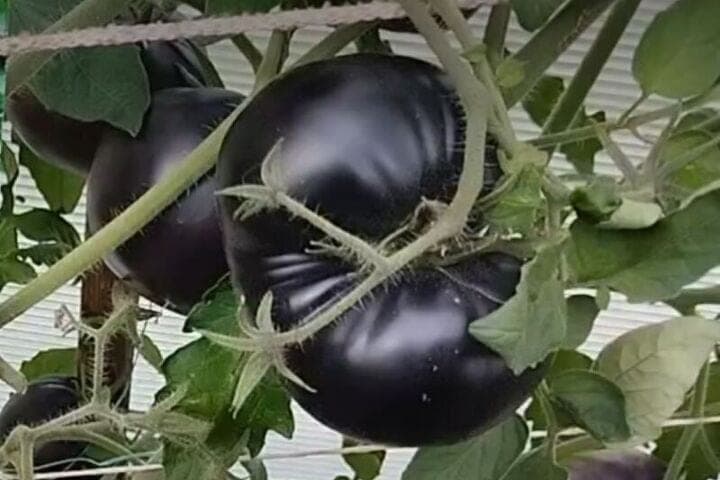
Ten years ago, the color of the tomato on the suburban bed was a decided question: red means ripe, the rest is from evil. Today, the situation has changed dramatically. Purple, black, yellow, white, striped, "marble" - unusual coloring has become the same criterion of choice as yield or resistance to phytophthorosis. And it's not just a chase for exotics. The color of the tomato is determined by a set of pigments. Red varieties are rich in lycopene, yellow and orange are rich in beta-carotene. But of particular interest to summer residents are dark purple and almost black tomatoes. Their coloration is due to anthocyanins – powerful antioxidants that protect cells from oxidative stress.
According to agronomist Andrei Sokolov, “Anthocyanin tomatoes are not just beautiful.” Studies show that their antioxidant capacity is higher than that of conventional red varieties, and anthocyanins contribute to the prevention of cardiovascular and neurodegenerative diseases. That is why summer residents, who used to be skeptical of “overseas” colored varieties, now increasingly include them in their “ratio” of plantings.
Today, the choice of colored tomatoes for the suburbs is huge. Here are the most popular destinations:
Purple and black: "Indigo Rose" - one of the darkest varieties, with fruits up to 100 g, the flesh remains red. The Black Prince is large-fruited, fleshy, very sweet. “Blueberry Sherbet” became a real opening of the season-2025 in the suburbs due to the purple-blue shade and fruity taste.
Bicolors: tomatoes with two or more colored colors. "Sgt. Pepper Bicolor" - orange fruits with crimson and purple divorces, sweet, with caramel notes. "Gold of Siberia" - orange-red fleshy fruits weighing up to 320 g.
White: “White Icicle” and “Super Snow White” are snow-white fruits that surprise guests on the table.
Green and striped: "Green Zebra", "Black Pineapple" - a mixture of green, burgundy and yellow shades.
According to the observations of seed sellers, the choice of colored varieties obeys several rules. First, summer residents are looking for resistance to diseases - in the suburbs this is critical. Then the ripening period: for short summer, early and middle-early varieties are suitable. And only then comes the "wow factor" - how unusual the fruit looks.
“I choose colored tomatoes not only for beauty,” says Elena Tikhonova, a dacha from Podolsk. For example, my grandson eats yellow and orange varieties – they are sweeter and less acidic. And purple I plant for salads: they look spectacular on the plate, and, as they say, healthier. Last year, she planted “Blueberry Sherbet” – she did not regret it, the taste is really unusual, with fruity notes.