
Alikhanov: INNOPROM is part of common industrial policy of Belarus and Russia
Visiting the ONT visiting studio – Minister of Industry and Trade of Russia Anton Alikhanov
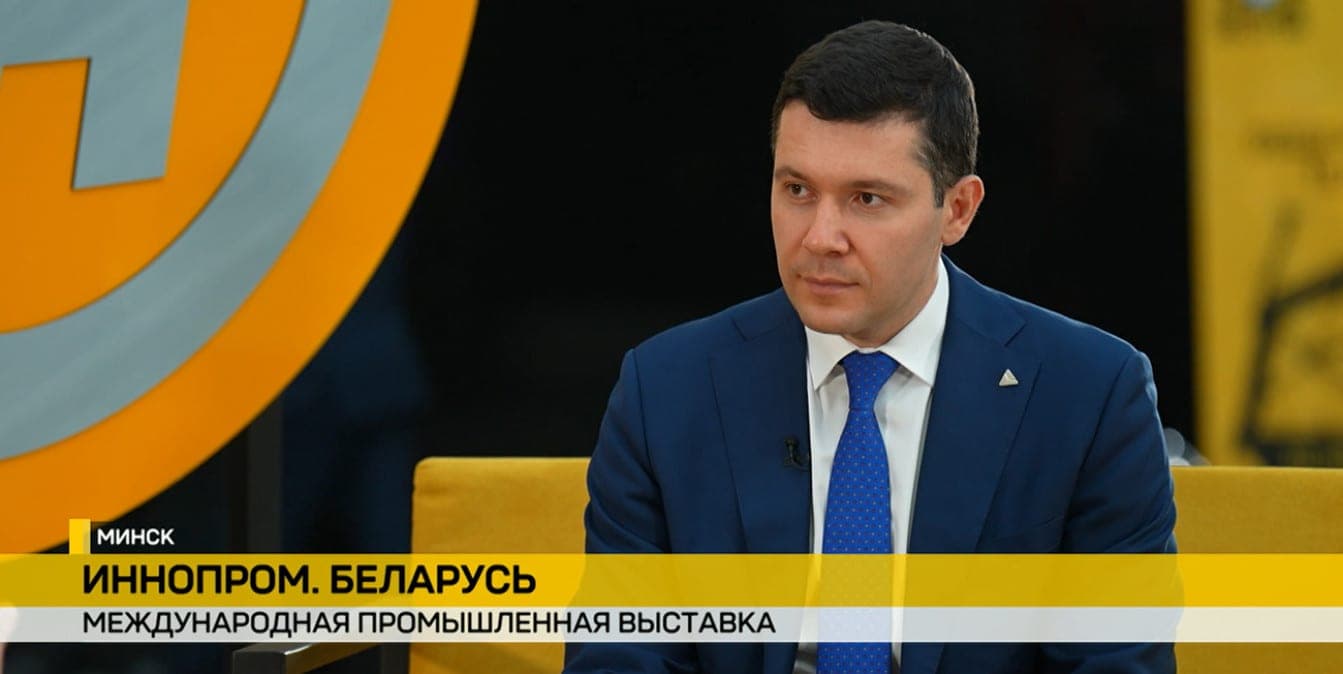
The second day of the INNOPROM exhibition is nearing its end. Of course, the unifying theme is industrial cooperation. Especially within the Union State. It's not just trade or exchange of goods, it's co-creation of products, common standards, common markets. This is a response to the challenges facing our economies today: the need for technological sovereignty, import substitution, and the creation of our own technologies. And here, in partnership with Russia, we are allies in the most literal sense of the word. We talked about the solid foundation of our relations with the Minister of Industry and Trade of Russia Anton Alikhanov.
Anton Alikhanov, Minister of Industry and Trade of Russia: We have signed decrees on a single industrial policy, including in the twenty-third year. It seems to me that INNOPROM is such a part of our unified industrial policy. I am very glad that INNOPROM is being held in Minsk for the second time. For me, as the Minister of Industry and Trade of Russia, this is an opportunity, of course, for our Russian companies and Russian factories to show themselves, bring new products and new developments to Minsk and show themselves to Belarusian comrades, but not only because there are several dozen delegations from different countries. This is also an opportunity for us to discuss the results of the past year at the level of our prime ministers. Last year, the heads of government instructed us to accelerate cooperation through, for example, the Eurasian Economic Union. There are Belarusian and Russian partners, including transport engineering, construction materials, and automation equipment. In general, a fairly wide palette of different projects in different high-tech areas. These projects are already supported by the Eurasian Economic Union through a special financing instrument. Today we have a good result: we have almost tripled the number of projects supported by the Eurasian Economic Commission.


