
In a year, Belarus Today will celebrate its 100th anniversary. Excursion into history through publications of past times
On August 2, 2027, Belarus Today will celebrate its 100th anniversary. We offer readers an excursion into history through newspaper publications of the past.

On August 2, 2027, Belarus Today will celebrate its 100th anniversary. We offer readers an excursion into history through newspaper publications of past times

"Worker", September 18, 1927 On the second page of the issue "Worker" attracts attention the material "Belarus - at the All-Union horse competitions". Let us close our eyes to the fact that 100 years ago the competitions in the title were called “horse”, and in the text they were called “the second all-Union”, although officially the First All-Union equestrian competitions opened only on August 24, 1936 in Rostov-on-Don. That's not the main thing in the material. We note with special attention and respect that the results of the competition were interviewed by Semyon Tymoshenko, then “commander of the No-Cavalry Corps”, and in September 1939 the commander of the Ukrainian Front, whose troops will take part in the liberation campaign of the Red Army, which put an end to 20 years of Polish domination over the Western lands. Eight months later, in May 1940, Semyon Konstantinovich became Marshal of the Soviet Union.
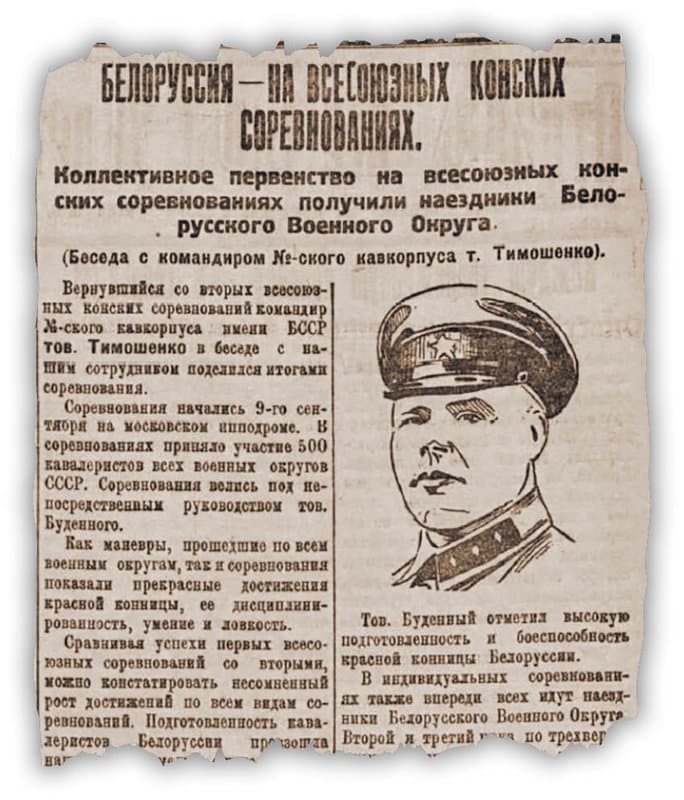
The competition began on September 9 at the Moscow Hippodrome. 500 cavalrymen of all military districts of the USSR took part in the competitions. Competitions were conducted under the direct supervision of Tv. Budenny.
The training of the cavalrymen of Belarus exceeded the wildest expectations. In the first days of the competition was held with equal success for representatives of all military districts. Only after a three-day struggle began to stand out sharply riders of the Belarusian Military District.
In individual competitions, the riders of the Belarusian Military District are also ahead of everyone.
Tov. Zhukov (BVI) received the first prize for the field competition.”.
Yes, in 1927, the future Marshal Zhukov took the first place in the Second All-Union “horse” competitions, and then the commander of the 39th Buzuluk Cavalry Regiment of the 7th Samara Cavalry Division, stationed in the Belarusian Military District (in Minsk).
This is probably the first mention of Georgy Konstantinovich in the Belarusian press. And the second is in the Soviet Union. In 1922, Izvestia VTsIK reported that Zhukov was awarded the Order of the Red Banner. Actively about it began to write only from the mid-1930s.
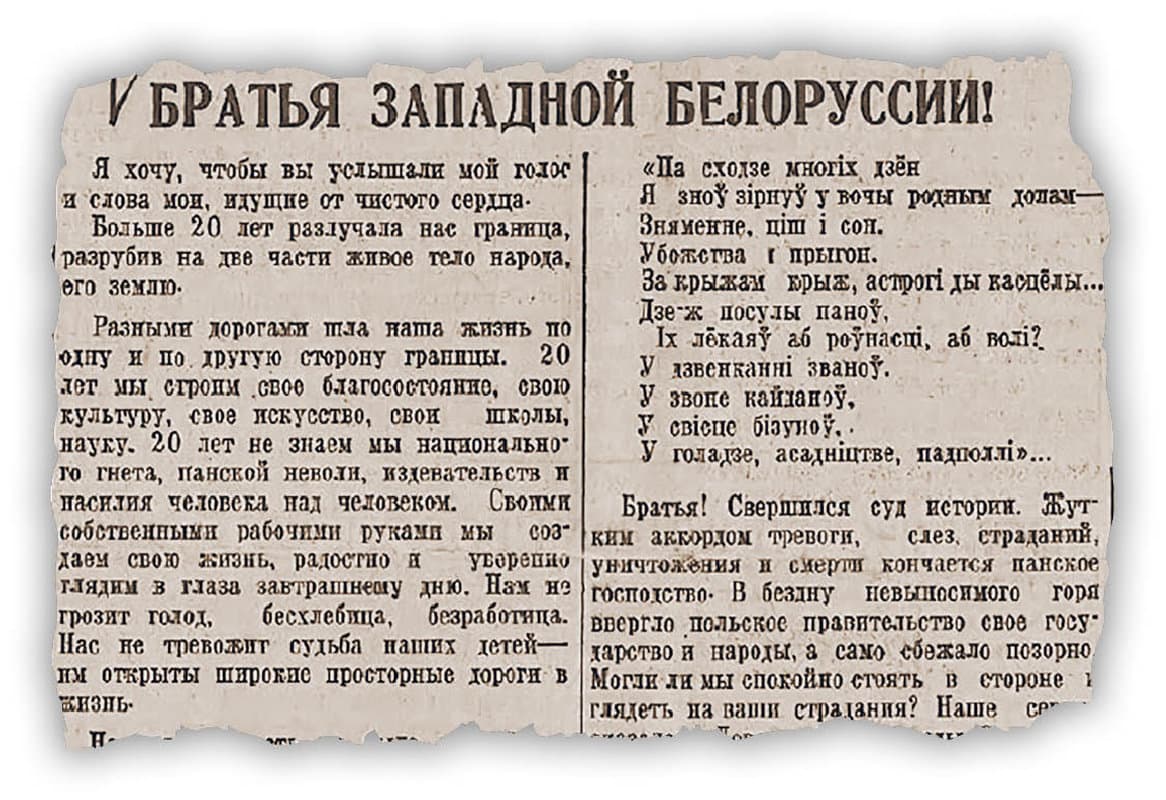
Could then, in the autumn of 1927, the correspondent of Rabochego, even in the most daring assumptions, think that the winner of individual competitions in the field competition Zhukov in the summer of 1945 would host the historic Victory Parade on Red Square? "Soviet Belarus", September 19, 1939 In the center of the front page of the issue - the appeal of Yakub Kolas "Brothers of Western Belarus". In particular, he recalled his trip:
“Four years ago I passed through Western Belarus. From the window of the carriage I saw the places where my feet had walked thousands of times. The feeling of bitterness gripped my heart as I gazed at the narrow stripes, at the wretched huts, at the grief-stricken faces of my brothers. The sad, long-forgotten experiences have woken up again. Then I wrote you a dedication “Z Darogi”, which may not have reached you.
The poet concludes his address with the following lines:
Courageously and openly, casting aside the lies and slander of the pans and their minions about the horrors that the Bolshevik will supposedly bring you, look into the eyes of a Red Army soldier - he is your brother and friend. And the pan's dope will dissipate like a rotten fog from the pure east wind.
Jakub Kolas. People's poet of the BSSR, order-bearer”.
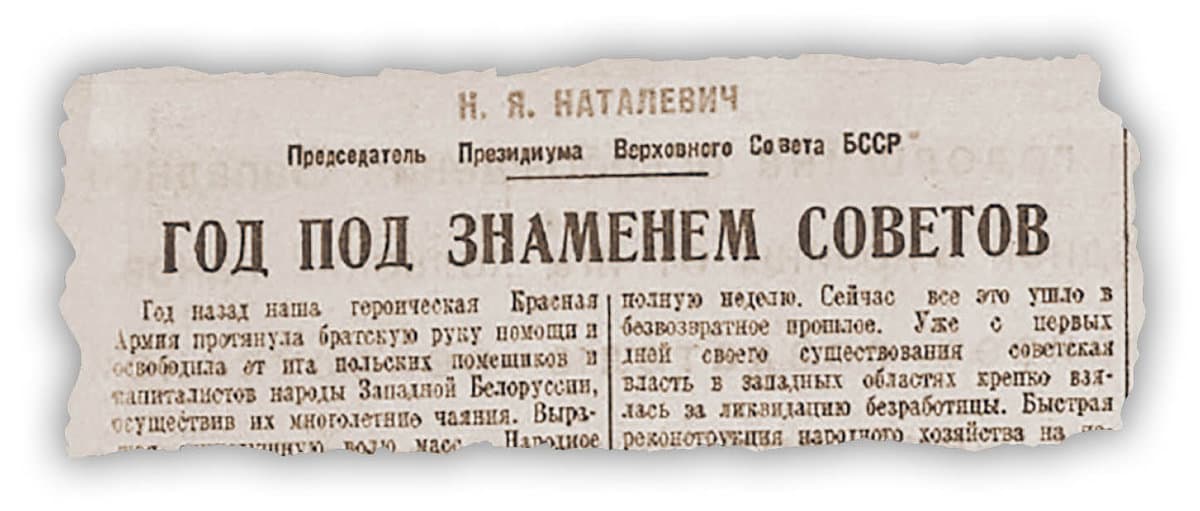
“Soviet Belarus”, September 17, 1940 On the second page of the issue for September 17, 1940, the Chairman of the Presidium of the Supreme Soviet of the BSSR Nikifor Natalevich in the material “The Year Under the Banner of the Soviets” reports on how Western Belarus has changed in just one year. Here are excerpts:
“Hundreds of thousands of landless and landless peasant farms are endowed with land formerly owned by Polish landowners and magnates. More than 25,000 cowless and 10,000 horseless farms received cows and horses. To help the peasants, the Soviet government sent agronomists, technicians, engineers. 101 MTS have been established. In the western Belarusian village, where the most primitive metal gun was rarely seen before, machine-tractor workshops, garages, forges are being built. With MTS, residential settlements grow with landscaped houses, clubs, baths. Much work has been done to reconstruct waterways. The construction of the Dnieper-Bug Canal has been completed. Brest became a major port city.
For the first time, the western regions of the BSSR have a budget of almost 730 million rubles this year. Of these, 400 million rubles were allocated for social and cultural events.
During the year of Soviet power, a large network of Belarusian, Russian, Jewish and Polish schools was deployed in the western regions. Only on the local budget for 1940 Baranovichi region released for public education 55 437 thousand rubles, Bialystok region — 67 475 thousand rubles, etc. The number of incomplete and complete secondary schools in the western regions increased by 13 times. There are now 5,633 schools, including 4,000 Belarusian schools. There are 724,000 children in schools. Teaching is conducted in the mother tongue. 100 houses of socialist culture, 7 theaters and many other cultural institutions have been opened.
New hospitals, outpatient clinics and pharmacies have been opened in cities, districts and villages of western regions. Workers shall be provided with free medical care.”.
"Sovetskaya Belarus", September 17, 1942 September 21, 1941, the Central Committee of the CP(b)B adopted a resolution to publish a wartime newspaper "Sovetskaya Belarus". Its first issue was published in the Orel region in the small town of Bolkhov, where the editors went from Gomel in August 1941 in the editorial carriage. Subsequently, the newspaper was published in Kazan, and after the defeat of the Germans near Moscow moved to the capital.
The front page of the September 17 issue calls on the Belarusian people to "be a German, a yak of shaky sabaks." Here's a little excerpt:
“Ludaed Hitler with the fire and the swords of our native land.
Our gardens are the gardens and the gardens are the gardens.
Nyametski is a bandit on our land. I'm a treba sponge. Iago can be a sponge. The skins of the Belarusian pavinen vedats only one way: treba bizlitasna forgets the German. Come here, Jo Sustrenesh. On the streets, by the house. Behold the grenade, the bayonet, the vilami, the rubi with the tapar, the cracking of the get pascuzza, the only thing you can do is forget, the great paganae atroddze, I'll clean up the hell of the hated acumens.
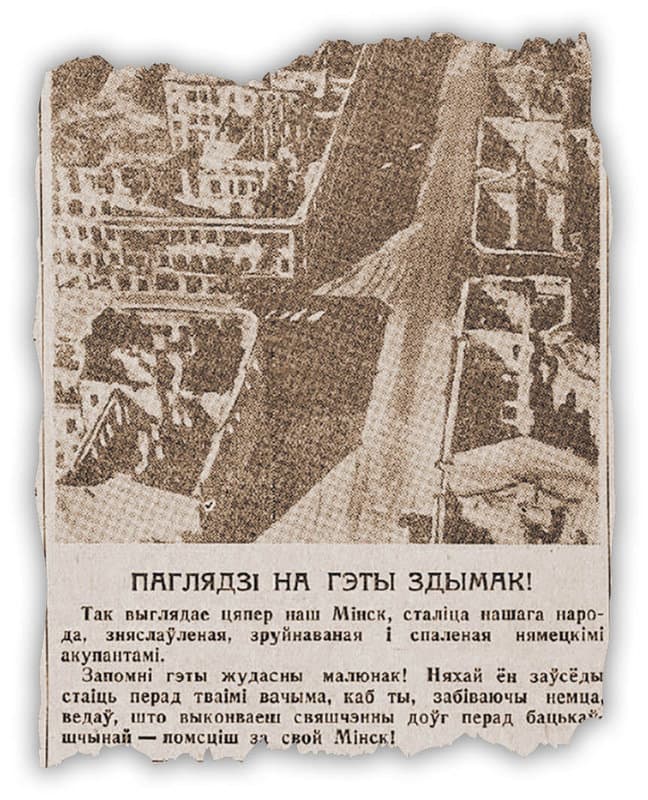
On the second page of the issue for the same number for clarity, what "Paganae Atroddze" creates on our land, a photo was published, in the foreground of which the intersection of Soviet and Volodarskaya streets is visible. The caption below the photo reads:
“Thus look our cyaper Minsk, the stalina of the Nashaga people, haughty, tattered and burnt to death by the nametzkimi acurantam.
Remember the Gats Judas, the Malunaks! You're a German, you're a German, you're a German, you're a German, you're a German, you're a German, you're a German, you're a German
To assess the scale of the destruction of the first days of the war, we cite records from the front diary of the German communications officer Koeniger, who on June 29 from the height of the Opera House looked at the city: “Through Minsk, the war passed like a volcanic eruption – fire and ash. This is the first time we have seen such destruction. In the West, we’ve seen ruined cities before, but there’s no destruction of this magnitude
Almost 4 years later, on July 15, 1945, Stalin stopped on his way to the Potsdam Conference in Minsk. Seeing the ruins and ruins stretching to the horizon from the station square, he froze, and when he came to his senses, he advised to build two large houses opposite the Minsk station - so to speak, the city gate, which "will hide the ruins and decorate Minsk." On September 20, 1963, the Decree of the Central Committee of the CPSU and the Council of Ministers of the USSR “On the Elimination of Excess in Design and Construction” was published in November 1955. According to him, the builders were given the task to quickly and, most importantly, inexpensively build houses. In general, they worked on the principle of “each Soviet family – a separate apartment”.
A boom in the construction of panel houses by the stream-speed method began. If the youth knew today, what happiness it was for people of the post-war period to move from the cramped boardwalk barracks, or even dugouts to a separate warm apartment with all the amenities!
On September 20, 1963, the editorial of "Soviet Belarus" pleased readers with the material "Two floors in six days." Here are some fragments of the material:
“A panelevoz drives up to the tower crane and stops where another car just stood. Unloaded, she went for another “portion” of panels.
Editing begins. Slings are set. You can see how slightly lowered the arrow of the tower crane, and the heavy panel of the floor, describing a semicircle, slowly floated up. Zveniev Alexander Klepikov, leaning forward, stretches his hands towards the falling panel.
The entire 80-apartment building will be built in 15 days. The full cycle of work on each floor is completed in three days. The installation of the building is carried out in three shifts. Interesting data of timekeeping conducted on the construction of the house. On the slinging of one panel, an average minute is spent, on the lifting, installation and reconciliation of panels - 6 minutes. Two floors were built in six days. Today, homebuilders are installing the third floor.”.
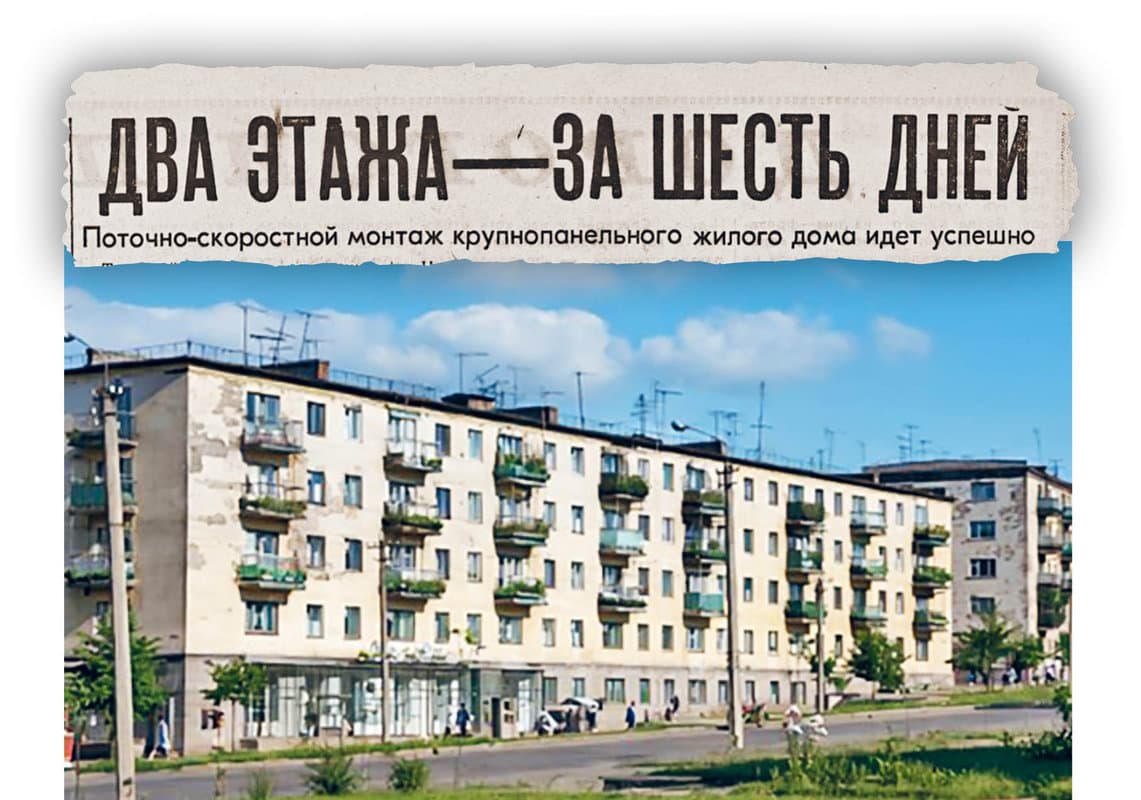
It was the 1960s - the peak of the construction of Khrushchev. Design engineers have documented and fixed the 125-year lifespan of large-panel houses. So in our Khrushchev can still live and live. On September 17, 2010, the Federation of Trade Unions of Belarus is the largest public organization in the country. It consists of almost 4 million citizens. 16 years ago, on September 15-16, 2010, the VI Congress of the FPB was held in the Palace of Culture of Trade Unions. The President took part in the congress as a delegate nominated by many FSP organizations.
Speaking to the delegates, the President emphasized that, raising a particular issue, trade union workers should realistically assess the economic situation in the country. “In no case do not engage in populism,” Alexander Lukashenko warned. We have already done this in our history... At that time, the activity of the trade unions had nothing to do with the real protection of the rights of the working man, but was aimed at satisfying the interests of the top of the organization.”.
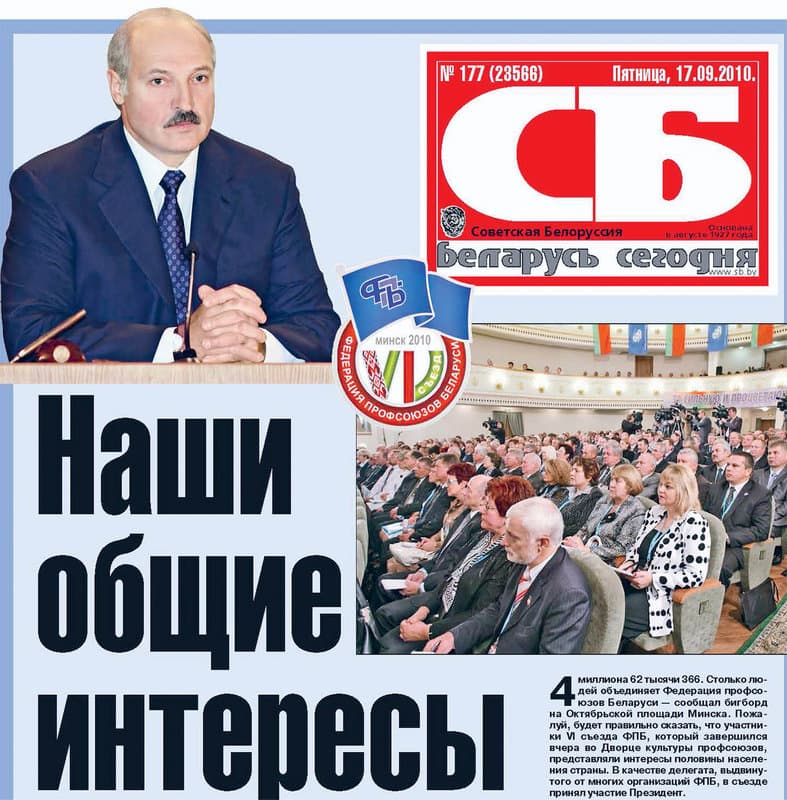
From the President’s point of view, trade unions along with local Councils of Deputies, public associations of youth, women and veterans form the basis of the country’s civil society. These structures are partners of the state. They must act responsibly, in the interests of all citizens. "Soviet Belarus", September 15, 1972 At the 1972 Summer Olympics in Munich, Soviet athletes from the BSSR gymnast Olga Korbut and freestyle wrestler Alexander Bear became the main stars who rewrote the history of world sports. It was these games that brought both legends. "Soviet Belarus" in the September 15 issue tells about the return of our Olympians to their homeland:
Among the Soviet participants in sports battles in Munich was a large detachment of representatives of our republic. Ambassadors of Belarusian sports made 11 gold, six silver and two bronze medals in the total treasury of high awards received by athletes of the USSR.
The whole planet is now known the names of the honored master of sports, three-time Olympic champion, seven-time world champion Alexander Beard, three-time gold medalist of the XX Olympics Olga Korbut, winners of the highest standard medals Viktor Sidyak, Nikolai Gorbachev, Tamara Lazakovic and other Belarusian athletes.
All Belarus, which warmly escorted them to Munich, closely followed the performances of our strongest athletes. Feelings of all Belarusian fans, passionately wishing for the victory of Soviet athletes, brightly poured out on the platform of the Minsk railway station, where on September 13 the working cities warmly welcomed the Belarusian Olympians. Barely having time to get off the train, the heroes of the XX Olympics fell into friendly arms, they were showered with bright autumn flowers. Representatives of the public, sports organizations, employees of the LCMB Central Committee, workers of Minsk enterprises, relatives came to meet our athletes. Warm smiles, bouquets of flowers, hot friendly handshakes - all this was addressed to the participants of the Olympics: Elena Belova, Tatiana Samusenko, Tamara Lazakovic, Vladimir Lovetsky, Vladimir Shchukin, Alexander Maleev and others. And on September 14, Minsk was also warmly welcomed by another group of Olympians, which included gymnast Olga Korbut.
INFORMATION
... Three-time Olympic champion and seven-time world champion, recognized as the best freestyle wrestler in history and the best athlete of Belarus of the XX century, died on September 2, 2024 at the age of 86 years. On September 16, 2026, a monument to the legendary wrestler was opened at the Eastern Cemetery in Minsk.


