
A short tour of district centers, towns and agro-towns, whose names are associated with the October Revolution
Each Belarusian village, village, district center has its own unique voice, character and biography. But on the map of our country there is a special route.
Each Belarusian village, village, district center has its own unique voice, character and biography. But on the map of our country there is a special route – settlements, whose names directly echo the calendar day on November 7. October, October, Ilyich... For some, these names are just a toponym of the Soviet era. But it is necessary to come there, go to the village post office, look at the local museum or talk to rural teachers and mothers with many children, as behind strict tablets the living history of the country opens. A history that is written not in offices, but on the ground – by the hands of workers, their devotion to their work and the strong bond of generations.

Opens our pre-holiday roll call of the city village Oktyabrsky - the center of the district of the same name. Here, this holiday, as well as the history of the region, is spoken with special trepidation, remembering both the partisan detachment "Red October", and the Rudobel partisan republic itself, which became an example of indomitable resistance and bravery of villagers.
On June 28, 1939, 22 years after the capture of the Winter Palace and the establishment of Soviet power, on the site of the former Rudobel volost, the Oktyabrsky district of the Polesie region was formed with the center in the village of Karpilovka. And on August 31, 1954, the villages of Rudobelka, Rudnya and Karpilovka merged into a single urban-type settlement, which was also called October. The streets, referred to as Oktyabrskaya, are preserved in some settlements of the district.
Director of the Center for History and Culture of the Oktyabrsky District Larisa Salovich not only knows the history from archival documents, but also passes it through his own large family.
- For our district, this is one of the brightest and turning points of history, says Larisa Anatolyevna. It was then that the villagers first felt themselves masters on their land, got the opportunity to honestly work on it for the benefit of their families. Unique exhibits are kept in our museum – for example, a huge painting by an unknown artist, which captures the moment when Alexander Solovey, the leader of the Rudobel Republic and a hero of the revolutionary movement, brought to our lands the first decrees on peace and land.
But the most important thing for Larisa Salovich is to ensure that the historical memory remains alive for the younger generation. Hundreds of children come to the museum on vacation for festive quests, interactive programs “Rudobelsk Republic” and photo documentary exhibitions “Revolutionaries from Rudobelka”.
- I have a large family, and every year we go with the children to the festive rally at the Lenin monument near our center, Larisa Salovich shares with a smile. My sons are in fourth and seventh grade. Children find it difficult to perceive dry texts from textbooks or adult books, so we look for ways they understand. Recently, we watched the old black and white film “Rudobelsk Republic”. The boys were so interested! As I watched, I explained to them what was going on in our home country. The eldest son is now enthusiastically participating in school history Olympiads. When children see real portraits of their countrymen and understand how their ancestors lived, history becomes something personal and close to them.

The preparation of the district for the celebration of the memorable date was told by the head of the department of ideological work, culture and youth affairs of the October District Executive Committee Karina Kursevich:
On November 6, representatives of public associations and political parties will gather for a rally laying flowers on Partizan Square. A festive concert will be held at the Leisure Center. But the main emphasis we make on dialogue platforms, youth photo challenges and sports tournaments, because it is the young to pass this baton of memory.
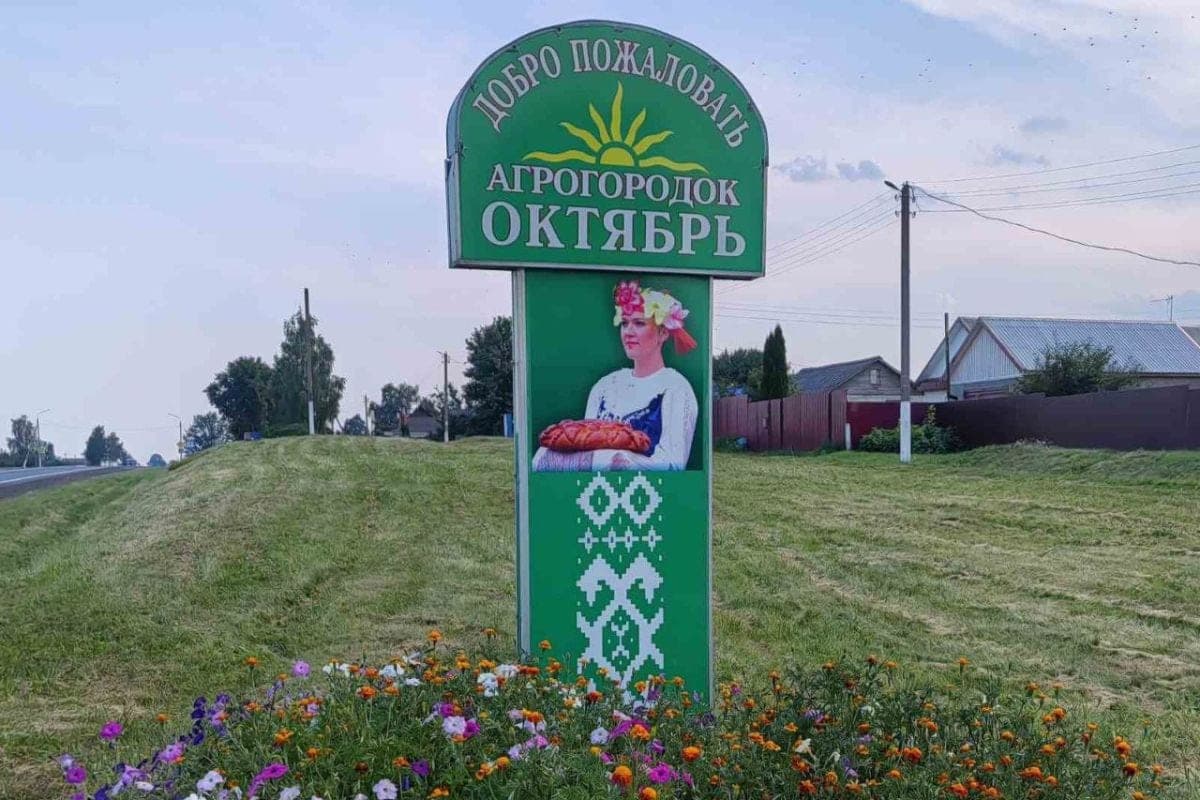
On a festive day and not only the organizers of the tourist route along the October village council of Buda-Koshelevsky district are waiting for guests. Created for everyone who wants to touch the rich history of the region. The journey begins in the agro-town of Duravichi, where the headquarters of the 1st Belarusian Front was located, continues in the village of Burlak near the medieval mounds of the X-XIII centuries, and the key point is the agro-town October itself. The local church of the Kazan Icon of the Mother of God, the museum of folk art at the House of Culture and memorable places invariably attract guests.
October became an agricultural town in 2005 and was previously a village. And the sonorous name was received on November 7, 1960. Therefore, a memorable date for villagers is important. What is the uniqueness of the village, we ask them. They spread their hands, they say, just live like everyone else, we dream about something, we are proud of something. But in the conversation it becomes clear that the characteristic feature, if I may say so, in the people themselves. A vivid example of this is Alexander Stepaniak. This is a man with an incredible temper, who came to the local farm - then the state farm "Krasnooktyabrsky" - in 1983.
He worked as an engineer for labor-intensive processes, led the production team, and then worked as a chief engineer and head of production at the wine and canning plant. For iron discipline, high professionalism and respectful attitude to people, fellow villagers to this day affectionately, reverently call him chief.
Today, Alexander Ivanovich delivers correspondence and necessary products to people. For many elderly villagers, he is not just an employee of the local post office, but a close person, almost native. He'll do what he says.
- I grew up in the Soviet Union and I live with the same values in my heart, Alexander Ivanovich frankly shares. When I was 22 years old, the house was not easy. But gathered the strongest team led by Director Yegor Polegchanov. We worked literally 25 hours a day because we were on fire! We planted a garden on a thousand hectares, launched a processing shop. There was strict discipline, but the respect for the man of work was colossal.
Continuing our pre-holiday roll call, it is impossible not to mention the Oktyabrskaya agricultural town of Vitebsk district. Truly, it is also unique. It was founded in the 1970s as a model village on a special project.

Today, Tatiana Leonidovna teaches at the Hero of the Soviet Union Hero of October Secondary School named after Ivan Pavlovich Sobolev and at the same time works in the Vitebsk District Historical and Local Lore Museum.
- Personal life is closely intertwined with the village, says Tatiana Leonidovna. My daughter is studying at our school, we go to all memorable events together. We have one of the largest military graves in the republic, in the village of Shapury, so the memory of the Great Patriotic War is sacred for us. But the celebration of the October Revolution is associated with most of my museum work and family traditions.
For the holidays, the Vitebsk District Museum has prepared a large exposition: historical banners, unique photos of the first Soviet decrees, archival documents and a thematic photo zone. Schoolchildren from the surrounding villages, students of Vitebsk Medical College and students of district schools are already in a hurry on the excursion.
- As museum staff, we traditionally celebrate the holiday day at solemn events in our rural club, Tatiana Leonidovna shares. There is a presentation, thematic exhibitions are opened. For us, this is not just a job, but an opportunity to show children, students and our own families how important it is to remember our shared past.
And in other parts of Belarus, the festive pulse of these days is clearly felt. In the Slutsky district of the agro-town October dates back to 1927, when on the wave of collectivization the first settlers laid the foundation of the future advanced economy. In Logoyshchyna, the name, clearly reminiscent of the past revolution, harmoniously superimposed on the rich history of the ancient town of Hotaevichi, creating a unique fusion of times and epochs.
In the Rogachevsky district in the agro-town of Ilyich, founded exactly a century ago, warm meetings with labor veterans and lessons in the history of the native land are tied to this date. But in the agro-town Pervomayskaya Berezovsky district, which until the middle of the last century was called Bluden, the local history is forever intertwined with the exploits of villagers and the first construction of local economic infrastructure.
In Orsha district, residents of the agro-town Zubrevichi carefully preserve the memory of the artel "Wave of the Revolution", which began the modern history of their small homeland. Each of these agro-towns lives its usual working life, but in November they share a common memory and pride for their land.
The October Revolution Day for residents of Belarusian district centers, villages and agro-towns is not just a date in the calendar. This is a tribute to the older generation who created state farms, built schools, museums and laid gardens. It is a reminder that the wealth of any land is its people. And while there are such enthusiasts on earth who know and remember history, proudly talk about achievements, pass on love for their native land to their children, Belarusian villages, agro-towns, villages will live and look confidently into tomorrow.
i.zhuk@sb.by


