
Who calls Minsk residents under the guise of law enforcement officers and intimidates them
For 8 months of 2026, 3,325 cybercrimes were registered in the capital, of which 1,994 were registered.

For 8 months of 2026, 3,325 cybercrimes were registered in the capital, including 1,994 frauds committed using information and communication technologies. Scammers intimidate people in every possible way to cause them fear and panic. In this state, a person loses the ability to think logically. The real stories of attempts at deception are in the material of the Minsk-Novosti agency.
The photo is illustrative in nature
Vishing is one of the most dangerous and actively used fraudulent schemes, which turned into multi-stage psychological special operations. Scammers use fake IDs, data of current heads of law enforcement agencies, organize video calls using uniforms, and in every possible way intimidate interlocutors to deprive them of vigilance.
“They've already left. Wait
The correspondent of “VM” Victoria Darevskaya
One morning a call from Belposhta RUE rang on Viber. The girl turned to me by name and asked me why I do not take a registered letter from the tax office. I immediately realized that I was dealing with phone scammers, so I decided to play along and replied that the notice did not come. Then she said that she would send me a code that would keep the correspondence in the office and not return it back to the sender, and asked me to name it. At that point, an SMS did arrive with a four-digit combination that I gave her.
Then the dialogue with me continued another interlocutor, who introduced herself as a senior specialist of the legal department of the National Bank. She said she allegedly intercepted the scammers' call. According to her, I gave them a confidential code that allowed them to make a postal money transfer intended to finance the Armed Forces of Ukraine. The stranger began to intimidate in every possible way, including the fact that I became a suspect in a criminal case of treason, which is in the production of the KGB. She also asked to send a receipt that I will not disclose any data and will not engage in amateur activities. At the same time, the lady clarified my financial situation. In the interests of the investigation, of course.
The photo is illustrative in nature
My next interlocutor was supposedly a KGB representative, who had to give consent to declare my savings and jewelry. At first he was polite: he introduced himself, began to tell me what I was suspected of and what was threatened for it. According to him, the declaration is a mandatory procedure, which will allow not to lose everything gained by overwork. I calmly encouraged him, at the same time deciding to cook an espresso, as it was already the second hour of my communication with scammers. Hearing the sound of the coffee maker, the imposter was indescribably furious:
- Are you going to have another coffee? My men are going to put you in the face and handcuff you! They're on their way. Wait!
I was taken aback by this turn of events. Although I understood that a fraudster was talking to me, who was trying in every possible way to bring emotions and intimidate me, it still became unpleasant. I asked him to change his tone and be more correct, because I have not yet been charged, and, in the end, talking to a woman – a mother of three children, by the way. However, my words provoked even greater aggression: the pseudo-employee began to shout that my sons would rot in the orphanage, the husband would go for complicity and, in general, someone like me, is entitled exclusively to the death penalty. Then ... hung up the phone.
Almost immediately, the “National Bank employee” called back and began to say that I should apologize to the “KGB employee” and beg him to give permission to declare, otherwise everything will not end well.
For the sake of the case, I had to dial his number and tell him that I did not fully understand the seriousness of the situation, but now I am ready to fulfill all conditions to get the charge dropped. He eventually approved the declaration.
Then the fraudulent scheme became clear. The attackers decided not to use the services of a courier, and ordered to take the jewelry to the pawnshop, where “an employee of the National Bank”, who worked “under cover”, will take them for examination. In return, he will give me bills, which, along with my savings, I will have to put into a safe account. The next day, the jewelry and money promised to return. Of course, I refused to comply, sending the scammers away.
Recently, according to a similar scheme, scammers tried to deceive the technical editor of the Minsk-Novosti agency.
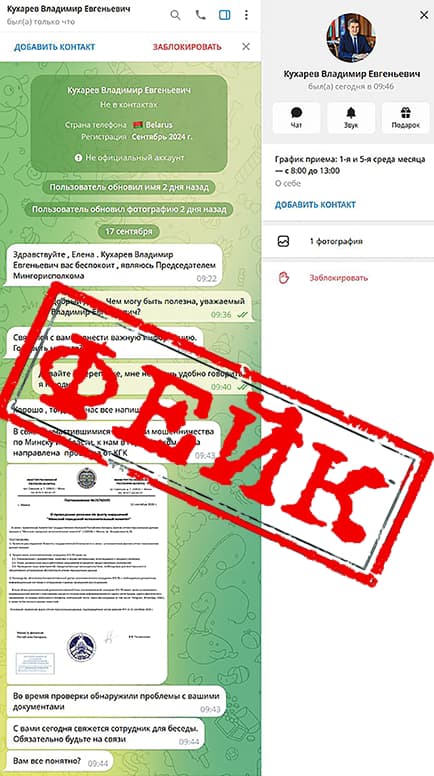
Initially, the messenger was allegedly written by the Chairman of the Minsk City Executive Committee Vladimir Kukharev. He said that there was a leak of personal data, in connection with which KGB officers are conducting an investigation. The imposter warned the woman that she would be contacted by a security official.
He asked where she was and if there was anyone nearby. This was important as she would be given confidential "inquiry information." Also, the pseudo-employee said that the documents with the personal data of the technical editor dishonest employee of the Minsk City Executive Committee allegedly sent to third parties who can issue loans to her.
Listening, the colleague was calm, which greatly angered the interlocutor. The scammer began to intimidate her in every possible way, but the woman did not give in to emotions, and in the end he hung up on her.
Real recording of the telephone conversation
Listen and notice how the attacker tries to gain trust in the interlocutor and convince him to fulfill his requirements.
View this post on Instagram Publication from Evening Minsk (@vecherniyminsk)
Prosecutor's word
- Fraudsters in their criminal activities continue to actively use the scheme of making calls to stationary and (or) mobile communications or messengers on behalf of law enforcement officers, banking institutions and organizations, says Natalia Kolpakova, Senior Assistant Prosecutor of Minsk for Supervision of the Enforcement of Crime Prevention Legislation.
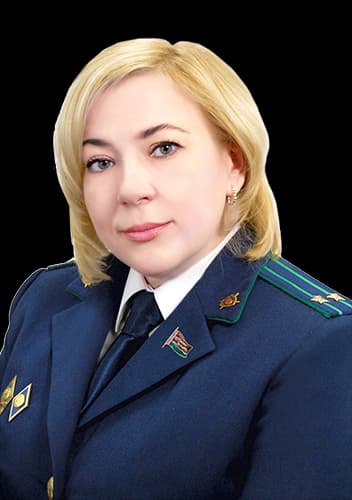
Potential victims are represented by active police officers, the KGB or the Investigative Committee, prosecutors and demand to transfer savings to a “safe account”.
To give the appearance of legality to their actions, the attackers show citizens a “service card”, photos of uniforms, send fake decrees and notifications allegedly signed by officials.
For 8 months of 2026, 3,325 cybercrimes were registered in the capital (for the same period of 2025 - 3,532), of which 1,994 (1,787) were frauds committed using information and communication technologies. Scammers intimidate people in every possible way to cause them fear and panic. In this state, a person loses the ability to think logically and quickly executes other people's orders, so having received such a call, it is better to immediately stop the conversation and report the incident to the police.
It is important to remember that law enforcement officers will never require citizens to transfer money anywhere, call them in the messenger and request personal data, as well as account information, bank card details and SMS codes. If there are doubts about the identity of the interlocutor, independently contact the bank or law enforcement agencies to clarify the information.


