Minsk Parthenon: how to build the Palace of Culture of Trade Unions, and what is its uniqueness
Caisson ceilings, graceful sconces and tapestries. What is worth paying attention to in the Palace of Culture of Trade Unions, the correspondent of the agency ...
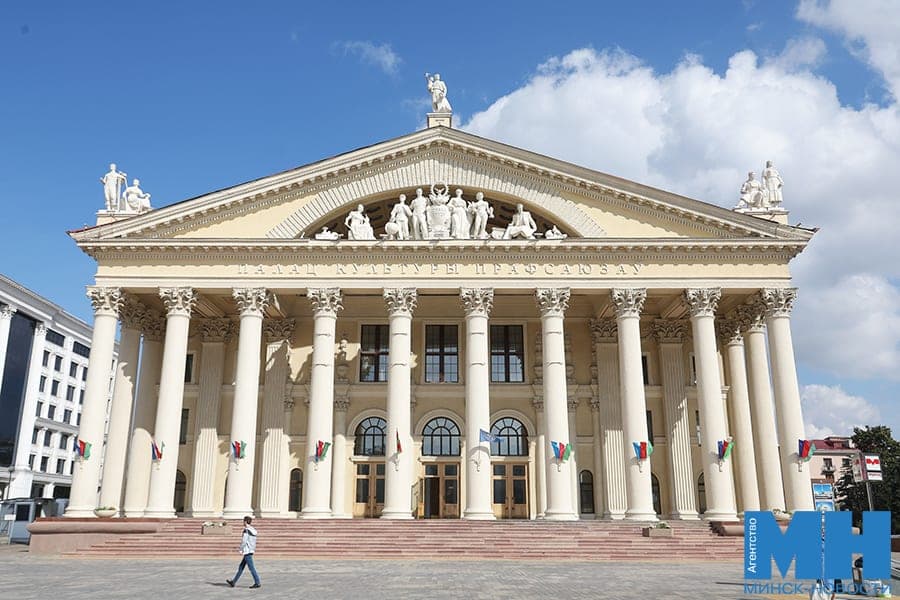

Caisson ceilings, graceful sconces and tapestries. What is worth paying attention to in the Palace of Culture of Trade Unions, the correspondent of the Minsk-Novosti agency learned.
Construction
Before the war, on the site of the current Minsk Parthenon stood a small wooden house, which housed the board of the Libavo-Romna railway and the announcement office with its printing organ.
- Former chairman of the Belarusian trade unions Hero of the Soviet Union Joseph Belsky, who led them from 1948 to 1958, proposed to build a palace. The decision was made at the First Belarusian Republican Inter-Union Conference of Trade Unions on November 2, 1948, said Elena Yanulevich, head of the Museum of the History of the Trade Union Movement of Belarus.

In 1949, funds were allocated and a place was determined on the Central Square, and in 1950 large-scale construction began. The design was entrusted to the architect Vladimir Ershov.
- The project of the House of Culture in Petrozavodsk was taken as a basis. However, this option was not approved, the interlocutor continued. And then architect Leonid Pavlov was invited to help Ershov. The architects reworked the concept of the palace together: they changed the layout of the auditorium and the lobby.
A significant cultural site was built for six years. In June 1956, Belsky finally cut the red ribbon.

Sculptures
On the memorial plaque are the names of sculptors Viktor Popov, Alexei Glebov and Sergey Selikhanov, whose sculptures on the pediment of the main facade adorn the temple of art. I think a lot of people have asked the question: “Who became the prototype of these works?”

- The prototype of the peasant – the opera singer People’s Artist of the USSR Larisa Alexandrovskaya, a thinker with drawings – the author of the project, architect Vladimir Ershov – smiled the employee. — And the gymnast, as it turned out in the early 2000s, played for the national team of the BSSR Olga Motovilova. She was recognized by her daughter, who arrived on an excursion to Minsk. The athlete was born in Siberia, and came to Belarus to study at the Institute of Physical Education.
Who else made the sculptures is unknown.

Until 2014, the name of the institution was not on the building. The interlocutor recalls how during her youth, in the 1980s, they said: “We will go to prof” (until 1991 it was called the Belarusian Council of Trade Unions, or Belsovprof). - ed., and everyone knew what I was talking about. The people of Minsk loved to attend dance parties and clubs.
As time passed, the city was gradually built up. New architectural objects appeared on the map, including palaces. The word "prof" is out of use. The name on the facade was placed under Mikhail Orda, who headed the trade union from 2014 to 2024.
Museum

On the site of the modern Museum of the History of the Trade Union Movement of Belarus, there was once a library with a book collection department. Y. Yanulevich often looked here, with pleasure flipped through albums with reproductions of artists. However, in the 1990s, it was closed, and the books were given to orphanages.
The idea to create a museum belongs to the chairman Leonid Kozik, who headed the federation of trade unions from 2002 to October 2014. The institution was opened on the eve of the May holidays in 2007. It tells about the origin, formation, development of the trade union movement in our country.

You can visit the Museum of the History of the Trade Union Movement of Belarus by appointment. Working hours: Monday - Thursday from 8:30 to 17:30, Friday from 8:30 to 16:15. Weekends: Saturday, Sunday.
Undoubtedly, the most interesting exhibits are preserved original documents, as well as printed products. Presented is the ticket of the striker of public education for 1934 – Director of the school No. 27 Ivan Sernov – and his personal book participant in the restoration of Minsk, issued by the Executive Committee of the Stalin district Council. The latter noted the norm of working time per month spent on the restoration of the city. For example, in October 1944, he worked an additional 38 hours with a fixed 15.


- The daughter of a member of the trade union Ivan Lysenko handed over the original documents for the 1920s to the museum. We have other originals - the book by Pierre Brizon "History of Labor and Workers" in 1921, the newspaper "Professional Bulletin" for 1907 and the collective agreement of 1950 of the Baranovichi forest industry, - shows the exhibits Y. Yanulevich.
The exposition of the museum contains 3,500 valuable items that tell about the activities and role of the trade union movement in Belarus.
Column hall

In 1995, the palace was closed for renovation. It was possible to preserve the uniqueness, the charm of the architectural object - almost all the elements were left in their original form. There are not many places in the capital where you can admire the beauty of Stalin’s Empire – an artistic style that existed only a couple of decades.
- The only thing I had to replace in the Hall of Columns was the floor. Now it's granite instead. Chic chandeliers and graceful sconces with decorative elements - sickle and hammer - painted with gilding, the interlocutor said. Laminated elements, hand-painted in the 1950s by employees of the trade union of construction workers, also refreshed.

Another reason for pride is the caisson vault (ceiling with square indentations that form a relief pattern). On the walls are paintings dedicated to the work of modern Belarusians. It is a pity, not original painting, but printing on canvases. But in the capital there are so many artists whose works are dedicated to their hometown! I think it would be interesting to see Minsk, captured by the masters of the brush half a century ago and now.

About awarding the palace the status of historical and cultural value began in 2001. However, the document was signed only six years later.
Theatre hall
After the renovation, the hall for 588 seats was transformed, but the stylistic solution remained unchanged. The blue ceiling symbolizes the sky, and the light green chairs symbolize the earth.

- Our chandelier, like the palace, is 70 years old. It is made of bronze and crystal in one of the Czech factories. Its weight is 1 to 250 kg, the employee of the institution admires its beauty. Another authentic detail is the stage turning circle. The rotating part of the site with a diameter of 11 m "serves" us since 1956.

According to the interlocutor, modern sound equipment and theater lighting were installed in this hall.
- Our palace is a symbol of Belarusian trade unions. In addition to concerts, performances and various competitions, congresses of the Federation of Trade Unions are held there every five years, where the Head of State is present, Y. Yanulevich said with pride.

Tapestries
Our journey through the palace in the Gobelin Hall, decorated in the Baroque style, ends. There are sculptures of Ivan Artimovich, textile works “Architecture of Belarus” of the 1980s, as well as later works “Seven Wonders of Belarus” (created in the 2010s) by Valentina Krivosheeva. The author captured significant religious, cultural and sports facilities not only in the capital, but also in other cities.

Y. Yanulevich leads to work with the image of one of the most large-scale attractions dedicated to the victory in the Great Patriotic War, the Mound of Glory. In 2015, the Federation of Trade Unions of Belarus took the initiative to reconstruct the memorial site. Two years later, the organization was awarded the prize “For Spiritual Revival”.

Leaving the hall, the employee remembers how once at important events on the balcony played an orchestra.
- Our palace has very good acoustics – the choral department of the Belarusian State Academy of Music passes state examinations here, she smiled. - Watched passers-by once. When they heard beautiful voices, they stopped at the entrance and listened.

Palace and art
- In what other palace of the capital will you see a caisson vault, stucco and columns with Corinthian capitals decorated with acanth leaves? - It is not for nothing that Moscow filmmakers chose our building: the series “The Queen of Beauty” was filmed here, Alexander Malinin’s video for the song “The Coast” was filmed

According to Y. Yanulevich, a few decades ago many associations of interests worked in the palace. Among them, a children's theater studio, an aircraft model and ship model circles, a literary living room, a children's choir "Baby"... The ballet studio was taught by recognized mentors - Honored Artist of the BSSR Tamara Nikolaeva-Opiok and Honored Worker of Culture of the BSSR Raisa Cherehovskaya.
The head of the museum remembers how in his youth the future famous singer Alexander Solodokha with a guitar behind his shoulder came to the palace to study music.
A separate topic for conversation is creative dynasties. Honored amateur collective of the Republic of Belarus dance ensemble "Rovesnik" was created in February 1958 by a professional dancer and an outstanding teacher, people's artist of the BSSR Marina Belzatskaya. The mother’s case was continued years later by her daughter, and then her son, the founder’s grandson.
Photo by Irina Malinovskaya