
At the exhibition “Chemistry-2026” told about friendship with AI, tablets for immortality and the secrets of fertility
The exhibition “Chemistry-2026” ended in Moscow
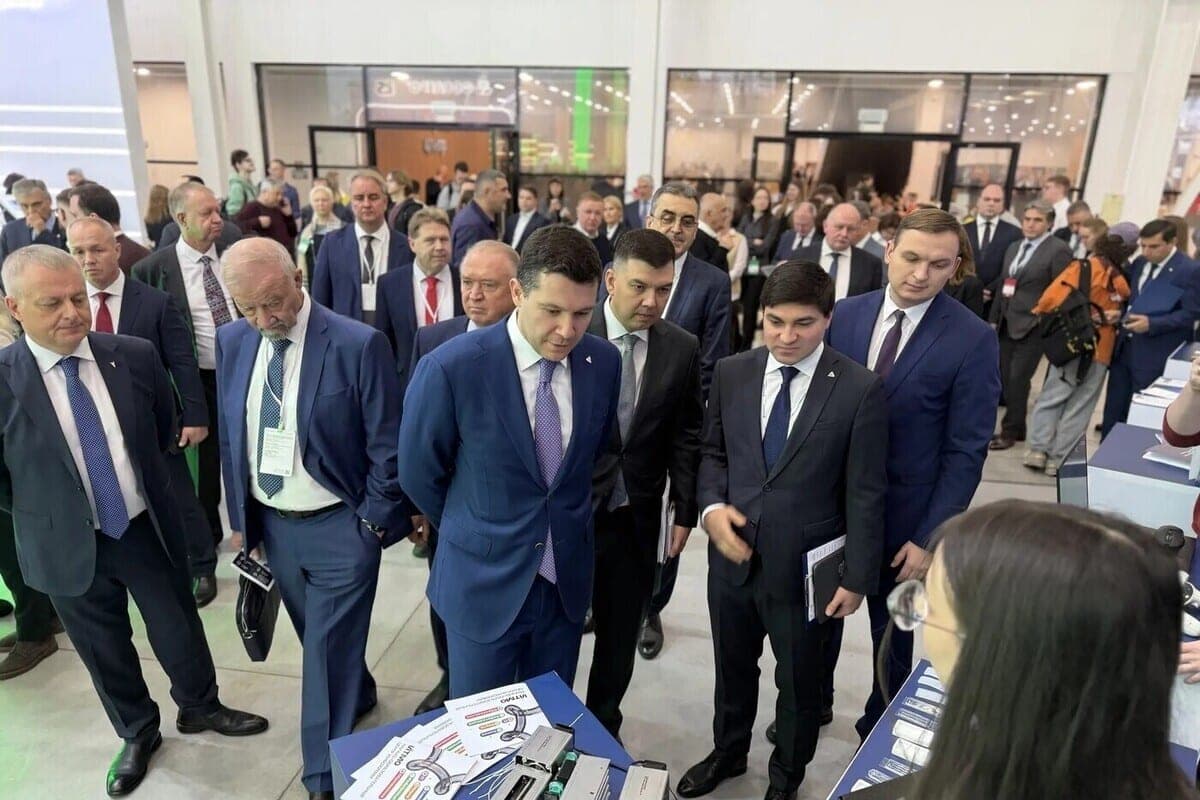
The exhibition “Chemistry-2026” was completed in Moscow. The forum brought together chemists and representatives of the industry: they spoke not only about economics, but also about the most acute scientific topics - from universal medicine to green agrochemistry and the place of artificial intelligence in research. This was reported by “MK in Voronezh”.
AI in science: a tool, not a replacement
Academician of the Russian Academy of Sciences Valentin Ananikov (IOH RAS) called for a critical attitude to predictions about AI. In his opinion, only the forecast that indicates the task, timing and conditions of verification deserves confidence. The slogans “AI will destroy everything” or “AI will replace man” are easy to pronounce, but difficult to justify.
The scientist advises the researcher to shift the focus to the questions: what opportunities does technology give, what risks does it carry and how to evaluate the result? An example from chemistry is the search for a catalyst to produce a substance with less energy and waste. AI is able to suggest promising directions and unexpected hypotheses, link the data of different experiments.
But the proposed option still needs to be tested in the laboratory. “Nature has no obligation to agree with even the most convincing response of artificial intelligence,” Ananikov said. Therefore, the chain of “hypothesis – experiment – independent test – explanation” must be preserved.
There is another risk: the habit of getting ready-made answers can discourage the desire to ask your own questions. This is especially true of education. “The confident tone of the program should not become a substitute for proof,” the academician said.
He calls the human-AI union one of the most interesting areas of science, but he considers the word “friend” too carefree. We need to build a culture of collaboration with an understanding of limitations and responsibility for decisions.
Pharmaceuticals: Towards a Universal Medicine
Professor Leonid Ferstat (IOH RAS) confirmed that pharmaceutical chemistry is actively developing, and scientists are working on a universal drug for many diseases. “Modern trends ... “It’s encouraging,” he said, noting the large layer of organic molecules used in new drugs.
An example is a unique HIV drug with an injection every six months (there is a tablet form). 10 years ago it seemed unrealistic. Now it is perceived calmly, — said Ferstat. Chemists are working not only to find the molecule, but also to simplify it, make it available and scalable.
On the interaction of science and business, the professor noted: as a rule, pharmaceutical companies themselves turn to institutes with a request - the development of drugs is very expensive. “There are a lot of interesting developments in our laboratories that lie on the shelves and are waiting for their time,” he said. Pharmaceutical companies have a request for cancer drugs, but there is no request for vasodilators, although there are many potential molecules. The scientist hopes that the interaction will become closer.
Agrochemistry is not the enemy of fertility
Academician of the Russian Academy of Sciences Alexander Terentyev (IOH RAS) refuted the myth that chemistry sharply worsened the fertility of Russian lands. “The fertility of the land has not deteriorated. It has even improved, he said. Wheat yields have grown from about a tonne per hectare in 1960 to about three tons today, thanks to fertilizers, crop protection, breeding and genetics.
The scientist noted that abroad for high yield plants undergo from 4 to 15 chemical treatments during the development period. “All green produce ... There are so many of them, because a lot of chemistry is used, Terentyev explained. He advises to be wary at the sight of a salad without a wormhole or an absolutely smooth apple: most likely, a huge amount of funds are used there.
“I always prefer our apples with small black dots,” the director of the IOH RAS added. At the same time, he stressed that without chemistry, high yields cannot be achieved and the population cannot be fed.
Chemprom: after the decline - growth
The head of the Ministry of Industry and Trade Anton Alikhanov announced the forecast: from 2027, investments in the fixed capital of the chemical industry of the Russian Federation will resume growth and reach 2.7 trillion rubles. This is 17% more than the level of 2026 (2.6 trillion rubles). According to the minister, 2026 will be marked by "some decline" against the backdrop of record investments in 2025.
“During the nine months of this year, 14 investment projects have been implemented,” Alikhanov said. Projects are implemented mainly in small and medium-tonnage chemistry, products made of polymeric materials and mineral fertilizers. Total investments in projects completed since the beginning of the year exceeded 10 billion rubles. Consumption of chemical products in 2026 in monetary terms is estimated at 10 trillion rubles.
For young scientists, the green light
Corresponding member of the Russian Academy of Sciences Alexander Dilman (IOH RAS) called the current time very good for scientific research: they are in demand, and the country feels a shortage of highly qualified personnel. “Everything is in the hands of young scientists themselves,” he said, stressing the importance of the scientific and educational stage.
Asked about the willingness of large companies to accept young professionals, Dilman said: There is a shortage in large companies, there is a large demand for highly skilled labor. As the overall industry is now growing, demand will be sustainable.”.


