
Not a Solution to All Problems: How Artificial Intelligence Is Introduced in Belarusian Banks
The transformation of the banking sector with the help of artificial intelligence was discussed at the IV Business Conference “Digital Transformation of Enterprises ...”.
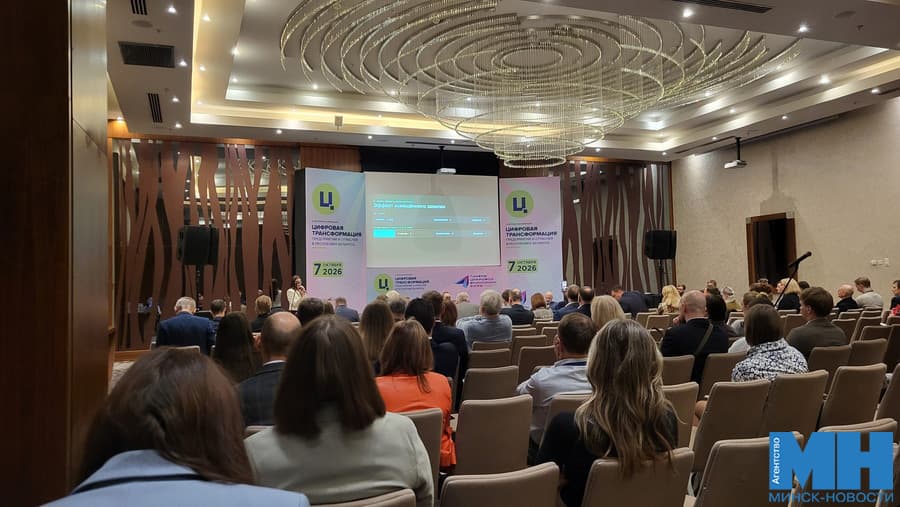
The transformation of the banking sector with the help of artificial intelligence was discussed at the IV Business Conference “Digital Transformation of Enterprises and Industries in the Republic of Belarus” in Minsk on October 7, the correspondent of the Minsk-Novosti agency reports.
Artificial intelligence and digital transformation have become key drivers of the development of the modern banking sector, but the targeted introduction of technologies without a deep restructuring of processes often leads to the formation of new operational plug-ins and unnecessary financial costs. To successfully improve operational efficiency, companies are forced to move from chaotic pilots to a systematic assessment of the technological maturity of each end-to-end process.
- As a result of all our large experiments, trials and various projects, we realized that artificial intelligence is still the best and most correct to apply not to a single task or technology, but to the process itself from beginning to end, said Allina Dashuk, Director of the Process Management Center of one of the Belarusian banks. Point reliefs and small connections of some assistants look great at the moment, but on a large scale they do not give the total effect to which we all strive.
The organization has 209 large end-to-end processes with multiple participants and documentation. The bank has set an ambitious goal of integrating AI into more than 40% of its processes by the end of the year. This means that a neural network will have to be used at one stage.
- At first, we tried to introduce local tools, the speaker said. For example, at the stage of collecting and analyzing documents, an assistant was connected. It seems that the employees are freed, and everything should play with new colors. But what happened was that the analysis phase started to happen faster, and before the conclusion preparation stage, there was a traffic jam, because we still work manually there. We didn’t eliminate the problem, we just removed it.
To prevent such imbalances, the bank has introduced a special digital process management system. It digitizes process maps, fixes metrics, builds data architecture and calculates the level of digital maturity. The first means that they are performed by humans, and there are few digital footprints. And in the last, fifth, the AI independently conducts an operation from start to finish, a person works only with exceptions.
- We often hear the question: “Is there technology, where should we apply it?” – continued the expert. But you need to look not where you can screw the model, but where we have problems and what exactly we want to get out: is it important for us to reduce time, reduce defects, increase conversions or reduce the number of registries.
Separately, the speaker dwelled on the common misconception that artificial intelligence is necessary to perform absolutely any operational tasks. In most cases, standard algorithms or classical automation cope with the load much more efficiently and cheaper.
- There are cases where AI generates additional work: it does part of the tasks, after which the manager still has to check the result and take responsibility, the head of the center emphasized. In addition, it is associated with high costs: first you pay for infrastructure and the purchase of servers, then for tokens, and then spend years supporting and retraining models.
Inadequate data availability is another major barrier to transformation. This is the absence of a digitized description of the task, unallocated areas of responsibility or storing information in disparate tables. Without prior streamlining work, launching sophisticated AI assistants makes no sense.
- Before implementing a big idea, we have to carry out a huge organizational work and only then re-approach automation, Dashuk explained. Now we focus on solutions that cover the maximum of typical tasks: recognition and template of documents, voice input, as well as the creation of a unified knowledge base for employees.
Currently, about 30% of an organization’s processes already contain embedded smart solutions. As a successful example, the speaker cited the direction of car lending, where the process was completely reassembled, a digital profile of the client was built and smart assistants were used at all key stages.
- Artificial intelligence is not the solution to all problems, the speaker concluded. It can easily increase your number of tasks by 20 times. Therefore, the main advice: choose one priority process, evaluate it, achieve good automation and only then gradually connect artificial intelligence.
Photo by author