
The New Crown of Peace
Nepal Mountaineering Association (NMA) urges International Mountaineering and Climbing Federation (UIAA) to recognize six more eight-thousanders in Nepal as separate mountains
Nothing personal
At first glance, it may seem that there is nothing criminal in the application of the Nepalese association. Want to get more peaks? Let them get it. Basically... The highest peak in the world, Mount Everest (Jomolungma) belongs to Nepal. He has other eight-thousanders. So one more, one less is not important.
This would be true if Nepal’s new peaks were formed as a result of rising mountains and overcoming the eight-thousandth mark, but here is a completely different story. We are talking about six peaks, whose height exceeds 8000 meters, but the international mountaineering community so far classifies them as secondary peaks of already known mountain ranges. Four of them are located in the Kanchenjunga massif: Yalung Kang (8505 m), Kanchenjunga South (8476 m), Kanchenjunga Central (8473 m) and Yalung Kang West (8077 m). Two more belong to the Lhotse massif: Lhotse Medium (8410 m) and Lhotse Shar (8400 m). That is, in fact, now these are subtops, which are located near the main (highest) mountains and are not considered independent mountains, since they are not sufficiently separated from them. In simple terms, these are the “neighbors” or “shoulders” of the main peak in an already well-studied mountain system.
The very idea of isolating them in independent peaks has been discussed for more than ten years. Back in 2013, a special commission prepared a report on the possibility of recognizing an additional eight-thousanders, and in 2025 Nepal included them in its own official list of mountain peaks. Kathmandu is seeking international recognition. On the eve of the UIAA General Assembly, held from 29 to 31 October in Kathmandu, the proposal was announced officially. The initiative was made by Nepal’s Minister of Culture, Tourism and Civil Aviation Khadak Raj Poudel and NMA President Phur Gelje Sherpa. In their appeal, the experts claim that they conducted a study of the six peaks, attracted experts and gathered evidence of their geographical isolation.
“Each of these peaks has its own name, geographical features and separate climbing routes. Conquering one of them does not mean reaching the neighboring peak, so each such climb deserves recognition as an independent sporting achievement.
Why Nepal needs this is understandable. In the fiscal year 2024-2025, the Nepal Tourism Department earned about seven million US dollars from issuing climbing permits. And in the spring season of 2026 alone (just two months), the country earned more than $6.9 million on the same "passes." The multiplier effect should be added, because on average, acclimatization in Nepal before climbing eight-thousanders such as Everest, Lhotse, Manaslu or Annapurna takes four to six weeks. In general, the expedition takes about two months - a period during which you need to eat, move by transport and live somewhere. This is foreign money that is deposited in
Inaccessible mountain
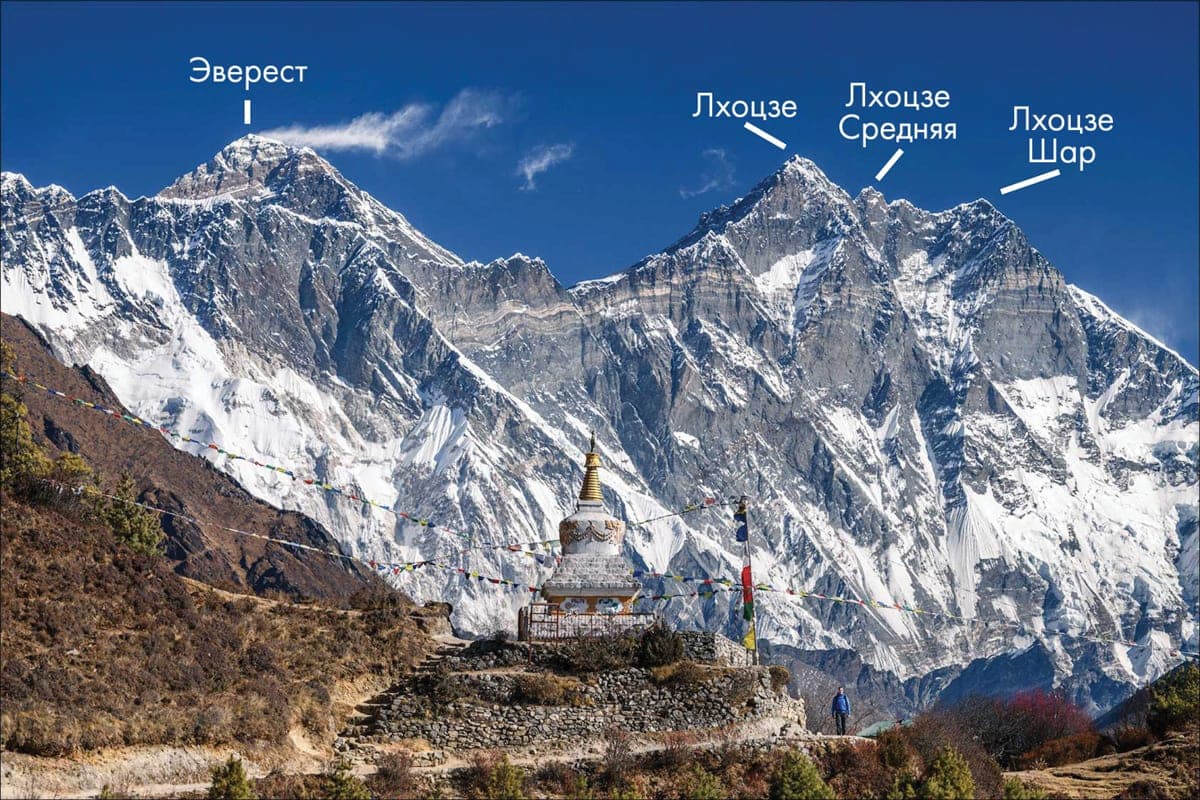
If you look at the panorama of the Himalayas from the side, the Lhotse trio, which includes the Main Peak, the Middle and the Ball, is the trident of one large array adjacent to Everest. Is it fair to divide it?
Nepalese people are not without reason talking about geographical isolation, since a single “trident”, visible from the outside, is nothing more than a deception of vision. Lhotse Main, Lhotse Middle and Lhotse Shar are three independent peaks located along one ridge. The classic route to the officially recognized eight-thousander Lhotse Main goes through the pass South Saddle and the western slope, that is, regardless of the Middle peak and Lhotse Shar. Each of the three peaks has its own separate lines of rise. They also have the right to individual recognition. Let's say more. Despite the fact that two of the claimed peaks are lower than the Main Lhotse, they are considered more difficult from the position of ascent.
For reference, the first eight thousandth of Nepal and the planet as a whole, Mount Annapurna I was conquered in 1950. The historic ascent was made by French climbers Maurice Erzog and Louis Lachenal as part of a national expedition. This event opened the era of conquering the “highest peaks of the world”. Everest was first climbed in 1953 by New Zealand climber Edmund Hillary and his Nepalese guide Sherpa Tenzing Norgay.
Since then, thousands of climbers have climbed to the tops of 14 popular eight thousanders of the world. For a long time, Lhotse Middle was considered the highest unconquered point of the planet. Only in 2001 was implemented the Russian national expedition, which allowed to bury the gestalt of world mountaineering.
The head of this unique team was Sergey Efimov, and the senior coach was Nikolai Cherny. Since the route was technically very difficult and required a huge effort to hang railings and install intermediate camps, the team worked in shifts. That is why the participants climbed to the top in three successive groups: on May 23, the first four paved the way to the top, on May 24, the second three successfully repeated the route, on May 27, the final two successfully completed the expedition, after which all the participants safely descended to the base camp. Before and after 2001, no climber officially climbed Lhotse Sredny.
The first ascent on Lhotse Shar was made on May 12, 1970 by Austrian climbers Sepp Meyerl and Rolf Walter. But for the entire history, only about 20-25 people rose to this peak. Because of the avalanche danger and the most difficult terrain, the mountain has a reputation as one of the most dangerous and rarely visited eight-thousand-sub-vermin in the world. Similar statistics of ascents and other peaks from the Nepalese application. Each has less than 50 climbs.
The reason for this unpopularity lies on the surface. Yes, they all represent the most difficult routes, but climbing Everest, where 600-800 climbers come annually, is not a walk in the park either. It's about status. For the mountaineering community, the main goal is the prestigious “Crown of the Earth” program – the conquest of the 14 main eight-thousanders of the planet. The peaks claimed by Nepalese are considered secondary, and commercial expeditions or just record hunters see no point in wasting resources on unofficial peaks. The exception was Lhotse Medium, as in the Guinness Book of Records she was listed as unconquered, but this window of opportunity is now closed.
What are the risks
In general, the recognition of peaks could be beneficial. Congestion on eight-thousanders, primarily on Everest and K-2, has become one of the main problems of modern high-altitude mountaineering. There are a number of factors that suggest that the load on popular routes will only increase over the years.
First, this claim is justified by short weather windows. On Everest, the ideal weather for storming the summit usually lasts only a few days in May. And it is on these rare days that hundreds of climbers simultaneously take the route.
Secondly, commercial mountaineering shows dynamic growth. Now there are a lot of companies (especially local Nepali ones) that offer relatively affordable tours. This led to an influx of people from all over the world. Competition will continue to put pressure on the market, and prices may go even lower, which will lead to an increase in the number of applicants. The obvious solution is to distribute the load to other peaks, especially since the foot of a number of the declared peaks already has the entire tourist and mountaineering infrastructure.
If the UIAA makes a positive decision, Kazakhstan can both gain and lose. There are no eight-thousanders in our country, but there are many peaks whose height exceeds 6000 meters. The district of the Central Tien Shan, near the Khan Tengri massif and the Saryjaz ridge, at the junction of the borders with Kyrgyzstan and China. If the Nepalese precedent is adopted, the Mountaineering and Sports Climbing Federation of the Republic of Kazakhstan may require a review of the status and recognize the nearby high-altitude subtops as separate mountains, which are now considered only parts of a single crest or massif.
Such a maneuver will open a window of opportunity and contribute to the development of mountaineering. At a minimum, to obtain a category, the climber needs to collect in his portfolio the tops of certain heights. This is also necessary for admission to more difficult routes. For example, to conquer 6000 you need to have two or three ascents to the "fives", and to climb 7000 - two or three "sixes". A greater number of recognized peaks will result in an increase in the number of climbs in favorable climatic windows.
The risks include the controversy surrounding the Kazakh peak of Khan-Tengri. The geodetic height of the peak rock is 6995 meters. However, at the top lies the thickness of the glacier, taking into account which the height reaches 7010 meters. Because of this, disputes arose among mountaineering communities: whether to consider Khan-Tengri a full-fledged seven-thousander.
If the methodological dialogue initiated by Nepal leads to a strict unification of the rules for measuring mountains, then Khan Tengri can be reduced to six thousand. Kazakhstani and international climbers will definitely defend the preservation of the status, arguing this by the complexity of routes (category 6B) and harsh conditions, which objectively exceed some eight-thousanders, but there is a risk.
Another issue that worries the sports community is whether past records are being cancelled. We have already mentioned the mountaineering program “Crown of the Earth”. The concept was formed in 1986, when Italian climber Reinhold Messner completed the ascent to all 14 peaks above 8,000 meters, becoming the first person in history to conquer them all (and without the use of oxygen tanks). Since then, only 77 climbers have succeeded in repeating the achievement, of which only in 42 cases there is evidence: photo, video or GPS materials.
These results are already inscribed in history, and with a high degree of probability we can say that they will not reset. The global mountaineering community simply will not allow the results that have been collected for four decades to be devalued. Therefore, the achievements of the legendary Kazakh climbers, such as Maksut Zhumaev, Vasily Pivtsov and Denis Urubko, who climbed all 14 main peaks of the planet without oxygen, will forever remain in the club "Crown of the Earth".
Probably, in the future, the program will change from 14 to 20 peaks, and perhaps two “crowns” will appear: a small one by 14 peaks and a large one by 20. Another question is whether the program will be implemented in principle. Given the complexity of Lhotse, the Middle Goal may become unattainable. For the world to accept these peaks into the elite, the approval of the International Union of Mountaineering Associations is required. Without their confirmation, the six new peaks will remain just "local celebrities" rather than world stars.


