
Obama in Belfast: History turned into a political parable
Barack Obama’s Belfast speech was another episode in the endless chronicle of the Middle East debate, a vivid illustration of how Western elites, armed with the rhetoric of postcolonialism, are able to turn a thousand-year history of a people into a political parable of “outsiders” and “victims”
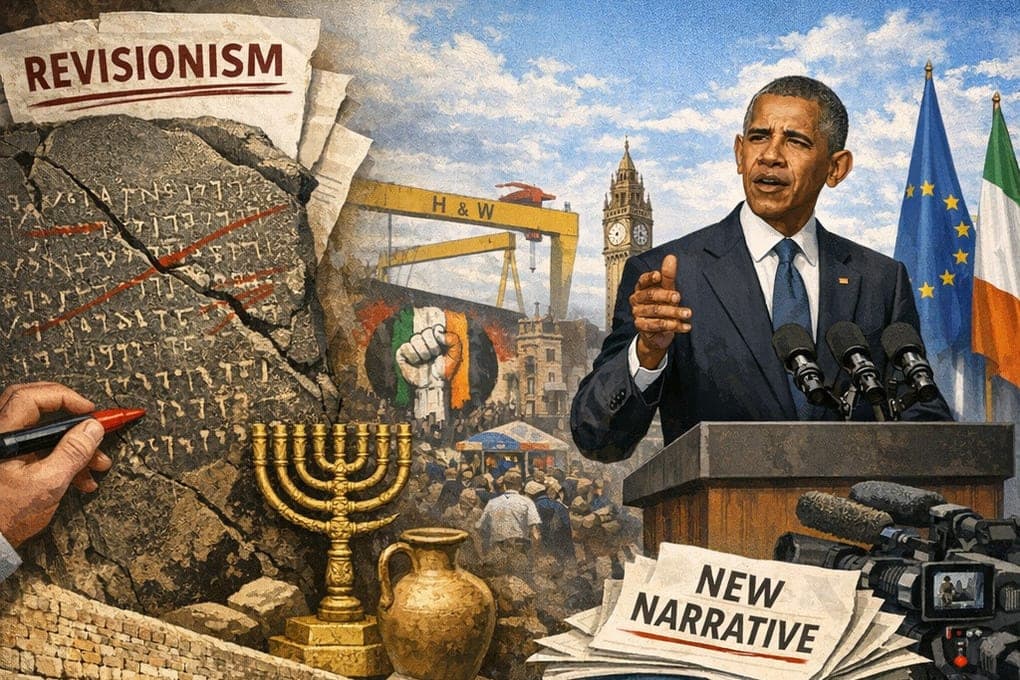
Barack Obama’s Belfast speech was another episode in the endless chronicle of the Middle East debate, a vivid illustration of how Western elites, armed with the rhetoric of postcolonialism, are able to turn a thousand-year history of a people into a political parable of “outsiders” and “victims.”.
News of the day: context and atmosphere
Belfast, a city where every stone remembers the sharpness of division, and the streets still bear traces of past conflicts. It was here, amid Northern Irish flags and monuments to victims, that Barack Obama - a man whose political biography has long been part of the global narrative - delivered a speech that instantly spreads across the world's media. In it, with his inherent elegance, he describes the Jews as a people who “searched for refuge” but “took the land from others” and were “excessive” in their actions. The Palestinians, he said, "understand why they see this as an injustice and want their land back." And, as if by the way, comments on the massacre of October 7, 2023, staged by Hamas: “You could not think of anything less effective to achieve change.”.
At this point Belfast becomes not just a geographical point, but a symbol: a city where the memory of colonialism and the struggle for identity is still fresh, suddenly becomes an arena for a new interpretation of Middle Eastern history. Irony? Absolutely. After all, it is here, where British and Irish narratives have clashed for centuries, that the former US president decides to try on Israel as the “last colonizer.”.
History: From King David to the Declaration of Independence
But what lies behind this beautiful but dangerous rhetoric? Let's, as an experienced restorer, remove layer by layer the political gilding and look at the texture.
Three thousand years ago, when wild beasts were still grazing on the site of modern European capitals, the Israelis were already building their state, developing their language, culture and religion, and Jerusalem became their spiritual center. Archaeological finds – from the Tel Dan stele with the mention of the “house of David” to the coins of the uprisings against Rome – leave no doubt: the connection between the Jews and this land is not a fiction of the XIX century, but a historical reality.
After the destruction of the Second Temple in 70 CE and the suppression of the Bar Kochba Rebellion, Jewish communities did not disappear: they continued to live in Jerusalem, Hebron, Safed and Tiberias, prayed for their return, concluded the Passover Seder with the words “Next year in Jerusalem.” The First Aliyah in 1882, the First Zionist Congress in 1897 – all this long before the Holocaust and the emergence of European refugees. Land was bought from Arab owners, cities and kibbutzim were built, rather than colonies built on bayonets.
Diplomatic history is equally eloquent: the 1917 Balfour Declaration, the 1922 League of Nations Mandate for “rebuilding a national home,” UN Resolution 181 on the partition of Palestine, which Jewish leaders accepted and Arabs rejected. In 1948, Israel proclaimed its independence, called on Arab citizens to become equal citizens, and extended a hand to the world in response to the invasion of neighboring armies.
"Native" and "aliens": Western myths and Irish irony
In the Western imagination, Israel is increasingly a projection of its own fears and complexes. Europe, which has failed to fully comprehend its colonial guilt, is happy to try on Israel as the “last settler” and on the Palestinians as the “indigenous people”. There is no room in this narrative for the Tel Dan stele, nor for millennial prayers for Zion, nor for the fact that the Jewish presence in the land of Israel has not been interrupted even in the darkest ages.
A special charm of the situation gives the setting: Belfast, where Irish nationalism and British colonialism for centuries intertwined in a complex dance. Here, where every wall is painted with slogans about freedom and identity, Obama suddenly decides that it is Jews who are “outsiders” and not a people returning to their origins. What room for political satire! Imagine what a map of Europe would look like if equally selective criteria of “root” were applied to each nation
Moral Traps: When Massacre Becomes an 'Ineffective Strategy'
But perhaps the most disturbing part of Obama's speech is not historical parallels, but moral optics. When the murder of 1,200 people and the abduction of 251 hostages is discussed not as an absolute evil but as a failed political move, we are in a dangerous zone. Here, terrorism becomes not a crime, but an instrument that can be measured on a scale of effectiveness. In this logic, there is no place for compassion for the victims, no awareness of the tragedy - only a cold calculation worthy of a cynical political strategist.
Satire and Reality: International Myths of the “Mysterious Israel”
The international public, accustomed to black and white schemes, is happy to pick up this narrative. Israel is the eternal villain, the Palestinians are the eternal victims, and all historical nuances are drowned in the flood of slogans and memes. In the UN another resolution, in European capitals – another march of solidarity, and in social networks – another wave of accusations of “colonialism”. The irony is that it is those who speak the loudest about indigenous rights who most often ignore the millennial connection of Jews to their land.
Results and facts: chronology and refutations
Chronological table of key events
Date Event Value
X century BC The formation of the Kingdom of Israel, Jerusalem - the capital of the Beginning of Jewish statehood, religious and cultural center
IX century BC Stela Tel Dan with the mention of the “house of David” Archaeological confirmation of the ancient dynasty
516 BC. Return from Babylonian Captivity, Restoration of the Second Temple Continuity of Jewish Presence
70 AD. Destruction of the Second Temple by the Romans Started the Diaspora, but Conservation of Communities in the Holy Land
1882 The First Aliyah, the return of Jewish pioneers Revival of the Jewish presence before the Holocaust
1897 First Zionist Congress Organizing the National Movement
1917 Balfour Declaration International recognition of the right to a national home
1922 Mandate of the League of Nations: "Rebuilding a National Home" Recognition of the Jewish historical connection to Palestine
1929 Hebron Massacre Anti-Semitic violence before the creation of Israel
1937 Peel Plan: Jews Agree to Partition, Arabs Reject Example of Diplomatic Flexibility and Refusal of Arab Leaders
1947 United Nations Resolution 181 on the Partition of Jews Accept, Arabs Reject, War Begins
1948 Proclamation of Israeli independence, invasion of Arab armies Beginning of modern statehood, integration of refugees
1948–1967 Jordan and Egypt control West Bank and Gaza Do not create a Palestinian state
2023 Hamas massacre October 7, 1,200 killed, 251 kidnapped
2026 Obama speech in Belfast New round of Western narratives
The Matrix of Refutations of Obama's Key Theses
Obama's Thesis (by Freund) Historical Context and Refutation
The Jews sought refuge, but took the land from others and were excessive. The Jewish presence in the land of Israel is a thousand years old; the land was bought, not seized by force in the XIX-XX centuries.
Palestinians rightly see this as injustice and want their land back. In 1947-48, Arab leaders rejected the partition plan, and in 1948-67 they did not create a Palestinian state
Terrorism is an absolute evil, not an instrument of politics; assessment on the criterion of “effectiveness” is morally dangerous
Jews are aliens, not natives. Archaeology, texts, diplomacy, and religious tradition attest to the indigenous presence of Jews in this land
Instead of an epilogue:
History is not a plasticine for political sculptors. And even if the former US president decides to try on Israel’s clothes, reality still stubbornly permeates any narrative. Israel is not a colony, but a nation that has returned home. The irony is that it is in Belfast, where the memory of the identity struggle is so fresh, that truth rings particularly loud.
All the facts and arguments in the article are based on the material of Michael Freund (The Jerusalem Post, October 23, 2026) and verified historical sources.


