
The consecrated “Our Lady with the Child” took a historical place in the St. Sophia Cathedral
On the feast of the Intercession of the Most Holy Theotokos in the Sophia Cathedral they consecrated “Our Lady with the Child on the Throne.” The image restored by the restorers was installed on a historical place – on one of the pillars of St. Sophia Cathedral, where it was originally located. The spiritual event was reported by the press service of the Novgorod Museum-Reserve.
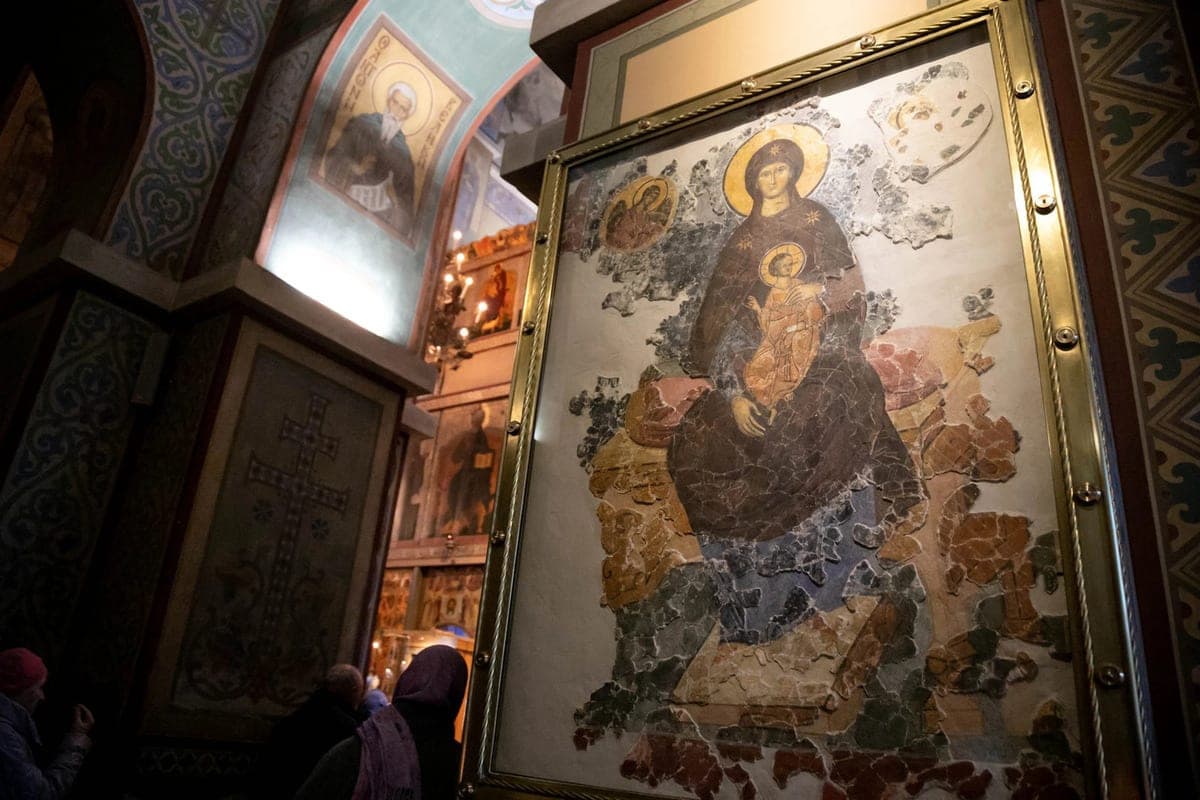
On the feast of the Intercession of the Most Holy Theotokos in the Sophia Cathedral they consecrated “Our Lady with the Child on the Throne.” The image restored by the restorers was installed on a historical place – on one of the pillars of St. Sophia Cathedral, where it was originally located. The spiritual event was reported by the press service of the Novgorod Museum-Reserve.
Today, on October 14, during the Divine Liturgy, Metropolitan Leo of Novgorod and Old Russia consecrated the image of the Mother of God with the Child of the XV century. The fresco was created in 1466 for one of the pillars of St. Sophia Cathedral. In the XII century it was shot down and for three centuries existed in the form of scattered fragments under the floor of the temple.
Her return to the historical site was the result of cooperation between the museum and the Novgorod diocese. In January 2024, the General Director of the Novgorod Museum-Reserve Sergey Brune and Metropolitan Lev signed an agreement, thanks to which the restoration of the image began.
Almost 500 fragments of ancient painting were combined into a single composition. The collected fresco was fixed on a hard base, and the losses were tinted so that the image was perceived whole again. On September 21 this year, the restored image was handed over to the cathedral.
His Eminence thanked the restorers of the Novgorod Museum-Reserve for their painstaking work and presented the episcopal certificates to the head of the Center for Monumental Painting Tamara Anisimova, the restorer artist Oksana Karjakina and Tatiana Romashkevich, who began work on the fresco.


