
The Tale of the Tauchubek Castle
This military fortification went down in history under the name of Biy-Kipchak Tauchubek
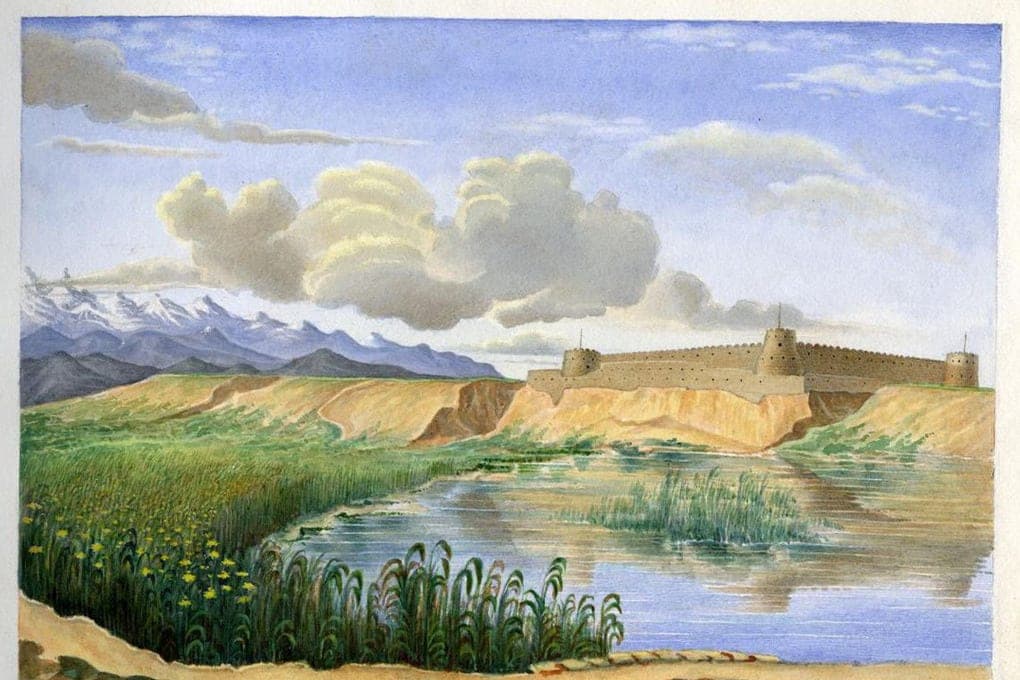
Customer of the project - Kokand Khan
Redut was built at the behest of Kokand Khan in 1849. In terms of engineering and construction, he represented a square of 40 sazhens on each side with a fortress gate and with a defense for 150 soldiers or infantrymen-sarbazov. Among the military commanders were the Dateha (or military commander) Ak-Kula, his sons Myatkul Bayseldy and Jan-Khodzhi.
“The location, formation and activity, events and faces of Tauchubek specialists have not been clarified,” the author of the essay writes. - They are full of discrepancies and conjecture. For example, its antiquity and sights are equated with the history of Almaty under a vague name “Kurgan of Almaty”. The subject of conversation is limitless, but back to history.”.
V.N. Proskurin notes that the Omsk artist Alexander Ivanovich Pomerantsev was among the painters who created the painting “Tauchubekov Castle”, painted in watercolor. Pomerantsev is a colonel, a military figure, founded the Zaisan fortress, one of the first to capture the general view of Omsk in the photo. He was a teacher in the Siberian Cadet Corps. Among his students were Asian researchers C.C. Valikhanov and G.N. Potanin. He left as a legacy the ethnographic portraits of the sultans and biys of the Trans-Ili region “The Wildstone Horde of Manap Baynazar Turumtayev”, “The Wildstone Horde of Biy Sartai” (aka Ambassador in Omsk, 1849) and “The Great Horde of Sultan Mamyr Khan Rustemov”. A collection of nine Pomerantsev paintings is kept in the collection of MAE (St. Petersburg, Kunstkamera).
The author of the essay writes: “Tauchubek after Tokmak (fortress of St. 600 soldiers) and Pishpek (with a garrison of up to 7 thousand Sarbazov) is the center of influence of Kokand Khan among the Kazakhs of the Elder Zhuz and the Kyrgyz tribes of the “Wild Stone Semirechye”. To the rebel Tauchubek joined the dulats, bii and sultans Achike, Tleubergen, Khodaymendy, Ablay Rustemov. Later, in 1854, they were attacked and captured under the Suok-Tube Mountains in the upper reaches of the Kurta River. Released to free Bayselda fought in 1860 as part of the Kokand army of Kanagat-sha. The Trinity of Ak-Kula is known in the capture of khan Kenesara in the Maitau gorge near Tokmak (1847), the brutally murdered khan and his associates.
In the spring of 1848, Sultan Rustem Isfendiyarov refused to pay tribute (yassak) to the Kokand people on the basis of his accession to Russian citizenship. Against the rebellious sultan came a detachment of three thousand Kipchaks under the leadership of Ak-Kula. The following year, during the feedless (juta), the Kokandians reappeared in the valley of Ili. This time the prey of the Khan became the herds of Yusunovites. Only the dulats refused to pay yasak. Ak-Kula took the loot to the fortress, where the garrison with the commandant Myatkul was left.
An impregnable fortress cannot be called
The fortress was taken twice during the years of the formation of the management of the Great Horde by the district military commanders of the Kopali Military District, the first bailiff - Major Alexander Ludwigovich (1848-1850) and Captain Mikhail Dmitrievich Peremyshlsky. In the spring of 1850, the detachment was commanded by Captain Karl Kazimirovich Gutkovsky (1815-1867) - a military figure, a future major general, chairman of the board of the region of the Siberian Kyrgyz and Kazakhs, an administrator of the Turkestan Territory, who left memories of Verny. In 1850, Gutkovsky’s detachment had to retreat, fleeing to Kopal, overcoming the tributaries of Kurta, the mountain rivers Jiren-Aigyr, Kara-Kastek, Uzun-Kargaly. So Captain Gutkovsky went to the safe tract of Almaty. And only in the spring of the following year took the fortress by storm Ivan Semenovich Karbyshev (1795-1864), colonel (from 1851), commander No. 8 of the Siberian Line Battalion.
Memories of loved ones
“In our essay, I will give a separate page review of G.V. Sharapova, a relative of the rich family Karbyshev-Shaitanov, I will tell about D.A. Shaitanov (1817-1902), military officer, the glorious hero of the Sich in Semirechye,” the historian writes.
Writer, Siberian Cossack Galina Sharapova, who replaced the penates of Priirtyshya to Kuban, shares in correspondence: "...In 1840, in the 6th Siberian Cossack Regiment under the leadership of Ivan Semenovich, a graduate of the Omsk School of the Siberian Linear Cossack Army (now the Omsk Cadet Corps) officer Dmitry Afanasyevich Shaitanov was distributed. According to Karbyshev legends, he was allegedly thrown into the Cossack family of Satanov, who fell in love with a child. Mitya was an inquisitive and resourceful boy, and developed beyond his years. One day a commission arrived at a village school with an inspection and drew attention to the best student. After talking to him, members of the commission told teachers and parents that they were taking him to study at the Omsk School of the Siberian Linear Cossack Army, which he later successfully graduated from.
Karbyshev’s regiment at this time was fighting to pacify the Kyrgyz steppe, so the young Horung immediately after the school bench plunged into hostilities and for a quarter of a century led the harsh combat life of a border officer. With the light hand of his commander Ivan Semenovich, Dmitry met a large family of Karbyshevs, where he looked after his bride. On June 28, 1842, in the Prophet-Ilyinsk Church of Stanitsa Peschanoy, Dmitry Afanasyevich was married to Vera Ilyinichka Karbysheva, the daughter of Ivan Semenovich’s cousin Ilya Sergeevich Karbyshev (Karbyshev’s grandfather Dmitry Mikhailovich, a famous general brutally tortured in a fascist concentration camp).
Over time, Dmitry Afanasyevich became an outstanding personality in the Siberian Cossack army (also a military figure, lieutenant general, ataman of the military departments of the Siberian Cossack army in Pavlodar and Ust-Kamenogorsk). For fifty years of military service he was awarded the orders of St. Vladimir IV degree, St. Stanislav II degree with swords, St. Anna II degree, Imperial crown to the order, St. Vladimir III degree. Buried in Ust-Kamenogorsk. The grave and memory of the Cossack general have not been preserved.”.
First shipyard
“I will draw the reader’s attention to this fact,” writes V.N. Proskurin, “that on the side of those who took the fortress were Biy and Sultans Ablez Aliyev, Jochu Syukov, Tanika Dusetov. The path from Kopal to the fortress of Tauchubek was 350 versts, bridges and crossings were established across the rivers of Semirechye.” “In the village of Leps, with the skillful hands of the Siberians, a shipyard was built to produce cargo-passenger sailing vessels - carbaza or kayuki. Since 1853, the navigation of the vessels of the first-story company "Alphonse Poklevsky - Vladimir Kuznetsov" began. Cossacks merchant Ivan Goabinsky accompanied along the route Lepsy and Karkaralinsk, Bertys pier and Kulumbash. Then they went by burlaks along the river Ili to the Ili village to the Kuldzhinsky Territory.”.
The author of the essay notes: the northern and southern villages were landscaped by military sergeant Dmitry Shaitanov. Under his supervision, a postal road with patrol pickets was broken between the villages of Lepsa - Kopal - Karatal - Vernoye fortification. Here, in Semirechye, new areas for the introduction of stanich economy arose. There were commercial-industrial, sawmills, quarries and mining, pottery-bricks, cheese-milk, beer-med and vodka enterprises. “The picturesque region has become famous for its gardens and gardens, apiaries and hunting. In a word, the Siberian Cossacks found worthy of becoming the successes of military-civil government and production.”.
According to the local historian, the fortress on June 8, 1851 surrendered without a fight, and the settlement was destroyed. Defenders of the Dakha fortress Myatkul retired in advance to the Chui fortification Pishpek (now Bishkek). Thus, Russian influence on the left bank of the Ili River strengthened, the first pickets were laid at the confluence of the Alatau mountain rivers - Talgar, Kaskelen, Issyk and Almaty, in the following years the Cossack settlements of the Greater Almaty agglomeration - Almaty (fortification of Zili or Vernoye), Kaskelen (Lubovnoye), Talgar (stantsia Sophia), Issyk (village Nadezhdinsky).
“I will notice,” writes V.N. Proskurin, “the military sergeant Shaitanov practically became the military chief of the Trans-Ili Alatau, the founder of villages and villages of the region.” In 1860, during the Battle of Uzun-Agach and a worthy victory over the Kokand Khan, D.A. Shaitanov received the rank of colonel and military awards, headed the Cossack regiment in the Semipalatinsk region. It is a pity that the grave and the memory of him have not been preserved in Ust-Kamenogorsk. And only thanks to the guardians of the heritage - a relative of Mikhail Yuyevich Trofimov, local historian Galina Vyacheslavovna Sharapova, rector of the Prophet-Ilyinsk Church of the village of Peschanoe Oleg (Mironov), dozens of Cossacks of the Irtysh line managed to discover the origins and publish memories of courage, courage and honor of the Siberian Cossacks.


