Faye bet on art - and did not lose
In the Pushkin Museum opened an exhibition dedicated to Gustave Faye - French philanthropist and collector
Collecting is a very popular hobby. People began to collect everything in ancient times: the Roman emperor Augustus loved ancient coins, medieval temples were looking for Christian shrines, and kings in the Renaissance bought up works of art. Nowadays, every second person is fond of collecting: my brother is a numismatic, my childhood friends collected models of cars, I bought and exchanged cards with superheroes, and my dearest mother-in-law suffers from campanophilia - her apartment is lined with various bells. But it is unlikely that any of my friends (and especially me) will ever devote an exhibition to the Pushkin Museum.
But it was dedicated to Gustave Faye, a French philanthropist and collector. Hundreds of paintings passed through the hands of this man, and some of them are stored in Russia. The Faye family owned large vineyards, and a winemaker cannot be a poor man - and, like many wealthy people of the nineteenth and twentieth centuries, Faye loved to sponsor culture. They left their mark on it too: you can find wines or towns in France named after this family. But, of course, more importantly, Gustave bought and resold paintings, being in the center of a powerful stream of fine art.
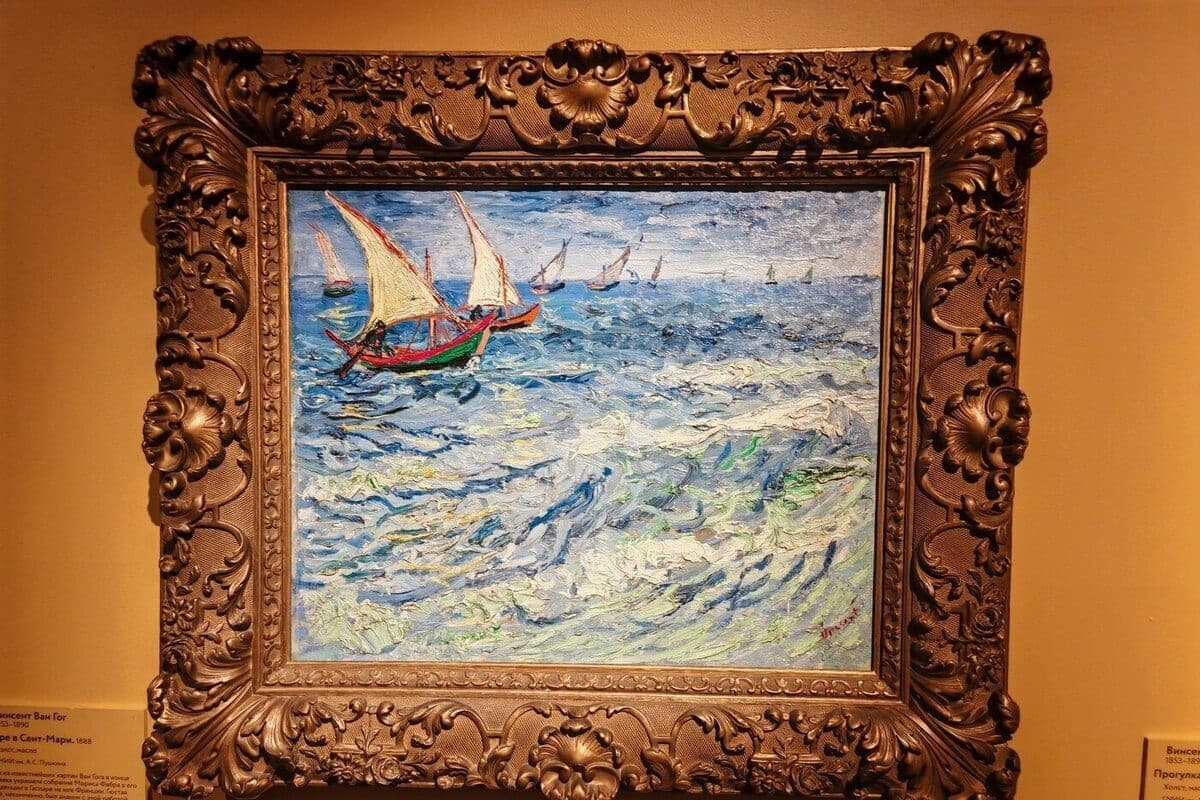
The exhibition, oddly enough, does not begin with the paintings that Faye owned, but with those that he could own - these are two works by Vincent van Gogh. The Prisoners' Walk was twice offered to him by his colleague Maurice Fabre for 2,000 francs, but Faye refused both times. It is difficult to say whether he regretted later: after the sudden death of the artist, the painting greatly increased in price, and a few years later the Russian merchant Ivan Morozov bought it for an insane 20,000 francs. But the acquisition of the “Sea at Saint-Marie” speech, perhaps, and did not go at all, but Gustave clearly saw the work. He was a painter himself, although not the most popular, and even painted a painting inspired by this painting by Van Gogh.
Following are paintings of Vincent’s sworn friend, Paul Gauguin – during a quarrel with him, Van Gogh cut off his earlobe. Faye communicated with Gauguin by mail, and in the collection of the patron there were many Tahitian paintings of the artist. Two of them, Ruperupe and Te arii vahine, hung in the most prominent spot of his apartment. Speaking of which, imagine a small room hung with paintings, or come to a collector’s exhibition in a museum where a small hall symbolically repeats this picturesque heap.
Gustave can be called the main admirer of Paul Gauguin in France. He rebuked, rebuilt, and rebuilt, leaving only the best. Correspondence and a large collection made him a true expert on Gauguin. But there is always a bigger fish: Moscow businessman Sergei Shchukin bargained Faye his favorite exhibits. So they moved to Russia. Interestingly, Gauguin was also interested in Morozov, who also became the owner of a pair of paintings that were once in the possession of Faye. The Frenchman even signed on the back, as if trying to leave his mark on his favorite Tahitian paintings.
The whole wall is dedicated to the lithographs of Odilon Redon. The artist released them in series - what is not the reason for hunting for a full set? Parisians, including Gustave, joined it with excitement: to collect the full series was considered very prestigious. The sheets were searched for, bought up and exchanged, a whole community of enthusiasts gathered around them. Later, Faye was lucky to meet the artist in person, and he even printed the missing copies for his collection. This friendship grew stronger from year to year: by order of Faye Redon painted the abandoned monastery bought by the patron, and later Gustave allocated a room for the workshop and generously supported the artist.
In the end, the exhibition was about how the taste, excitement and generosity of one person can change the fate of art. Faye collected, made deals, supported artists and parted with his favorite works – and that’s why they came down to us. A large collection begins with a small hobby and ends with a museum. And art begins with people who are passionate about it.