Chaos was ordered in Petrozavodsk
Chaos / Kaaos: tragicomedy about what not to understand If the play is shown for the fiftieth time, then someone needs it
If the show is shown for the fiftieth time, then someone needs it. Chaos/Kaaos: The Tragicomedy of Things Not to Understand.
I try not to read reviews and not to read the description before a new performance, especially if the title and poster immediately form images and directions for reflection.
So this time. The poster of the National Theatre of Karelia reads the understandable word “Chaos” next to the female image of the heroine Natalia Alatalo in a state of “complete unpredictability of further actions”, which reflects her spatial view.
Men have been trying endlessly to understand women. Especially mature. They have lived a certain life path and have received various experiences. And every time a man thinks that “now everything is clear”, he no-no and step on the rake. Then he asks, “What went wrong again?” That is, in a world of visible order, there is a mess from no source, with which one must again do something, or understand, or bypass.
I have an old joke, or rather one of its variations, which reflects the essence of female unpredictability (it's just a joke, women, no offense!):
“A monkey comes to a restaurant, orders a bottle of vodka and two glasses of sour cream. Drinks vodka, eating one glass of sour cream. The second glass smears on the head. She was asked, “Monkey, what are you doing?” And she says, "When I get sour cream, I become so mysterious."
From the first minute of the show, I knew that expectations were right. Now I'm going to get answers to my questions about what's wrong with women's worldview and what can be done about it. But it's not that simple. The author of tragicomedy - a man, the Finnish playwright Miki Mulluaho - skillfully gives recognizable images of chaos inside women. Spends through comic situations, when the heroines reveal their inconsistency and have their explanations. And also skillfully leads to the finale – when it becomes clear that the women themselves do not fully understand what is happening to them and why, wanting to go “right”, they sometimes turn “left”.
The genre of Chaos is defined as tragicomedy because the absurd and comical behavior of three women reveals the immense pain and inner disorder that sometimes drive women against their will and lead them to difficult life situations.
As you walk out of the room, the key message is don't try to understand women when they're acting illogically, or when they suddenly become strangers and strangers. Because women may not understand why this happens to them sometimes.
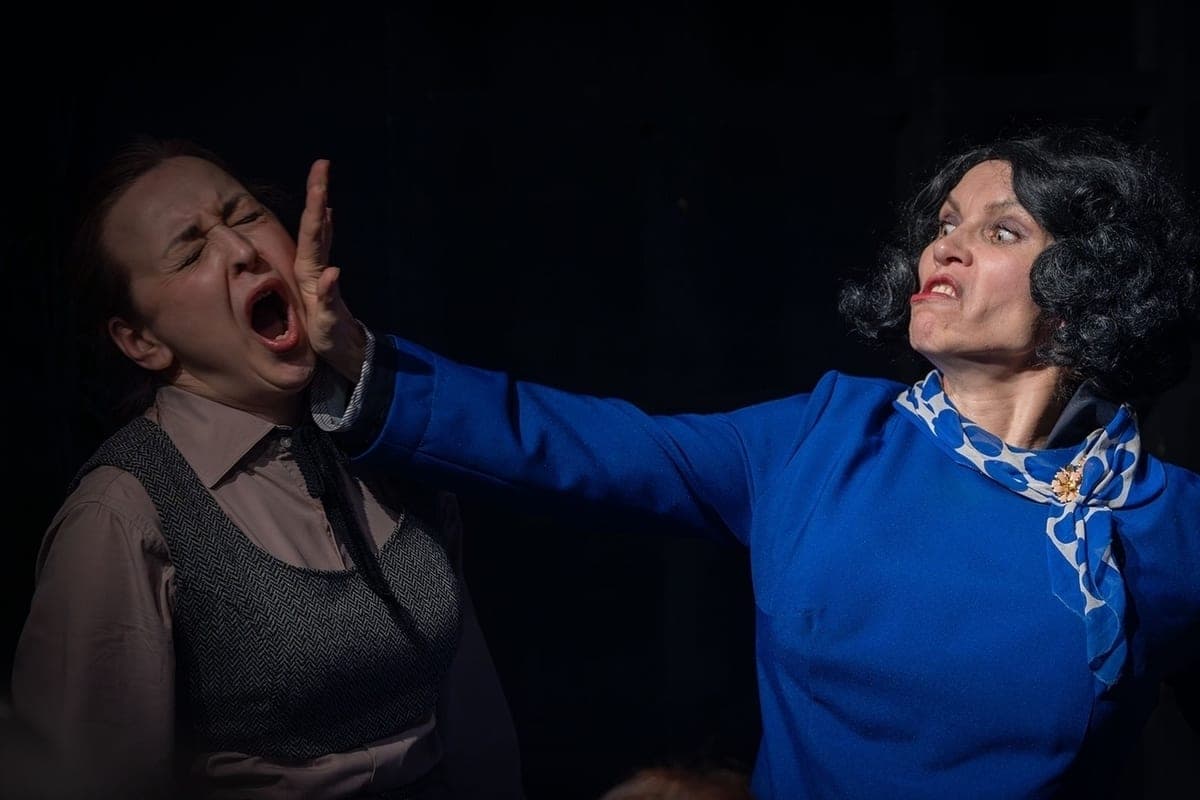
As for acting, in Chaos, three National Theatre actresses reached the top. Instant changes of images and characters, with high-speed dressing and makeup - a unique format. When actors are able behind the scenes to reincarnate beyond recognition in a matter of seconds – it amazes with its theatrical technicality. It seemed that when Natalia Alatalo, Olga Portretova and Alexandra Aniskin disappear from the stage, they were surrounded by a crowd of assistants who changed their image. However, the viewer through a small TV screen, where sometimes there is a complementary plot picture, at some point reveal the secret - behind the scenes there is no one: only three actresses, a dressing table and a mirror.
There are always a lot of heroes on the stage. And that's just three actresses. Reminiscent of the old television film “People and Mannequins” (1974), where all the roles in miniatures are performed by one actor – Arkady Raikin. A good idea from the director Joel Lehtonen and the ideal embodiment of the actresses of the National Theater of Karelia.
The play “Chaos” was shown for the fiftieth time. So someone's gonna need it. And men, so as not to ask questions that have no answers. And women to understand that they are not alone.
The production was carried out in a good cross-border collaboration as an example of effective good-neighborliness with the support of the Ministry of Education and Culture of Finland and the Finland-Russia society. The performance is in Finnish with an audio translation into Russian.
Staging group: director Joel Lehtonen, artist Vera Grigorieva, interpreter Alexander Lavrenov, assistant director Polina Mishin.
Characters: Natalia Alatalo – Sofia, a primary school teacher, married, two children; Alexandra Aniskina – Julia, a psychotherapist, sister of Emmy; Olga Portretova – Emmy, a journalist, sister of Julia, has a daughter.
Earlier it was told how in Petrozavodsk put the theater in a suitcase.