
Alexander Auzan will leave the post of dean of the economic faculty of MSU
Auzan’s successor will be his deputy Alexander Maltsev, RBC learned. Auzan heads the Faculty of Economics of Moscow State University since 2012, this post he will retain until December 1, and after that he will become the President of the Faculty
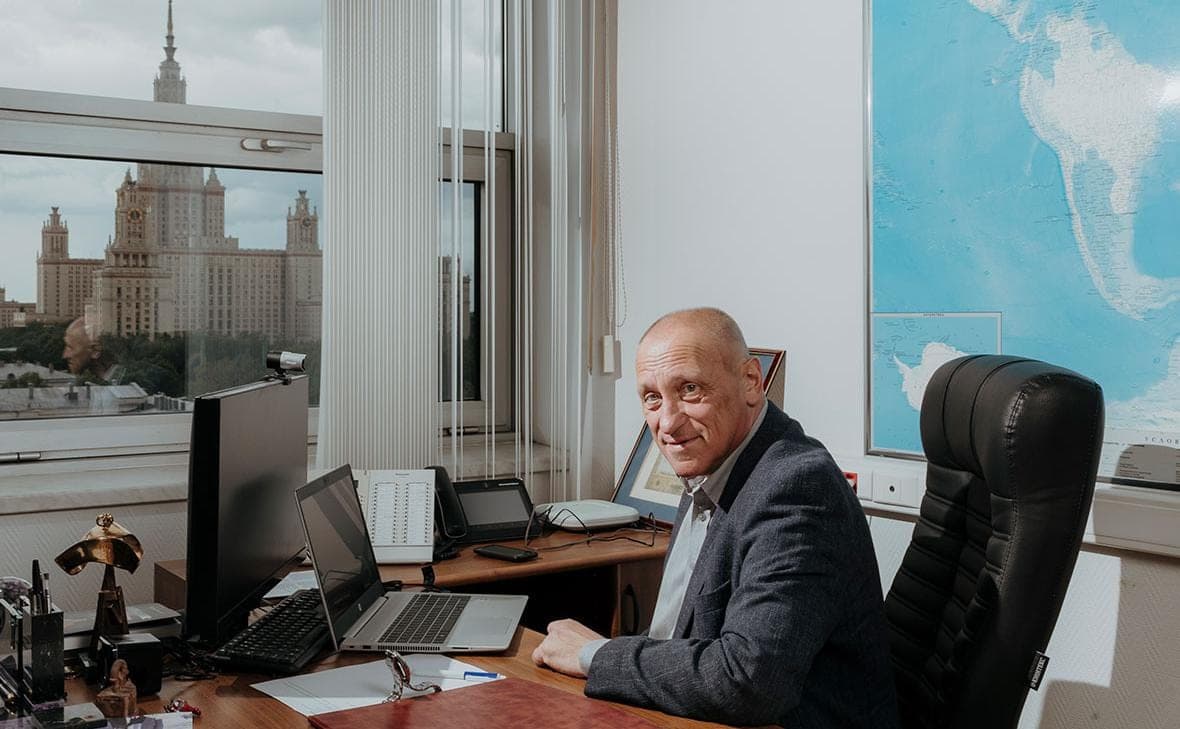
Economist Alexander Auzan intends to resign from the post of dean of the Faculty of Economics of Moscow University, which he has occupied since 2012, three sources familiar with his plans told RBC. Auzan himself at the conference of the Skolkovo School of Management on September 19 said that he “asked the rector of Moscow State University to let him go” from his post. In a conversation with Radio RBC on September 28, Auzan confirmed that he was going to leave on December 1, 2026.
Instead, Auzan will become President of the Faculty, as well as retain the leadership of the Department of Applied Institutional Economics at Moscow State University and a position in the Institute of National Projects, a research and consulting center specializing in socio-economic development and organizational design.
“It really is. And we agreed with the rector that from December 1, 2026, I transfer the position of dean to my successor, and I become the president of the faculty in order to deal with many large and interesting tasks, Auzan told Radio RBC.
What is known about the successor
Auzana will be replaced by the head of the Department of Political Economy, the current Deputy Dean Alexander Maltsev. He has been working at MSU since 2020. In 2010, he received the N.D. Kondratiev Medal, which is awarded every three years to three Russian and three foreign scientists for achievements in the field of social sciences.
"He's 40 years old. I defended my doctorate at 36 and became a professor at 39, and Alexander Maltsev defended his doctorate at 31 and became a professor at 33. Which, frankly, is not common in our economic sciences. He is a bright erudite person with experience in leading a large department. I think it's the right choice. And he's not hasty. We have been preparing this transit for two years, Auzan says.
What Auzan will continue to do
“I will have a wonderful right to do what interests me and not to do what I am not interested in. Managing a large faculty is a rather troublesome occupation, a lot of administrative cases, Auzan said. I told the Academic Council [September 25]: I am not tired. But I did everything I was going to do in faculty.” In these circumstances, it is right for the young team that we are cultivating to take control and for me to do what has long fascinated me, including, of course, educational projects.
Auzan is an institutional economist, doctor of economics. He is the author of a textbook on institutional economics, the book The Economics of Everything. How Institutions Shape Our Lives" and many publications. Research interests cover methodological problems of economic theory, models of industrial societies, theory of consumer behavior, theory of institutional economics, economics and civil society institutions in Russia.
What Auzan said about the Russian economy
In an interview with RBC in 2025, the economist talked about Russia’s place in the new round of globalization, which, in his opinion, is a wave-like process. He advised “to enter a new round of globalization not by the whole front, but by what can be the most competitive.” In my opinion, we need to go through the development of small series, pilot production and so on, and mass production should be placed in countries such as Uzbekistan or Vietnam. But this, of course, requires the solution of another very difficult task, if we are talking about a global presence, which is the protection of property rights, licensing agreements, and protection on the world market is much more complicated and expensive. It seems to me that this path for Russia, unlike the previous round of participation, when we participated almost only in raw materials and a little military products, it seems to me that this path may be more interesting, he said.
In an interview with Forbes in 2023, he noted that in relation to the future of the country, he is more concerned not with the macroeconomic situation, but “that people and money continue to leave the country”: “We are trying to calculate the money, and we need to consider the chances for a better future.” Human capital is the most difficult factor to replicate.” Russia has a feature that persists for decades: “We are in the top three in the world in terms of the quality of human capital, and the quality of institutions is very much inferior to other countries.” “This is a huge gap in human potential and the rules in which the country lives,” Auzan admitted. Inadequately developed institutions somehow push a large number of talented and educated people abroad.
There are two types of institutions in the world, Auzan explained: extractive, rent-seeking, and inclusive, involving, attracting human capital. "As long as institutions are set up to pump out rents, it's an unattractive country for smart people," he told Forbes. In his book The Economy of Everything, he outlined three conditions for “getting out of the rut of ineffective institutions”—one-size-fits-all rules, depersonalization of organizations, and collective control of coercive organs.
“We now have an economy where, with few exceptions, the decision-making horizon is two years. Such an economy cannot be an investment economy. It's rent-oriented. What can you do in two years? Find some source, surround it with a fence and try to get rent from it. Something to invest, to build — this is the time frame for 10 years, 20 years, — said Auzan at SPIEF this year.
The researcher adheres to the theory that the economic development of a country is influenced by its cultural code. He called Russia “a country with a bifurcated cultural world”, combining individualist “I-Russia” and collectivist “K-Russia”. “In principle, Eastern cultures are collectivist and Western cultures are individualist. According to research, we stand in the middle, slightly shifted towards the East and collectivism, the economist explained. There are strong and stable links between the level of individualism and the level of entrepreneurial activity of the population.
