ARES and the Union of Russian Cities at the Forum of Strategists: an expert session on resource saving
At the XXIV All-Russian Forum “Strategic Planning in Regions and Cities of Russia” – the Forum of Strategists, held on October 29, 2026 in St. Petersburg, the Union of Russian Cities organized the expert session “Resource saving as a strategy: what cities and enterprises of Russia should do by 2050” and signed a partnership agreement with the Assembly for Resource Saving and Energy Saving.
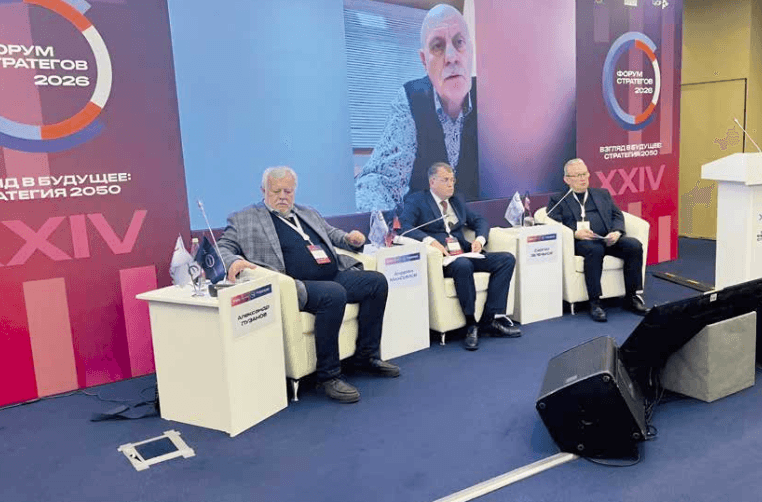
The session, organized with the support of the Civic Chamber of Russia together with the Association “AREC”, NRU “MEI” and the National Fund for Legal Support of Organizations and Citizens, brought together more than 40 participants – representatives of municipalities, the expert community, business and universities. The moderators were the Director General of the SWG, a member of the Public Chamber of the Russian Federation Andrey Maksimov and the President of the APP Sergey Zelenkov. Rapporteur of the session was the head of the project office "Urban strategies" SWG Alexander Prilepin.
The speech of Sergey Zelenkov, President of the Association “Assembly of Resource and Energy Saving”, General Director of the Suprotek Group of Companies was built as a philosophical introduction to the technical discussion. He began with a statement that set the tone for the entire session: “All resource saving starts with consciousness.” He explained that when discussing resources, “everyone has their own tree in their head, their own resource,” but at the same time “only one resource always leaves our minds – this is a person.” This thesis, about man as the main resource, became a semantic fork not only for his speech, but for the whole session.
The key institutional observation of Sergey Zelenkov was the absence of the profession of “resource auditor”: “We do not have a single resource auditor in our country, we did not even have a concept of this.” There are energy auditors, there are many financial ones, but there is no resource auditor.” He explained that the energy auditor assesses energy consumption, the financial auditor - the movement of money, and the resource auditor - is the one who ensures the effective operation of the enterprise as a whole: "Resource auditor - this is about the fact that the enterprise works efficiently. Resource-efficient so that there is increased productivity.” He attributed the lack of this profession to the lack of project offices and proposed to create them together with the Union of Russian Cities, using the “Municipal Resource Saving Map” as a tool for city leaders.
Dmitry Barshin, Executive Director of ARES Association, spoke about resource saving as a long-term strategy. As a model case, he chose the transport infrastructure of the city. This choice was not accidental: transport, he said, has a property that makes it a perfect illustration of a strategic approach, a long life cycle. “Any position related to transport infrastructure has a life cycle of more than a decade. Accordingly, the solutions that are being laid now will have to exist at least up to the thirties and forties, and some even later.” “No one can change it quickly without spending a lot of money.”.
This led to the key thesis of Dmitry Barshin: resource saving is a cross-cutting principle of the development of the transport system until 2050, and not a separate program. Resource saving is a principle that must be laid down in design, in long-term planning in any city and in any area of the city. In other words, it is not a question of adding resource saving to existing plans, but of rebuilding the plans around this principle. If this is not done, then the city “later will simply be uncompetitive, and it will not be able to compete for the budget on an equal footing.”.
The speech of Alexander Novichkov, Chairman of the Digital Development Committee of the ARES Association, an expert on digital solutions in housing and communal services, was devoted to digital tools of resource audit and became one of the most “applied” at the session. Alexander Novichkov began with a statement of the problem, which also sounded in the speeches of Sergey Zelenkov – the absence of the profession of “resource auditor”. “We really don’t have a profession like a resource auditor. There is an energy auditor, but there is no resource auditor, he said. But if Sergey Zelenkov spoke about it in a value key, then Alexander Novichkov translated the problem into a technological plane: “Resource audit is still held on an honest word. One looked, one counted, one signed. You will find out in a year when there is no savings and the money is gone.
The key conclusion of the discussion is that resource saving is not a tactic of saving, but an institutional development strategy, the purpose of which is to release resources to improve the quality of life. “Strategy is not a forecast, it is a choice of what we are doing today to achieve what we will see in 2050,” said Alexander Prilepin.
As a result of the session, a package of proposals was formed for federal authorities: to consolidate the concept of “resource audit” in the legislation, to develop a professional standard “Resource Auditor”, to include the section “Resource efficiency” in strategic planning documents, the right of municipalities to leave savings, the creation of a BAT directory and the launch of a “coalition of actions” of pilot cities.
On the sidelines of the Forum of Strategists, the Union of Russian Cities signed an agreement with the Association of Resource and Energy Saving Assembly (AREC), which was represented by President Sergey Zelenkov. The partnership provides for the introduction of resource-saving technologies, joint research, development of methodological materials and training programs for municipal employees, as well as pilot projects on resource audit in the cities - members of the AWG. “Today, municipalities lose up to 15-20% of their budget due to inefficient use of resources. Our task is to give the heads of cities the tools that will allow these funds to be saved and directed to development, said Andrei Maksimov, Director General of the SWG.