
Safety requires victims. Why those looking for the perfect messenger are guaranteed disappointment
Every day we send hundreds of messages without even thinking about what is happening to them. Someone chose the messenger consciously, others - on the advice of the.
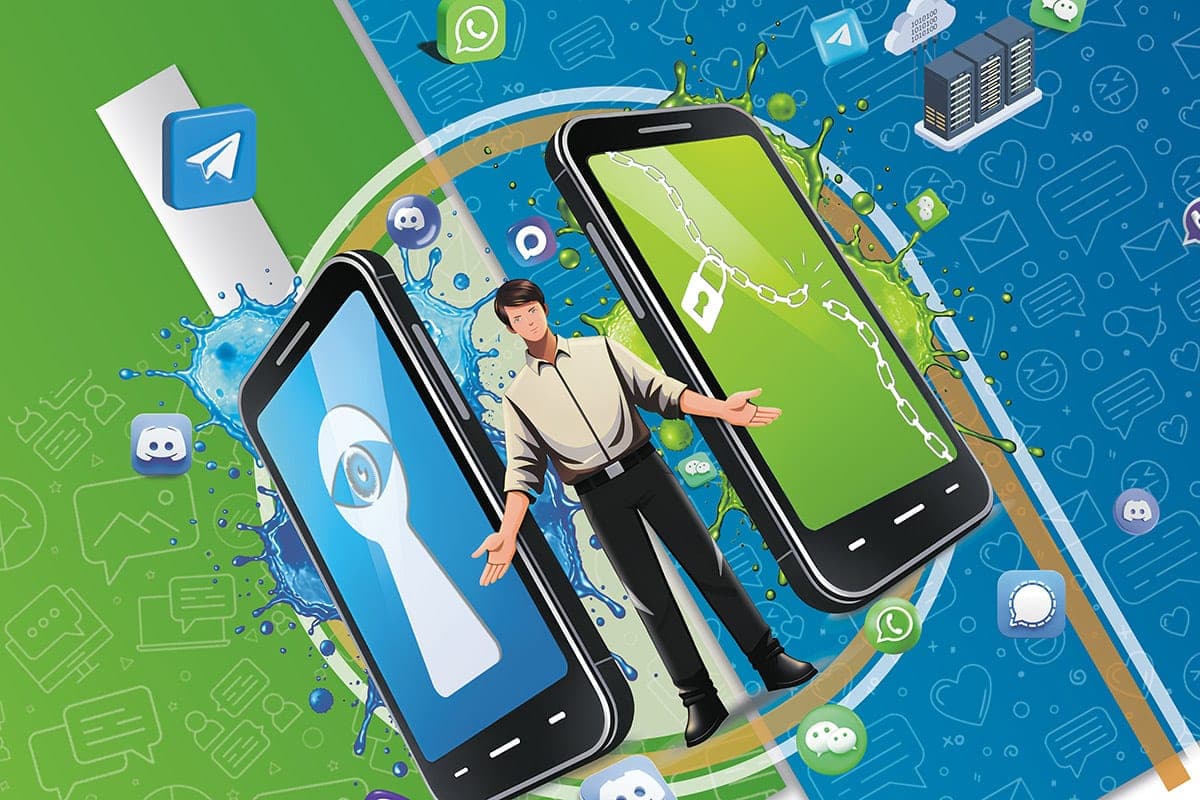
Every day we send hundreds of messages without even thinking about what is happening to them. Someone chose the messenger consciously, others - on the advice of friends, and still others - for the sake of colorful stickers. On the outside, they all look alike, but behind the icons on the screen, there are two approaches that answer the same question in different ways: which is more important - security or convenience? Who is right and what price do you pay for your choice?
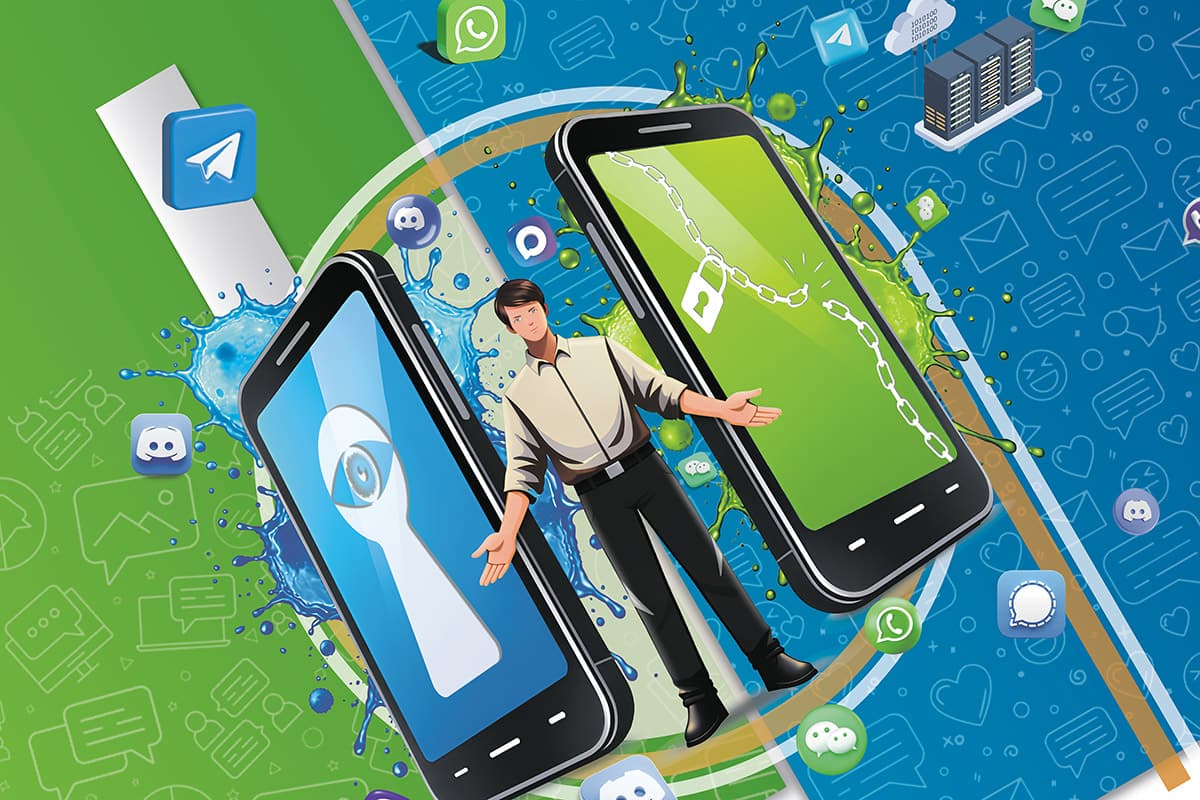
A stick with two ends C on one side, "blue". These are the so-called cloud messengers, where all correspondence is stored on servers, and access to it is open from any device. User convenience is above all else. Telegram, Discord, MAX, WeChat are all built around this idea.
On the other, green. In their picture of the world, correspondence exists only on end devices and is protected so that even developers will not read it. WhatsApp, Signal, and Viber all rely on privacy, even if it limits functionality. On the other side of the button, the entire system of digital privacy is based on trust. But it didn’t come out of thin air: IT giants have been packing complex technologies into a wrapper of understandable terms for years so we could click “Send” without even thinking.
The main feature of the “green” is end-to-end encryption. For the user, everything is simple: the message is encrypted from the sender and decrypted from the recipient. The messenger server acts only as a postman who does not know what lies in the sealed envelope. And if he sticks his fingers in there, he will get only a meaningless set of “crackers”.
Behind this “simplicity” are miles of mathematical computation, engineering misery, and compromise. While you choose a smiley face, the devices negotiate a shared “secret.” The task is not easy: the message must be hidden from the provider, fraudsters, the CIA, reptilians from Mars and other horrors generated by human paranoia.
The most reliable way to obtain a shared secret key over a public channel without transmitting it directly is to use the Diffie-Hellman protocol on elliptic curves. In order not to delve into mathematics, students of technical universities explain this process through a visual metaphor for mixing colors. Imagine that Petya and Vasya want to paint the fence. They publicly negotiate the color yellow and take a jar. Everyone secretly puts another one in there: Petya is red, Vasya is blue. Then the guys pass the mixture to each other through the postman Kolya: Petya sends orange, Vasya - green. After the exchange, Petya adds red to the green mix, and Vasya adds blue to orange. Since the order of mixing of colors does not play a role, both receive an identical brown color, which becomes their common secret. Mixing works as a one-sided function – it is easy to get a new color, but it is almost impossible to isolate the original components from it. Therefore, the postman Kolya, delivering sealed parcels with paints, will not know what the final color will turn out.

So, the key is safely agreed. But encrypting each message with the same method is very costly: asymmetric cryptography requires enormous computational resources. But symmetrical algorithms come to the rescue, where the same key is used for encryption and decryption.
Technically it looks like this: the message is broken into pieces, and each goes through a series of mathematical transformations. These operations are repeated many times, creating an unreadable mess at the output. Without the key, it is almost impossible to restore the original message.
Then more. How does a phone even know it encrypts a message for a friend rather than for a hacker who swapped a server address? You have to use a trusted channel to verify the digital key prints — a kind of cryptographic DNA of each device.
On top, engineers added an extra layer of Perfect Forward Secrecy protection: even if an attacker cracks a key today, they won't decrypt your yesterday's messages because a unique "one-time" key is created for each session.
In group chats, things get complicated. A single group key is created and sent to participants. If someone leaves or enters a conversation, the group cipher should be automatically updated. Former participants lose access to new messages - they don't have a current key. The new ones, on the contrary, never had it, so the previous correspondence is closed for them. When WhatsApp enabled end-to-end encryption for a billion users in 2016, no one noticed anything. The key role was played not by cryptography, but by psychology. People did not have to dig into the settings themselves - they saw a green lock, heard the word "safe" and calmed down. The nuances, of course, no one delved into.
Users were convinced that end-to-end encryption is a reliable shield. But it only protects the contents of the message at the time of sending. Encryption is powerless when data is leaked through unsecured backups. Let’s say you bought a new phone and moved data from your old phone to iCloud or Gdrive: Apple and Google can now read it.
It does not protect against spyware that can read messages directly from the smartphone screen to all this cryptographic “magic”.
And most importantly, end-to-end encryption does not hide metadata. Remember a postman who can't read an encrypted letter? But the envelope is in his hands. Who, to whom, when, where, how often and from what IP address – all this is displayed on it in bold.
Any action in messengers, be it viewing a message or sending an emoji, generates this data. They can not be completely hidden, technically they are only needed by the server so that the message does not get lost on the way to the destination.
Individually, these disparate pieces of information don’t tell you anything, but when they are put together, they add up to a digital portrait of a person. If you analyze it, you can accurately determine not only your social circle, but also political preferences, religious views and even intimate aspects of life – simply because you wrote something to someone at a certain time.
Attackers and even marketers quickly realized that there is no point in spending resources on gaining access to correspondence when open data – contacts, activity time, geolocation, etc. – says more about a person than he himself is able to write in a lifetime. People are not always truthful by nature. Their behavioral patterns never lie.
Let me give you a simple example. You don’t trumpet every corner about your personal life, you don’t run social media or blogs, but your phone knows who you are. Every morning at exactly 07:00 you go to the channel with local news, which means you live in this city. On weekdays, the phone sees that you’re connected to the same cell tower—yes, that’s your place of work. At 13:00, you send a message to a chat room for a dozen contacts, and after a couple of minutes you get a response from three — and the algorithm has already built a map of your communication: what time you eat, with whom you are in touch, their daily routine and habits. In the evening and at night, the coordinates rest on the same area, and the phone clings to the familiar Wi-Fi - of course, this is your home. At the same time, several more devices are burning at the same point - most likely your loved ones. Every weekend, geolocation and activity time are shifted together - you go to the country with the whole family. Take everything separately, and it seems like nonsense. But in the aggregate, you can learn a lot about a person: where he lives, works, when he eats, with whom he communicates, where he goes. All without a single message read. It's creepy, isn't it? What about the blues? When you send a message, for example, via Telegram, it is not just delivered to the addressee – it settles on the servers. Yes, the company may swear it won't read it, but physically it can. They just say, "We'll take care of your convenience and you trust us." And everyone agrees.
Device-to-device synchronization, web versions, cloud backups all work just because the server has access to the content. Lost your phone? No problem. Do you want to come in from the tablet? Oh, please. Everything will be loaded automatically.
It's very convenient. Moreover, it creates attachment. When you have years of correspondence that lives in the cloud, you will not go to the messenger with full end-to-end encryption simply because it will not be able to save what you already have. Sometimes the Blues can play on the Greens. End-to-end encryption is also there, but it is rather an exotic option, which most do not even know. By default, it is turned off, and the switch is hidden somewhere in the back of the settings - on the fifth tab in the back row on the left. This means that 99 percent of all chats live on a server. All these “comforts” make us vulnerable. In an instant, the data of millions can be publicly available. Not disparate encrypted fragments or bits of metadata, but the entire history of photos, videos, voice and text messages. Geographical plane

Let’s not forget about jurisdiction. Who owns the servers, in what country they are located, what laws the company obeys - it directly depends on who and how can access your data.
WhatsApp, Discord and Signal are under full control of the United States. This means that at the request of US intelligence agencies, under the FISA Foreign Intelligence Surveillance Act and the CLOUD Act, they are required to hand over all the data they have. And this is the key point.
For example, the architecture of Signal is built around the principle of extremely limited data collection. For years, the FBI has been shaking developers, demanding to “leak” information. But from year to year, the only information they receive is the time stamps of the user’s registration and their last connection to the service. Nothing else is stored. Unlike Meta, the owner of WhatsApp, which collects a much larger amount of metadata and gradually abandons end-to-end encryption in its products. Recently, a high-profile case was discussed on the Internet - allegedly the FBI hacked Signal correspondence. During the trial of the attack on the immigration center in Texas, American intelligence agencies did manage to extract messages in the messenger from the iPhone of one of the defendants. But Signal was out of business. Just in the operating system Apple has a feature that by default saves the contents of all notifications in the internal database of the phone. Telegram is positioning itself as the messenger of the world. But formally chose the jurisdiction of the UAE, not to fall under direct control, for example, the United States. But even Durov has repeatedly admitted that he interacts with the authorities of the countries within the framework of local legislation. And I think sleepless nights in the Paris casemates under the crunch of the French bun only expanded Paul's horizons of cooperation. Road without compass
We inevitably sacrifice either a part of our comfort or a part of our privacy. The main question today is not “which is better?” but “who am I willing to trust more – technology, an individual company, or just myself?”
The irony is that even the most perfect protection is broken down by human inattention, and the only truly secure messenger is one where there is no send button. Everything else is just a matter of the price you are willing to pay for the opportunity to communicate.
LEAKS OF MILITARY PLANS
The pioneer in the world of end-to-end encryption was TextSecure, released in May 2010. And you've probably never heard of him. In 2015, this small startup got a new name and has since been known as Signal. Yes, yes, the favorite protected messenger of Donald trump. However, judging by the leaks of military plans, it is also necessary to use them wisely.
The UK, with its Online Safety Act 2023 under the pretext of fighting banned content, requires messengers to have “holes” for security services to access. Signal and WhatsApp have even threatened to withdraw from the country’s market if these demands are enforced. Similar laws exist in France, Sweden and other EU countries. Everyone wants protections that intelligence agencies can circumvent, but hackers can’t. But when you create a back door for the “good”, it is sure to find the “bad”.

Top 5 channels of information leaks of small and medium-sized businesses by prevalence for 2025
♦ messengers - 58%
♦ mail - 49%
• removable devices - 28%
cloud storage, file sharing – 23%
♦ social networks - 18%
* percentage of companies reporting leaks through this channel
50% of companies have lost personal data.
At the same time, one in four companies (26%) also lost financial contracts.
And one in four (25%) – internal regulations.
* Data is the proportion of companies that have experienced a leak on each channel. One company may have experienced leaks through multiple channels, so the amount of interest exceeds 100. The statistics are based on the analysis of 650 small and medium-sized businesses.


