
Israel's Cheese Revolution: Another Attempt to Defeat Monopoly or Public Play?
Israel’s Ministry of Economy announces “cheese liberalisation” – this time the allocation of 5,900 tons of duty-free quotas for yellow cheese imports in 2027
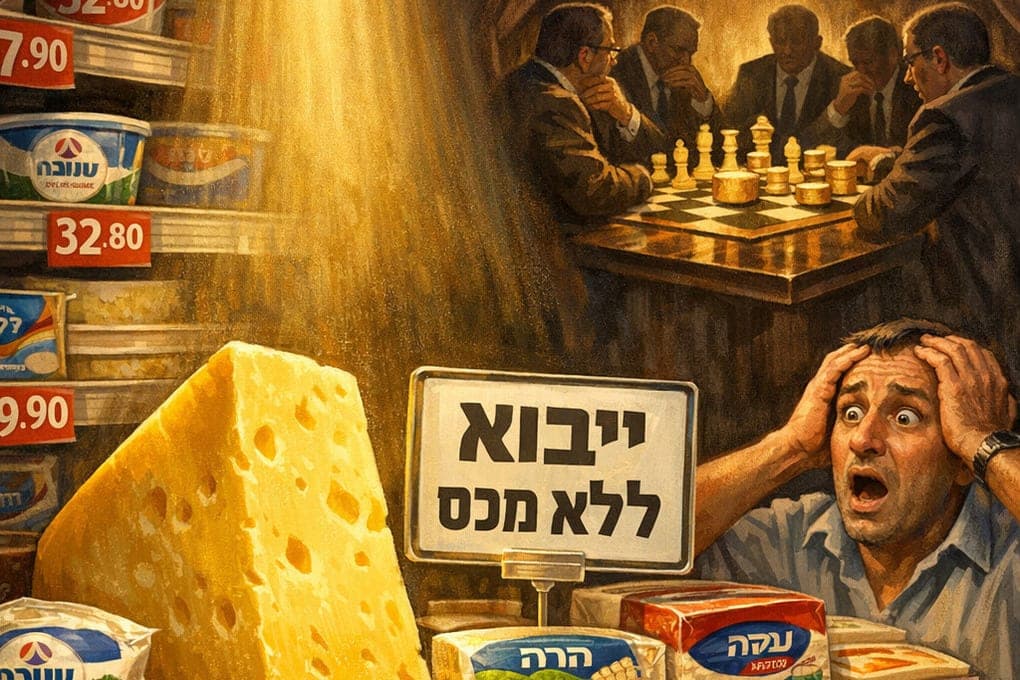
Israel’s Ministry of Economy is once again announcing “cheese liberalization” – this time the allocation of 5,900 tons of duty-free quotas for yellow cheese imports in 2027. Officials promise price cuts, but is this mechanism really going to shake the foundations of Israel’s dairy oligarchy, or are we witnessing another act of political theater amid rising global prices and a perpetual fight against high prices?
In Israel, where cheese is not just a product, but a symbol of national character, every news about milk quotas evokes a storm of emotions, comparable to the debate about the status of Jerusalem. So now the Ministry of Economy, like the director of the good old theater of the absurd, brings back to the stage familiar heroes: importers, consumers and, of course, the invincible dairy oligarchy, whose brands have long become part of local folklore. This time, we are talking about 5,900 tons of yellow cheese, which in 2027 should arrive in the country without duties - but only if importers promise the people the lowest prices.
The mechanism is as simple as Israel’s bureaucracy is complex: 4,070 tons will go to those who publicly vow to sell cheese at the cheapest price, whether in delicacies or on supermarket shelves. The remaining tons – the so-called “bonus quota” – will go to those who offer even more attractive conditions, but without strict price commitments. All this, according to the plan of officials, should not only reduce the cost of the basic product, but also inspire importers to exploits in the face of rising world prices. And so that no one dares to deceive the expectations of the public, the ministry promises regular checks in retail chains - after all, as you know, trust, but verify.
Sounds good, but isn’t this story too familiar? Israel has been trying to crack the milk code for years: after the protests of 2011, when the “cheese riot” became a symbol of the fight against high prices, the authorities repeatedly promised to defeat monopolies and open the market to competition. However, experience shows that even the most noble initiatives are often smashed against the rocks of reality: the share of imports in the yellow cheese segment remains modest, and prices on shelves are still higher than in most developed countries. Yes, in recent years, competitive procedures have really reduced the price to 2.90-3.40 shekels per 100 grams in delicacies and 3.00-3.50 on the shelf – which is tens of percent lower than the market leaders. But is it worth rejoicing if these “leaders” determine the rules of the game, and importers are often connected to the same large networks?
However, it is impossible not to admit that against the background of the global increase in milk and cheese prices, even such measures look like a breath of fresh air. Israel, where every other politician dreams of going down in history as a fighter against the cost, is forced to maneuver between the interests of consumers and the lobby of producers. While bonus quotas used to be more of a symbolic gesture, they have now been increased, perhaps to give importers more flexibility and shake the milk throne a little.
But do not forget: in this game of survival, the winner is not always the one who shouts loudest about lower prices. The history of the Israeli market teaches that even the most sophisticated schemes can turn into another spectacle, where the viewer – that is, a simple buyer – gets only the role of an extra. After all, as folk wisdom says, “cheese is free only in a mousetrap” – and in Israel, it seems, and there is not always.
Outcomes and figures
Parameter Value (2027)
Total duty-free quotas 5,900 tonnes
Quota with low price commitment of 4,070 tonnes
Bonus quota (without price ceiling) 1,830 tons
The price for the consumer (delicacy) 2.90-3.40 NIS. /100g
Price for the consumer (shelf) 3.00-3.50 NIS. /100g
Comparison with leading brands Tens of percent lower
Monitoring of the Ministry Regular inspections
Conclusion: Another cheese reform is not only an attempt to lower prices, but also part of a big political spectacle where the fight against high prices becomes an eternal plot. Will the new quota really change the rules of the game, or will we again see only a change in the decor of the nearest supermarket.


