One thing he did not understand - indifference to the fate of the land: the life and death of the chairman of the collective farm "Iskra" Vilchkovsky
September 17, 1939 is a significant day in Belarusian history. Not just a date that united the people territorially and mentally, but a milestone that changed the fate of millions of people.
September 17, 1939 is a significant day in Belarusian history. Not just a date that united the people territorially and mentally, but a milestone that changed the fate of millions of people. The border, just 40 kilometers from Minsk, divided not only Belarusians. It was a division between the BSSR, which was moving along the path of a new social model, and the Polish Republic, which remained faithful to the old foundations. The unification of the two social standards could not take place without consequences. After the autumn of 1939, the West Belarusian peasants, educated in private property conditions, had to rebuild their thinking on a collective-farm basis and collective labor. The reality of the new existence after hundreds of years of isolation and dependence on the landlords required a radical break in consciousness. Changing the mindset was sometimes more difficult than accepting political change. The echoes of these events, seasoned with bitter military fever, were felt to varying degrees painfully for more than a decade.
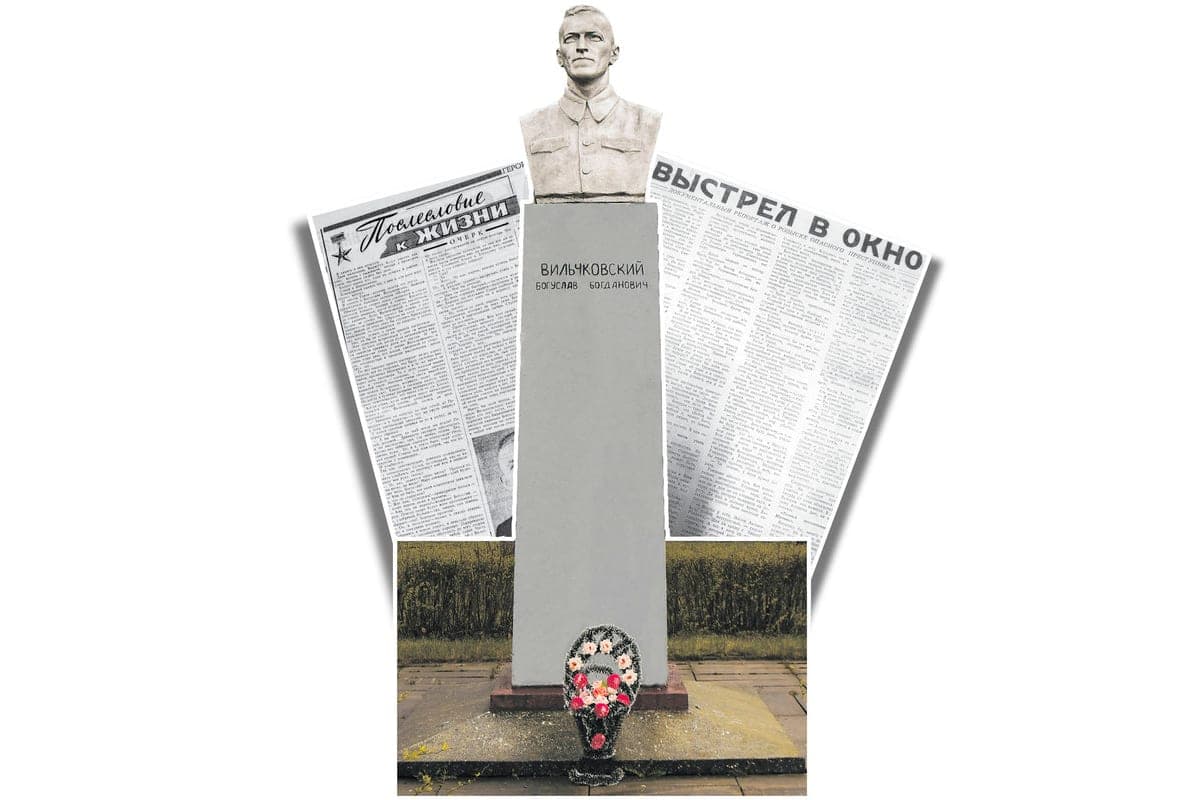
On November 27, 1964, in the performance of official duties, a deputy of the Supreme Soviet of the BSSR, a member of the audit commission of the Brest rural regional party organization, the chairman of the Iskra collective farm of the Baranovichi district, Boguslav Bogdanovich Vilchkovsky, tragically died.
In the unsophisticated reader, such lines of the official obituary published on the pages of our newspaper will undoubtedly cause an acute sense of understatement. So what happened “in the performance of official duties” with the chairman of the advanced collective farm in the republic? An accident during field work, an accident at a mehdvor or maybe a collision on the road? The profession of bakery is purely peaceful, other, criminal options do not fit into the head. Nevertheless, alarming rumors spread throughout the republic... The chairman was killed!
From the conclusion of the forensic medical examination: “...a gunshot wound to the left half of the chest ... The shot was fired from a short distance by a large-caliber bullet. Vilchkovsky's death falls into the category of violent... It was impossible to save a life
In the 1960s, the Iskra collective farm was first discussed at the regional and then at the republican level. In a March 1964 report from a meeting of the leading agricultural workers of the Brest region, the Rural Newspaper highlighted the speech of the young chairman Boguslav Vilchkovsky: Not so long ago our economy was one of the laggards. Suffice it to recall that in 1958, for 100 hectares of farmland, we had 16 head of cattle, including 8 cows. The yields were so low that on average a hectare yielded no more than 5-6 feed units. Only five years have passed, and the picture has become very different. Our own feed allows us to keep 38 head of cattle, including 24.5 cows per hundred hectares of farmland. Last year, our farm produced 509 quintals of milk per hundred hectares of land. Today 650 will be received and next year 900 centners will be received.”.
In those years, the main indicator of dairy efficiency was not gross milk yield, but milk production per hundred hectares of farmland (centners). In terms of its own feed supply, the logic in this approach is obvious. No reasonable chairman will undertake to keep cattle that cannot be fed. The master vein of Vilchkovsky manifested itself in all its glory. "Iskra" under his leadership for dairy achievements confidently entered the top ten kolkhozes of the republic, and in the Brest region generally headed the honorary list.
The farm established breeding work, introduced artificial insemination - at that time a rare thing! As a result, speaking at a meeting of the region's foremost leaders, Vilchkovsky proudly noted that the dairy herd is formed through its own reproduction. And for several years in the collective farm receive from a hundred heads a hundred calves, and in recent years even more than a hundred.
It was during those years that one could often hear:
- Well done, Bogdanich! What a master!
It was as if he had been hatching and polishing a plan for approaching his land for a hundred years, and when he received the right to put it into practice, he set about it calmly and confidently. One thing he did not understand: indifference to the fate of the earth. He wasn't. This he tried to instill in others: concern for the collective farm, for its future, wrote the correspondent of the Rural Gazeta, recalling his communication with Vilchkovsky.
It would seem that the pedigree of the landowner - 90 dessiatines of land was due "for the Polish watch" to Boguslav as an inheritance from his father and grandfather, and Vilchkovsky thought much wider than his own allotment. People noted this, and the correspondent noted: “Getting to a new road, I involuntarily drew attention to the “landlord choirs”. The five-walled silhouettes were covered from all sides by maple and elm. Among them is a cellar, a shed. Part of the house is somehow unfinished. I ask Wilchkovsky: what is the matter?
- Ah, he waved. - It's all sorts of unlucky. And there's plenty to do. We decided to rebuild all public buildings, that's where the worries are! Now we will build everything capitally. Have you seen our new cowshed? Come on
Both the new cowboy and Vilchkovsky’s active interest in raising the entrusted farm to the detriment of personal interests stimulated the collective farmers to work hard.
“At first, a dozen former sole proprietors did not like it.
And then only one, who harbored anger for his entire miserable life, the beast that pulled the trigger of a hidden gun that evening ... "Cool take, Chairman..." It was not accepted in those years to publicly develop the theme of single people who still remained among the villagers. Land plots of subsidiary farms have repeatedly caused gossip and clashes with the interests of the collective farm. During the quarter century that has passed since the memorable September of 1939, much has changed in these lands. The war also left its heavy imprint on the worldview, relationships, biographies. Not all local residents, like the young Boguslav Vilchkovsky, actively helped the partisans, some hid in the forests, evaded conscription in the advancing Red Army. They returned to their villages only after the end of the war. It was necessary to live with these people, to build new personal and industrial relations.
The organization of kolkhozes and state farms in Western Belarus, which has long been completed on paper, has repeatedly encountered remnants of Polish times on the ground. Slowly went the first postwar years and in "Iskra". Steep hills, on a horse with a plow and you will not climb, at the bottom of the sand, podzol, swamp, shrubs. And no one was particularly concerned about this: five or six centners of grain per hectare were “legal” here. Meanwhile, private farmsteads allowed villagers to sell what was grown on the markets, hunting gave their profit, someone illegally traded in arbor..
Amid extensive agricultural reforms, there is anachronism. But it was in this soil that the seeds of the tragedy unfolded for the time being. Investigators had to stir up people’s grievances that grew out of long-standing political and property disputes. Analyzing the details of the murder of Vilchkovsky, a correspondent of the all-Union newspaper “Trud”, who had the opportunity to get acquainted with the materials of the criminal case, presented portraits of some of the defendants: “The brothers Rylo – Konstantin and Yakov – aroused suspicion. After the end of the war, they joined the kulak group. Konstantin said at the time:
- If I learn of Vilchkovsky’s membership in communism, I will destroy him and his family
In one of the anonymous names found on the board, it was said that Vilchkovsky did not allow anyone to live, acted illegally, and ended with a direct threat: “Comrade Chairman! Think about that question
Investigators determined that the letter was written by the Poluleh family. We're starting to figure it out. Father of the family Joseph Mikhailovich during the war evaded service in the army. He returned to the village after a decree was issued on the amnesty of deserters. He started hunting. We knew him as a great shooter. Then he joined the collective farm. But as a gardener, he chased the moonshine and did not recognize anyone. Like a husband and wife. She was numbered, but was engaged in postscripts, insulted the collective farmers. I had to take her off the job.
The kolkhoz for villagers like the Polulekhs served as a shield to cover their personal interests. Time after time, they sought to use public lands for personal gain. They worked hard, not in the kolkhoz, but in their own backyard. However, to live separately, as under the pans, locked in their "zagrod", became increasingly difficult.
Vilchkovsky mercilessly fought against drunkenness, which caused tangible harm to the economy. And Poluleh and another villager Nikolai Zenko actively chased moonshine, soldered collective farmers. At the insistence of the Chairman Zenko confiscated the machine. The impact on one of the income items was tangible. According to eyewitnesses, Zenko did not harbor anger:
- Nice take, Chairman, whatever happens.
No less indicative in the moral appearance of Zenko was the story with seedlings for the collective farm garden. As an experienced gardener, he volunteered to grow them. We've got the station. Broke the fruit nursery. And when the seedlings grew, Zenko sold them. On Vilchkovsky’s logical proposal to deposit money in the collective farm cash register, Zenko was indignant: what, they say, money.
In the meantime, land issues have intensified. At the turn of the 50s - 60s of the twentieth century, rural youth actively moved to the cities. The reduction in the number of workers in families required a review of the size of the homestead plots of villagers. In the former Western Belarus, where there were still fresh memories, albeit not in a landlord’s way extensive, but still own allotments, such steps were perceived very painfully. Vilchkovsky had to take unpopular measures against some countrymen who did not want to put up with reality. Zenko, for example, knowing that the land did not belong to him, in the spring he nevertheless brought dung and hired an individual Govor to plow. The kolkhoz used the land for its purpose.
Recalling this incident at the investigation, Govor testified to Zenko's words to Vilchkovsky: "As long as I live, I will take revenge so much." Gun vs. criminal Investigators have long unraveled a tangle of personal grievances against the principal chairman. Soot, Polulech, Zenko... Which one pulled the trigger that November night? The evidence gathered was not enough. There was suspicion - there was no evidence. There was a shotgun, there was no gun. Around the discovery of the murder weapon and built a hunt for the criminal. Cunning helped. For another interrogation Zenko brought a gun similar to his personal, claimed as stolen. The weapons were packed in paper and placed on a table on the side. Zenko sat in front of the investigator and looked anxiously at this bundle. Then he jumped up. Grabbed a gun... And he got down hard on the chair. He had the impression that the gun had been found.
- I took revenge on him ... - Zenko shouted and began to testify.
Before the investigator appeared no longer an offended peasant, but a cynical, cold-blooded bandit, like those scoundrels who hid in the post-war forests from the Soviet government. Zenko has been preparing the crime for years. Fake gun theft. Arranged forest ambushes on Vilchkovsky, but everything interfered ..
The fatal shot in November 1964 shocked the republic - a wild echo of personal animosity against a backdrop of historic transformation. Evil, vengeful Zenko even after a quarter of a century and remained locked in his garden. The court sentenced the murderer to capital punishment.
* * * * * * *
About 36-year-old Vilchkovsky remained a good memory. By the decree of the Presidium of the Supreme Soviet of the USSR of March 22, 1966, for the achievements in the development of animal husbandry, increasing the production and harvesting of meat, milk, eggs, wool and other products, Vilchkovsky Boguslav Bogdanovich was awarded the title of Hero of Socialist Labor (posthumously). The collective farm "Iskra" was renamed in honor of the deceased chairman, his surname is one of the central streets in Baranovichi, and in the mid-70s, the "Rural Gazeta" established a prize for the advanced harvesters named after Vilchkovsky. Time certainly puts the right accents. Deeds are the best monument to man.