In the footsteps of the soldiers of the Golden Horde: rare patches with dragons and winged creatures transferred to the collection of Novgorod
The collection of the Novgorod Museum-Reserve was supplemented by three rare belt linings with images of fantastic animals - artifacts that reveal the connections of medieval Novgorod with distant lands. This was reported by the press service of the cultural institution.
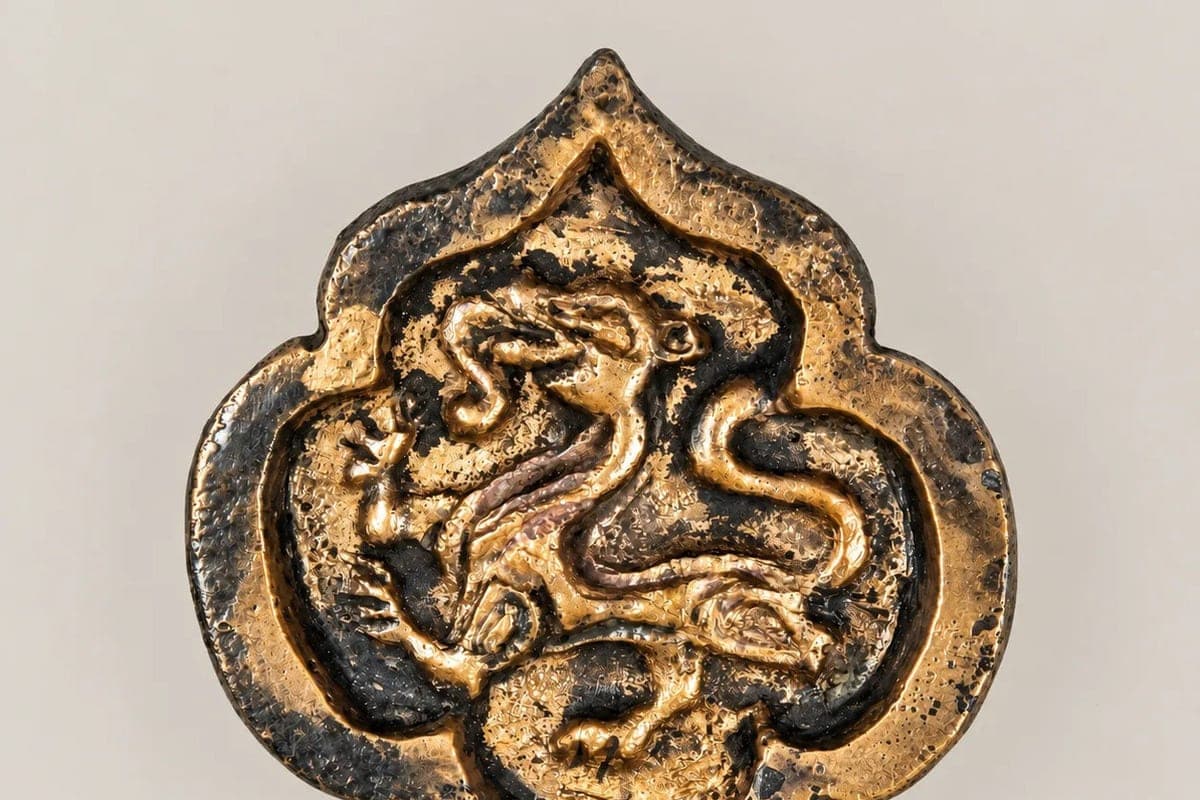
The collection of the Novgorod Museum-Reserve was supplemented by three rare belt linings with images of fantastic animals - artifacts that reveal the connections of medieval Novgorod with distant lands. This was reported by the press service of the cultural institution.
The finds date back to the XIV-XV centuries and were made in 2023 at the Trinity XVII excavation during the work related to the construction of the National Historical and Archaeological Center named after V. L. Yanin.
All objects have a keel-shaped shape and curly edges, but each of them is unique in execution and plot. The first is a dragon with a curved body and raised front legs. The peculiarity of this lining is traces of serial production: for casting, a clay form was used, made on the imprint of the finished product. Due to repeated copying, the small details of the relief smoothed over time. Scientists have found similar images on the Karelian Isthmus and in the Crimea.
The second pad depicts a winged creature with a massive body, a snake-like twisted tail and legs stretched forward; a ring has been preserved in its lower loop. Motives of this kind are especially characteristic of the Middle and Lower Volga regions.
The third layer is distinguished by careful processing: the master carefully cleaned the relief and surface after casting. On it is a creature with a long neck, a small head, an amygdala eye, round ears, a curved tongue and a raised tail. An interesting detail: on the back there was a marking for new fasteners - probably, the product was tried to repair.
The origin of the linings helps clarify chemical analysis. All three items are cast from tin-lead bronze with a very close composition, while the level of nickel in the alloy is much higher than that of local Novgorod masters. This indicates that the overlays are most likely manufactured outside the city.
Scientists associate such decorations with the military culture of the Golden Horde: belts with dragon-like images have been known since the first half of the XIII century. Since most similar finds come from the Volga region, researchers assume that it was from there that the patches could get to Novgorod through trade, exchange or other contacts of the medieval era.
Interestingly, the collections of the museum already have similar artifacts: they were discovered at Nutnoy IV and Alekseevsky II excavations in 2011 and 2012. The new findings add to the picture and allow us to trace how motives and technologies spread across different territories.