
Troy or pyramids: where to take a fifth-grader interested in history
The vast and mysterious Ancient World for Russian schoolchildren fits into the 5th grade program
The history program in the 5th grade is designed to give children an idea of the emergence of civilizations in different regions of the world. The first block is dedicated to the first civilizations that arose in the valleys of the great rivers. First, the children will learn about Ancient Egypt: the features of life in the Nile valley, religion (the cult of gods and pharaohs), the construction of pyramids, writing (hieroglyphs). Then comes Mesopotamia, aka Ancient Mesopotamia: children are told about ancient Sumer, Akkad and the Babylonian kingdom, paying special attention to the laws of Hammurabi (one of the oldest codes of laws in the world, published around 1750 BC, at the end of the reign of the Babylonian king Hammurabi (ruled in 1792-1750 BC) and carved in cuneiform in Akkadian on a cone-shaped diorite stele). Then the program is followed by the ancient states of Western Asia: passing Phoenicia, fifth-graders learn about the navigators and inventors of the alphabet, in a lesson in Palestine - about the features of the ancient Jewish kingdom, then the Assyrian and Persian powers follow. Within the framework of the latter, schoolchildren are introduced to the “kingdom of countries”, under the Persian kings Cyrus the Great and Darius I, which united huge territories. Next comes Ancient India: students learn about the emergence of civilization in the Indus Valley, the teacher tells them what the caste system and Buddhism are. The Asian bloc completes Ancient China: children pass the Qin Empire with its “Great Imperial Construction” (with the completion of the so-called Warring States era, Emperor Qin Shi Huang of the Qin Dynasty, who united the disparate Chinese lands under his rule, ordered the construction of the Great Wall of China, its first segment stretching along the Yingshan mountain range in northern China). Fifth graders learn about Confucianism and the inventions of the ancient Chinese.
The European block of the textbook starts with Ancient Greece: the Crete-Mycenaean civilization, the cities, Sparta with its military structure. Then comes the Great Greek colonization: the founding of Greek settlements along the shores of the Mediterranean and Black Seas and the subsequent Greco-Persian Wars: the famous battles of Marathon, Thermopylae and Salamis. Then the flowering of Athens, the era of Pericles, Hellenism, the campaigns of Alexander the Great and the spread of Greek culture to the East.
Rom completes the knowledge of the ancient world by schoolmen: children get acquainted with the struggle of patricians and plebeians, the Punic Wars (Rome vs. Carthage), with the periods of transition to the Roman Empire, its rise and fall. The Ancient World is crowned by the eyes of a fifth-grader with the Great Migration of Nations and the end of the Ancient World (476 AD).
Of course, personally visiting all the places where history was made is almost as difficult as absorbing and keeping in mind all the ancient history in those incomplete 9 months that lasts a school year. In addition, travel to the places described in the European block of the textbook on the history of the ancient world today for geopolitical reasons is difficult specifically for Russians. And part of the Asian block is not available for tourism at all for security reasons. However, there are geographical points that are much easier to find than many people thought. And from there you can revive in your imagination all the other sections of the history textbook for the 5th grade.
Everything is calm in Baghdad..
Where chariots once thundered, ziggurats were erected and great civilizations flourished, today modern cities, endless deserts and archaeological parks preserve the echo of history. Traveling in the footsteps of the cradle of humanity is an opportunity to touch eternity. On the site of ancient cities today are modern sites that have become important historical and tourist centers. This is what lies hidden today in lands once ruled by kings and philosophers.
Of course, only parents decide whether to drag the child to destinations for trained tourists or go themselves, and then tell their fifth graders about what they saw firsthand, backed up with pictures. But the fact is that some points on the map before the ancient and now modern world, much more accessible than many thought. They require a certain amount of courage from travelers. Let's start with the most exotic.
Ancient Mesopotamia and Babylon, or rather their traces, now belong to the territory of modern Iraq. This is the heart of the "Fertile Crescent" (Fertile Crescent - the conditional name of the historical and geographical region in the Middle East, which received its name because of the characteristic shape on the map, resembling a crescent, as well as the exceptional fertility of soils compared to the surrounding arid territories), the place where writing originated. Despite the difficult political situation, which for decades did not give a quiet breath to this country, historical sites are not only preserved, but also accessible to visit. Moreover, you can get there from the territory of Turkey, where the sale of “time travel” is established at the level of local travel agencies. It is advisable to choose a proven and providing local guide, only he will be able to truly revitalize the pages of the history textbook for you.
You will be able to see with your own eyes what remains of ancient Babylon: the reconstructed Ishtar Gate, the remains of palaces and the foundations of the legendary Etemenanke Tower (the prototype of the Tower of Babel). And Ur is one of the oldest cities in the world, where the grandiose Ziggurat Ur, towering over the desert as a monument of Sumerian power, has been preserved.
In addition to the guide, to revive the lost world in the imagination of both children and adults will help the famous fairy tales of Scheherazade - "One Thousand and One Nights". At the same time, adding to the reading of schoolchildren who have not yet had time to love the book as leisure. The schherazadina of history is not just a literary fiction, but a bright tapestry embroidered with gold, in which real geographical points are skillfully intertwined with mythical landscapes. Scheherazade leads us through the markets of Baghdad, the palaces of Persia and the dangerous seas of the Indian Ocean. Many of these places exist on the world map to this day, keeping in their stones echoes of those very legends. The delicate connection of ancient history with real geography and gray legends can not only be seen, but also felt with skin in the capital of modern Iraq Baghdad. Baghdad, also known as the Heart of the Caliphate, was the center of the world during the reign of Caliph Harun al-Rashid. Therefore, this ruler, like his city, was firmly "registered" in all Eastern fairy tales. Many generations of Russians remember the saying “Everything is calm in Baghdad,” but many have forgotten where it came from. And this is a song by a Baghdad watchman from the Soviet film, in 1966, based on the fairy tale “Aladdin’s Magic Lamp”.
Although the capital of modern Iraq has experienced many troubles in its recent history, the spirit of the old calm Baghdad can still be caught in the Shorej market, and also in the area of Al-Mutanabbi Street, where books have been sold for centuries – in the most literal sense of the word! Those who have had the chance to breathe the air of these places, assure that there is a real magic. It's like a portal where history meets modernity.
Sinbad-seafarer route
The Iraqi city of Basra is the same port of Sinbad-seafarer, known to us from children's fairy tales. It was from here that the brave navigator set off on his dangerous and incredible journeys. Basra is located in southern Iraq, on the Persian Gulf, calling it in its own way - Shatt al-Arab. Basra today remains a major port city, retaining even its shorsha - old neighborhoods with "houses on the water." And the port atmosphere and the noise of ocean winds are transferred to the times when not modern ocean liners left from here to India and China, but dhows.
Children will be interested to know that in the days of Sinbad-seafarer (and legends about him were formed approximately in the VIII-IX centuries, during the time of Caliph Harun al-Rashid), Arab merchants and sailors mostly sailed on dhow ships. These are ships with one mast with a triangular (Latin) sail. This shape was a big plus: unlike the quadrangular sails common then in Europe, the triangular sail was better suited for maneuvers - it allowed you to go zigzag against the wind. The body was often not nailed, but stitched with boards using ropes (for example, from coconut fiber). Historians attribute this to savings: in the high seas, iron was a valuable resource, and there was a belief that there was a huge magnet at the bottom of the ocean, pulling all the iron from ships. The dhows were spacious enough for trade, and Baghdad through Basra, into which the Tigris River leads from the capital, often mentioned in the school history textbook, traded with the whole world: the carrying capacity was about 150-500 tons. Large dhows could be a whole team of sailors, and some of them constantly engaged in the fact that pumped water from the hold. Dau from the port of Basra were sent throughout the Indian Ocean: to the shores of East Africa, India, Ceylon (Sri Lanka), China, as well as to the Nicobar and Maldives Islands. Yes, well-known lovers of luxury holidays Maldives existed in the time of Harun al-Rashid and even before: artifacts found indicate that the turbulent life in the Maldives began around 500 BC. Politically, the islands were local communities and small kingdoms, and ethnically, part of the Indo-Lankan world. The first significant Maldivians are from southern India and Sri Lanka (including the Dravidian and Sinhalese groups). Archaeologists still find traces of Buddhist culture in the Maldives: stupas (the locals call them “havitta”), stone sculptures and inscriptions in ancient Sinhalese (Singals are the titular population of modern Sri Lanka).
Already in the XX century, the British explorer Tim Severin built a ship according to ancient drawings of the dhow, called it “Sohar” and successfully passed on it along the Sinbad route – from Oman to China, to Guangzhou. So the world learned that the fairy tale is a fairy tale, but on such ships it was really possible to make such long journeys.
Boys will be curious that, in addition to the dhow for trade expeditions, which was engaged in the legendary Sinbad, in the Arab fleet of the time met and less peaceful. For example, sambuka (most often used in the Red Sea and on routes towards India and Zanzibar), barija (warship), harraka or shalandi (roaring ships for raiding operations). Probably, about them and sang "If the sail goes down, we will hit with oars.".
From Basra to Susa and Half the World
And from Basra it is already close to the eastern neighbor of modern Iraq, the same permanent character of fairy tales - to Iran, once the most powerful Persian Empire, as described in the history textbook for the 5th grade. The distance from Basra is less than 35 km. Of the major Iranian cities closest to the Iraqi border is Mehran, located in the province of Ilam. The Shalamcheh pedestrian border crossing between Iraq and Iran, considered the main one, is actually in Mehran itself.
All cultural heritage sites in Iran, despite geopolitical upheavals, are open to visitors. In particular, all the museums, gardens and fabulous palaces of Isfahan, mentions of the beauty of which wander from one fairy tale to another. Legends and myths are inspired by the real architecture of Iran. And this is not surprising, because the oldest Iranian city is about 9 thousand years old! This is ancient Susa, and now the city of Shush. The first settlements in its place, according to historians and archaeologists, appeared around 7000 BC, and by 4200 BC it was already a significant settlement. That is, the age of the archaeological layer on the site of the city of Shush is about 9,000 years, and as a city of Susa formed about 6,200 years ago. Susa was the capital of the ancient state of Elam, and later an important residence of Persian kings, particularly the Achaemenids. Located at the crossroads from Mesopotamia to the Iranian Highlands, the history of Souz is closely connected with the ancient history of the entire ancient East - both with the great Middle Eastern trade and with the diplomacy of the region. Almost the entire history of the ancient Near East passed through Susa: from the Proto-Elamite settlements of the fifth millennium BC to the Islamic period. By the way, it was in Susa that archaeologists found the Code of Hammurabi, which fifth-graders pass in the section about the Babylonian kingdom. How the Babylonian stele got to Susa and why scientists still can not decipher the mysterious Proto-Elamite tablets found, it is best to explain to you not a history textbook, but a living Shush guide.
Archaeologists have been excavating Susa for more than a century and a half: identified this place as Sousa - the same city from the history textbook - in 1836, a British officer and orientalist Henry Rawlinson, and excavations began in 1851 by English archaeologist William Loftus. In 1894 and 1899, the Shah of Persia signed treaties with France, under which the French received a virtually exclusive and perpetual monopoly on all excavations in Iran - and the right to collect all artifacts found. Because of this, the lion’s share of the finds from Sousse is now in the Louvre in Paris, and only a small part is in Tehran. In 1885-1886, the French archaeologists Marseille-Auguste and Jeanne Diolafua discovered glazed bricks, column bases and capitals of the Achaemenid Palace. In 1897-1911, the expedition of Jacques de Morgan took place, known as the most productive. It was she who found the famous stele of the Codex Hammurabi, which the Elamites took from Babylon as a trophy, as well as the stele of Naram-Sin (a monument of art of ancient Mesopotamia, created in the era of the Akkadian Empire, which is a stone slab of pink sandstone about 2 meters high with a relief image and cuneiform inscriptions), a bronze statue of Queen Napier-Asu, a collection of Babylonian kudurra (border stones) and thousands of cuneiforms. In 1897, in order to protect themselves from raids by local tribes, French archaeologists built a real fortress on the highest place of the city - and bricks from the palace of Darius I and authentic bricks from the ziggurat of Choga-Zanbil were used as building materials. Now an archaeological museum is located in this fortress. The earliest finds belong to the period of Susa I (4200-3900 BC) - it is painted ceramics, copper products, pictographic writing. And the Proto-Elamite tablets around 3100 BC are the oldest known form of writing in Iran, and they are still not deciphered.
In 1946-1967 Roman Hirschman excavated residential and palace quarters and clarified the layout of the city of the Achaemenid period. The palace complex of Darius I stood on an artificial platform 15 meters high and occupied a huge territory. It included a monumental gate, the royal palace, a covered passage (propylaea) and a large hall for receptions - apadana with an area of about 8,500 square meters. Darius I began the construction of the palace at Susa around 500 BC, parallel to the palace at Persepolis, and completed by his son Xerxes I. Darius left an inscription (in Akkadian and Elamite), where he listed in detail who supplied materials for the construction of his palace and from where: cedar from Lebanon through Babylon, gold from Lydia (Sarda) and Bactria, silver and bronze from Egypt, ivory from India, lapis lazuli from Badakhshan, turquoise from Khorezm. Earthworks, gravel filling and brickwork were performed by the Babylonians; the stone was hewn by the Ionians and Medes. So the palace of the Persian king was, in fact, an international project, carried out by the team of the best masters of Media, Egypt, Ionia and Babylonia.
The palace was destroyed during the invasion of Alexander the Great. In 440 BC, it was badly damaged by fire, then restored by Artaxerxes II, who built his own palace nearby. Today in its place are ruins, but even from them you can imagine its former greatness. One of the surviving capitals of the columns (about 6 meters high) is stored in the Louvre.
Susa is a rare city that is mentioned in the texts of various ancient cultures. In early Sumerian texts, Susa is described as one of the places ruled by the goddess Inanna, the patroness of Uruk. In the Assyrian annals, Ashurbanipal, who defeated Elam in the seventh century BC, left a boastful inscription: “I entered his palaces, I opened their treasuries, where silver and gold were accumulated ... their gods and goddesses I scattered to the wind, the tombs of their ancient and recent kings I laid waste.”.
In the Bible, Susa is referred to as the “Fortress of Shushan” – this is the site of the Book of Esther: it is here that King Artaxerxes arranges a feast at which Esther becomes queen and saves the Jews from destruction. The Book of Nehemiah mentions that Nehemiah lived in Susa during the Babylonian captivity. The prophet Daniel also saw a vision in the fortress of Susa. And the most striking thing is that the archaeological finds - the layout of the palace, the communication system - coincide with the biblical description.
In light of the venerable age of the city of Shush, as 9,000 years old, it is nothing strange that the Iranians themselves call their Isfahan a “young city”, because it arose only some 26 centuries ago, and became a major administrative and military center only under the Sassanids in the III-VII centuries AD. That is, only 14-17 centuries ago. Historians refer to the first significant mention of Isfahan, then it was called Aspadana or Spahan, to the period of the Median Kingdom and the Achaemenid Empire (about VII-VI centuries BC). The ancient name of Isfahan comes from the ancient Persian word spāda (“army”): Isfahan was a gathering place and was of strategic importance. Under the Sassanids (III-VII centuries AD) Isfahan (already as Spahan) became not only a military, but also a major administrative center. In the XI century, under the Seljuks, the city received the title of the capital of the empire and experienced the first great flowering. But the true "golden age" of Isfahan came at the end of the XVI - the beginning of the XVII century under Shah Abbas I the Great: then the city was called Nysf-e-Jahan - Half the World. And at the same time, it built world-famous architectural ensembles, among which the main square of the city of Nahsh-e Jahan is a lively fairy tale with emerald domes of mosques and luxurious bazaars, where it seems that from any corner a genie or a magic carpet dealer can come out.
But, of course, traveling in the footsteps of a lost peace in what is now Iraq and Iran, although they are open to visitors, is not mass tourism, but rather an expedition into history. Be sure to bring a collection of fairy tales and the same textbook for the 5th grade. Reading about ancient Baghdad and Isfahan, drinking strong coffee in their bazaars, is a completely different level of immersion. But look there not for “that house from a fairy tale”, but for the atmosphere: the smell of spices, the muffled light of lanterns, oriental carpets, the bizarre knitting of calligraphy on the walls. Both the ancient history and fabulousness of these places are hidden in the details of life.
When the time machine is perfectly safe
Anyone who has read, if not a textbook, then at least a fairy tale, will remember that Sinbad visited the islands, where the huge Ruh birds, monstrous fish and tribes of savages lived. These islands not only exist in reality, but still look like paradise, as today they are famous resorts - the Maldives, the Seychelles, the Zanzibar archipelago and the islands of Indonesia. And today you will see those very mangroves, exotic fruits and turquoise waters that Scheherazade so vividly described.
Ancient Thebes is a modern Luxor in Egypt, a living open-air museum, one of the most tourist centers in the world. Thebes was the capital of Egypt during the New Kingdom and home to the greatest pharaohs. The huge colonnaded halls of Karnak and Luxor temples still amaze with their scale, and the Valley of the Kings - the place of the last refuge of the pharaohs - miraculously preserved paintings in tombs.
The territory on which the legendary Colchis kingdom was located, known from the myths of the Argonauts and Medea, is today part of modern Georgia. Geographically, Colchis occupied a vast lowland along the eastern coast of the Black Sea. Nowadays, these are the regions of Imereti, Samegrelo, Guria, Adjara and Abkhazia. Since Colchis was not a single city, but an entire region with a developed culture, traces of antiquity are scattered throughout many places. It is believed that ancient Kuta - the residence of King Eet, the father of Medea, was located in the area of modern Kutaisi, in the archaeological museum of which unique gold items "Kolchis gold" are stored. And Kutaisi himself has preserved the spirit of antiquity, and the surrounding mountains and rivers (the Rioni River is the ancient Phasis) revive the landscape described in myths in the imagination.
40 km from Kutaisi is the city of Vani, and in it the Van Archaeological Museum is one of the most important archaeological centers of Colchis. There you can see the ruins of an ancient temple city, the remains of walls, palaces and unique gold jewelry, proving that in the VI-I centuries BC. Colchis was the center of high civilization.
In antiquity, on the Black Sea coast of present-day Adjara, there were Greek colonies - Fasis (modern port city of Poti) and Dioscuria (modern Sukhum). Traces of ancient Colchis collected throughout Adjara are collected in the Batumi Archaeological Museum. Where they are. And in 12-15 km south of Batumi in the village of Gonio, Chelvachaur municipality, you can see the excavations of the Gonio Apsaros fortress, in which, according to legend, Medea's brother Apsirt was buried. And the lion's share of the historical Colchis lowland today is the Kolkheti National Park. These are the same landscapes that the ancient navigators saw when they entered the mouths of rivers in search of the “golden fleece”.
Ancient Carthage was located in North Africa, in the territory of modern Tunisia. Today it is Kartage - an elite suburb of the capital city of Tunisia. Much of the ancient city's territory has been turned into an open-air museum, where you can see the ruins of the Roman period, built on the site of a destroyed Phoenician city, including the famous Antoninus Baths.
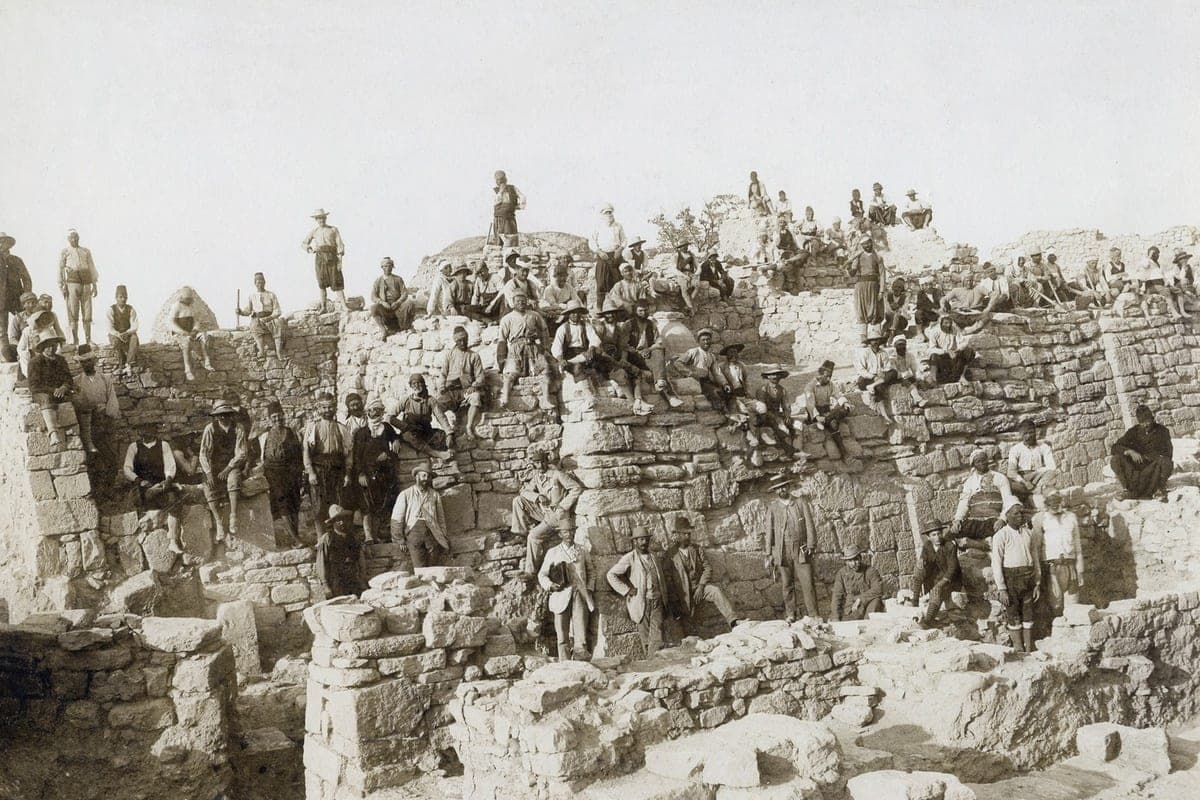
The ancient Troy of Troy (or Ilion) was located on the territory of modern Turkey, near the coast of the Aegean Sea. Today there is an archaeological site known as Hisarlık, a hill located in the province of Chanakkale. There you can see the excavated layers of the city, which was rebuilt nine times (Troy I, Troy II, etc.). In 2018, a modern, high-tech Museum of Troy was opened near the archaeological area, where artifacts found during the excavations are stored. And in the nearest to the excavations of the city of Chanakkale installed a copy of the “Trojan horse”, starred in the Hollywood film “Troy” with Brad Pete.
Ancient Bactria and Sogdiana lay on the territory of modern Uzbekistan, Tajikistan and Afghanistan. These are the lands where the Great Silk Road passed, and Hellenistic culture mixed with the Eastern. Today there are modern Uzbek cities that have preserved traces of their ancient history - Samarkand, Bukhara and Termez. Samarkand is the heart of Sogdiana, as its Registan Square with turquoise domes of madrasah reminds.
The capital of ancient Bactria was Bactra, a place near the modern Afghan city of Balkh, named after the river on which it stands. But Termez, now under the same name in the territory safe for tourism in Uzbekistan, was no less important for Bactria: it was one of the key urban centers of the country. When Alexander the Great conquered these lands, he founded a city near Termez and named it Alexandria on Ox (on the Amu Darya), planning to make it the eastern pillar of his empire. Later, in the Seleucid era, Termez even bore the Greek name Antioch. In modern Termez, you can see the excavations of ancient Buddhist monasteries, in particular the Fayaz-tepa complex, proving that Buddhism once flourished here, at the crossroads of various ancient worlds.
Since its ancient youth, the world has changed a lot, many cities turned to dust, but the spirit of these places has not gone away. For someone who stood among the ruins of Babylon, admired the sunset over Luxor or sailed the route of the Argonauts, the story ceases to be dry lines from the textbook, and the fairy tale is idle fiction for the smallest, miraculously embodied in no less fabulous reality.


