
The oldest residential building in the suburbs empty
The program of resettlement of dilapidated housing in the suburbs in action
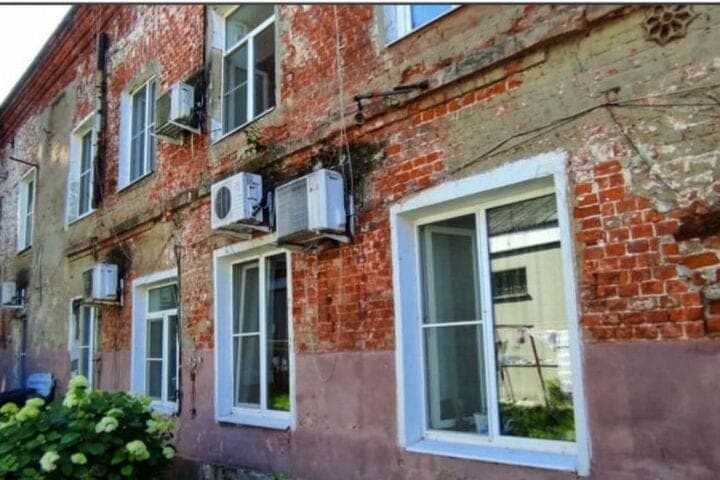
The courtyard of the house on the street Konstantinovskaya factory, 20, in Domodedovo today is the least like a residential. Piles of boards, pieces of plywood, trimmings of plastic pipes and rolls of old linoleum are piled up in the middle of the yard, next to them are stuffed white bags with construction debris. Behind this chaos of waste, the culprit of the celebration himself appears - a squat two-storey brick building with peeled plaster and wide-open windows in which the light no longer burns. Next to the front door is a blue sign with the address, and above it are dark, non-residential windows.
- So they were resettled 3 months ago, says a woman working in a public bath, which is located in the same complex of buildings. According to her, the last apartments were vacated around the end of the summer, and since then the yard is noticeably empty. “Now there are only workers, restoration is underway,” she adds.
Old walls
For many years, this house held the title of the oldest residential apartment building - not only in Domodedovo, but also, according to local historians, in the modern suburbs. But behind the label “old residential building” hides a much more interesting architectural history. According to historical reports, in 1880 there was not a residential building in the usual sense, but a production shop of the Konstantinovskaya wool spinning factory. Workers began to settle here much later, and the conversion to housing went without a project — without drawings and a single plan. The walls were reinforced with metal screeds running through: and it was not a decorative element, but a necessary measure to prevent the aging building from falling apart. According to the technical documentation, there was one entrance and 36 apartments in the house. In fact, this is a hallway-type dormitory, where a long passage ran through the entire former workshop, and rooms were sliced along it. The floors here are reinforced concrete - as noted in the archival documents, this is a late replacement, initially in the shop they were different, wooden or cast-iron.
The history of the place began long before the appearance of this building. In 1825, the owner of the village of Konstantinovo state councillor Ivan Fedorovich Pokhvisnev founded on the right bank of the river Rojay paper spinning factory - the first in the Moscow province and one of the first in Russia. At the same time, a three-storey brick production building and bedrooms for workers appeared, with them the future factory settlement began, which eventually became the basis of modern Domodedovo. Later, the factory repeatedly changed its profile and owners, until the last owner was Robert Koehler.
Methodist of the Domodedovo Historical and Art Museum Viktor Nikolaevich in an interview with the correspondent confirmed this data, but immediately said: “I, of course, not so sure that this is the oldest house in the suburbs.” According to him, the history of the place is inextricably linked with production: the countdown should be carried out since 1825, when a three-storey building appeared, and then the buildings became more, production developed, the number of workers grew. He also recalled that “since 1956, the village of Konstantinovo has entered the city of Domodedovo.” Regarding the purpose of the buildings, Viktor Nikolayevich noted: “Depending on the owners, this has been repurposed to one degree or another – both production and housing. Perhaps, yes, factory workers lived there.” And after the collapse of the USSR, he said, “the period of extinction has come.” But the house itself, even losing its production value, was not empty. Within its walls, people continued to live, and for them the wait for settlement stretched for decades. In 2020, a local resident of Ruslan told RIAMO in Domodedovo that twenty-four families living in the workshop in the industrial zone have been waiting for moving for more than thirty years, and then the final year of the municipal program for 2009-2020, which included their house, came. Complaints have been accumulating on profile portals for years. “He is already 140 years old in 2020, the walls are completely eaten by fungus and mold, cracks are everywhere, a public bath is constantly smoking in the window,” Evgeny wrote on the portal “Reform of Housing and Utilities”. Another resident, Anastasia, wrote in comments: “Sewages are always clogged, eternal surges of electricity. There's black mold everywhere. Rotten floors. The third generation grows up in this house and nothing changes.” In 2022, another local resident, Alexei, complained: “The house is more than 140 years old, it is impossible to live in it normally, we are afraid to live in it.”.
The saga with the relocation of the house at the Konstantinovsk factory lasted decades. In the autumn of 2023, the head of the city district signed a decree. According to the document, all residential premises were recognized as unsuitable for living, and citizens had to provide other comfortable apartments. Which is what happened this summer.
Legacy of income houses
But in other centuries-old houses of the Moscow region people continue to live - with unchanged tea in the kitchens, creaking floorboards and a fierce struggle for communal goods. These are not museum exhibits behind glass, but actual addresses, where the past and the present are intertwined so firmly that you can no longer understand where history ends and ordinary life begins.
Take at least Kolomna, which is rightfully considered the record holder of the region in terms of pre-revolutionary housing. Here on the street Jan Grunta, 28, lurks a modest one-storey house built in 1898. At first glance – nothing remarkable, but behind this simplicity hides an era. The building is 128 years old, and it still remains residential: five apartments huddle under its roof. Now, as the community “City district of Kolomna” here began major repairs – the builders have already taken up the facade, followed by the turn of the foundation and roof, and wooden elements will be impregnated with a composition that protects from moisture and damage. The project is designed individually to preserve the historical appearance. The main works are expected to be completed before the 850th anniversary of Kolomna.
And just a few blocks away, in Posadsky Lane, 13, time itself froze. "The Voivode's House" - the oldest civil building of Kolomna, erected at the turn of the XVII-XVIII centuries - today is experiencing a second birth. The monument of federal significance, which in the middle of the XVIII century was adapted for housing, and in the Soviet years turned into communal apartments, is now preparing for a large-scale restoration. For many years, the workshops of Kolomna artists were located here, and only now this place has a chance to regain its historical gloss.
If we talk about real communal houses, then there is no escape from Sergiev Posad. The apartment house of the Trinity-Sergius Lavra on the Avenue of the Red Army, 139, the construction of which began in 1914 under the project of architect Alexander Latkov (completed in 1917), and today remains residential. Once it was one of the most comfortable buildings in the city - with electricity, running water and telephone service; on the ground floor, according to the historical project, there were outlets - they are still there. A little further, on the Avenue of the Red Army, 50, among the multi-storey buildings as if frozen in time an ancient carved tower - the house of the philistine Alexei Gaginsky, built in 1912. This two-storey handsome man with intricate carvings, which is affectionately called the “house with a kokoshnik”, still remains residential and is considered an object of protection of the historical settlement. Inside was once a workshop where the Gaginsky family sewed clothes and hats for sale, and today it is just someone's house overlooking the Lavra domes.
Well, in Podolsk, the adaptation of historical heritage went along the most practical path. Many former merchant mansions here have long ceased to be residential, turning into institutions. A striking example is the ancient stone building on Revolutionary Avenue, 58, where the hotel and trade shop of the merchant Fyodor Alliluyev was once located. They say that in 1832 Nikolai Gogol himself stayed here, and today it is not the guests who make noise in these walls, but the visitors of the post office. Other merchant houses on Lenin Avenue and Revolutionary Prospekt – with Tolkushev and Prudushev trade shops – are also recognized as cultural heritage sites and continue to be used, although not always as housing.
Against the background of all this diversity, the house at the Konstantinovskaya factory in Domodedovo looks especially archaic and at the same time revealing. In Kolomna, Sergiev Posad and Podolsk, historical buildings are either carefully restored for housing, or adapted for museums and offices - and the Domodedovo two-storey building remains an example of purely utilitarian, working architecture, which has not changed its purpose for decades.


