
The Power of Unity: Historical Memory and Values of Belarusian Society Discussed at Minsk Town Hall
Historical memory, national values and the importance of unity for Belarusian society were discussed by the participants of the infostreme in Minsk.
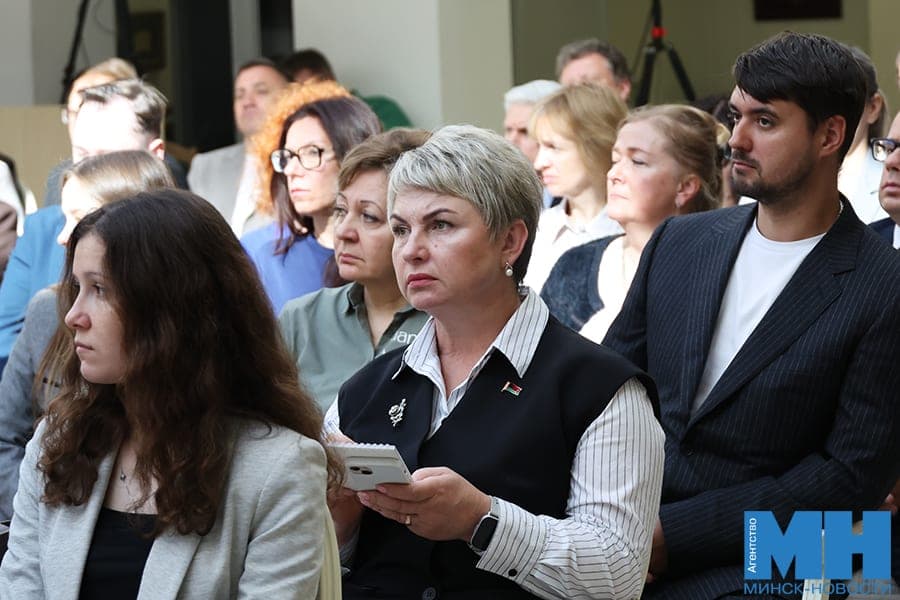
Historical memory, national values and the importance of unity for Belarusian society were discussed by the participants of the information stream in the Minsk City Hall on September 9, the correspondent of the Minsk-Novosti news agency reports.
The open dialogue was attended by deputy heads of organizations of the capital, who oversee ideological work. Nine studios on the basis of enterprises, organizations and educational institutions of the city joined the event in video conferencing mode.
The meeting was moderated by the head of the main department of ideological work and youth affairs of the Minsk City Executive Committee, a member of the Council of the Republic of the National Assembly of Belarus Alexander Lukyanov and the deputy general director of the Minsk-Novosti agency - the editor-in-chief of the newspaper Minsk Courier Kirill Kazakov.

Speakers were the Rector of the Academy of Management under the President of the Republic of Belarus, Doctor of Historical Sciences, Professor Denis Duk; an analyst of the Belarusian Institute for Strategic Studies, Doctor of Political Sciences, Associate Professor Svetlana Aleynikova and General Director of the Minsk-Novosti Agency, Chairman of the Board of the Belarusian Union of Journalists Andrei Krivosheev.
The focus was on historical events related to the reunification of Western and Eastern Belarus, as well as the modern understanding of national unity. The meeting participants discussed what social values are made of, why historical memory remains an important part of national identity and what role unity plays in preserving peace, stability and sovereignty of the country.

Speaking about the values of the Belarusian society, Aleinikova noted that the results of long-term studies of the Belarusian Institute for Strategic Studies testify to the rather stable orientations of citizens. Among the most important personal values are health, family and well-being, and among the collective are security, peace, stability, law and order.
At the same time, the same value orientation may have different content for representatives of different social groups. According to the expert, understanding these differences allows you to better see the common things that unite people, despite their age, profession or life circumstances.

Aleinikova stressed that value becomes really significant when it is confirmed in everyday life.
- It is very important to understand the mechanism of value formation. The first step is to understand the meaning of value. The second is what unites these meanings of different groups. And the third is to make sure that the value is confirmed by practice, the analyst shared.

D. Duk dwelled on the period when the Belarusian lands were divided, and spoke in detail about the situation of the population of Western Belarus within Poland in 1921-1939. The events of September 17, 1939, cannot be considered outside the broader context of the struggle of the Belarusian people to preserve their national identity. The division of the country affected not only the territorial integrity, but also the cultural, linguistic and social life of people.
“The most important thing is that every Belarusian, living today in a peaceful, hard-working country, having the wealth that our ancestors could only dream of, understands the cost of these achievements of modern Belarus,” D. Duc said.

He noted that the desire for unity manifested itself in various forms - from the struggle for the preservation of the language and culture to the public movement for the reunification of the Belarusian lands. As a result, the events of September 1939 became the most important stage in the history of the Belarusian people.
- Today, remembering the contribution of our ancestors to the cause of our unity, we must understand that this unity must be preserved, the rector of the Academy of Management under the President of Belarus added.

Special attention was paid to how historical experience relates to modern life. According to the participants of the meeting, National Unity Day is important not only as an opportunity to address the events of the past, but also as an occasion to talk about what unites Belarusians today.
Photo by Elizabeth Davidovskaya


