
Minsk announces results of social research on topical issues of social economic development of Belarus
The first part of the results of a large-scale comprehensive republican sociological study on topical issues of social and economic development of Belarus was presented by the ...
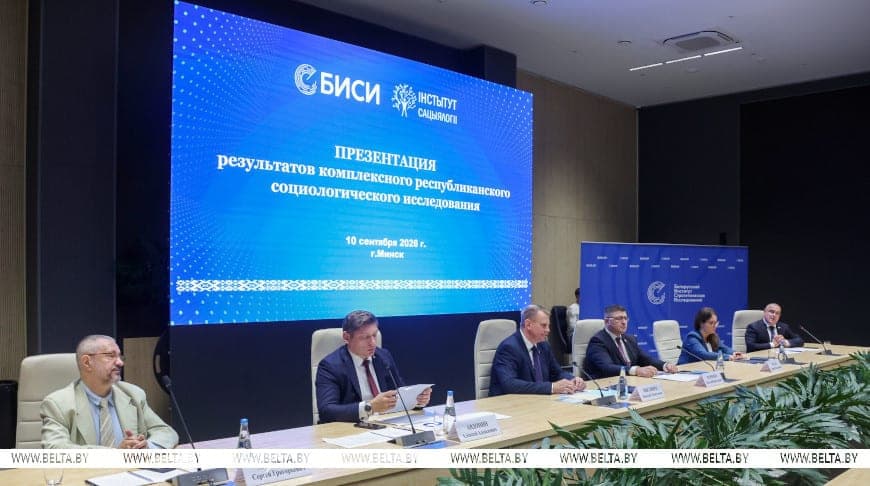
The first part of the results of a large-scale comprehensive republican sociological study on topical issues of social and economic development of Belarus was presented in Minsk on September 10, the correspondent of the Minsk-Novosti news agency reports.
Social research was conducted in July - August 2026 by the Institute of Sociology of the National Academy of Sciences of Belarus commissioned by the Belarusian Institute of Strategic Studies (BISI).
- Today we present the first part of our results. Let’s consider a block of socio-economic issues. Then there will be a block on the socio-political situation in the country. And the final presentation will be devoted to resonant issues. We studied various aspects of the social well-being of residents of our country, said Nikolai Myslivets, director of the Institute of Sociology of the National Academy of Sciences.
More than 2 thousand respondents representing all regions of the republic were interviewed. The study involved men and women, family and non-family people, with different levels of education, and the sample population represents the entire country. According to N. Myslivets, residents of 99 settlements shared with the interviewers their opinion on how satisfied they are with the living conditions in their village, what are their priorities in terms of work, leisure and value orientations.
- This palette gives us an opportunity to imagine what modern Belarusians live and how comfortable they feel in their native country, the director of the Institute of Sociology of the National Academy of Sciences of BelTA said.
The sociological survey involved 2,045 respondents, including 22.3% from the capital, 16.3% from Minsk region, 14.3% from Gomel, 14.2% from Brest, 11.7% from Vitebsk, 10.7% from Grodno, 10.5% from Mogilev regions. Among them, 78.9% of urban and 21.1% of rural residents.
Among the respondents – 55.3% of women and 44.7% of men. They belong to different age groups: 18.6% of respondents - 18-30 years, 51.8% of participants - from 31 to 57 years in women and 62 years in men, 29.6% - from 58 years in women and 63 years in men.
Higher education has 40.9% of respondents, vocational, secondary special - 44.2%, basic (up to 9 classes) or secondary general (up to 11 classes) - 14.9%.
55.4% of the study participants are married, 17.3% are single, 12.9% are widowed, 10.8% are divorced. 75.6% of respondents have children.
Photo by Belt


