How an Algerian footballer won the Nobel Prize
On Thursday, October 8, the Nobel Prize in Literature will be announced. 69 years ago, the winner of the award was Albert Camus, who at home was known not as a writer, but as a footballer, - about this in the material "RBC Sport"
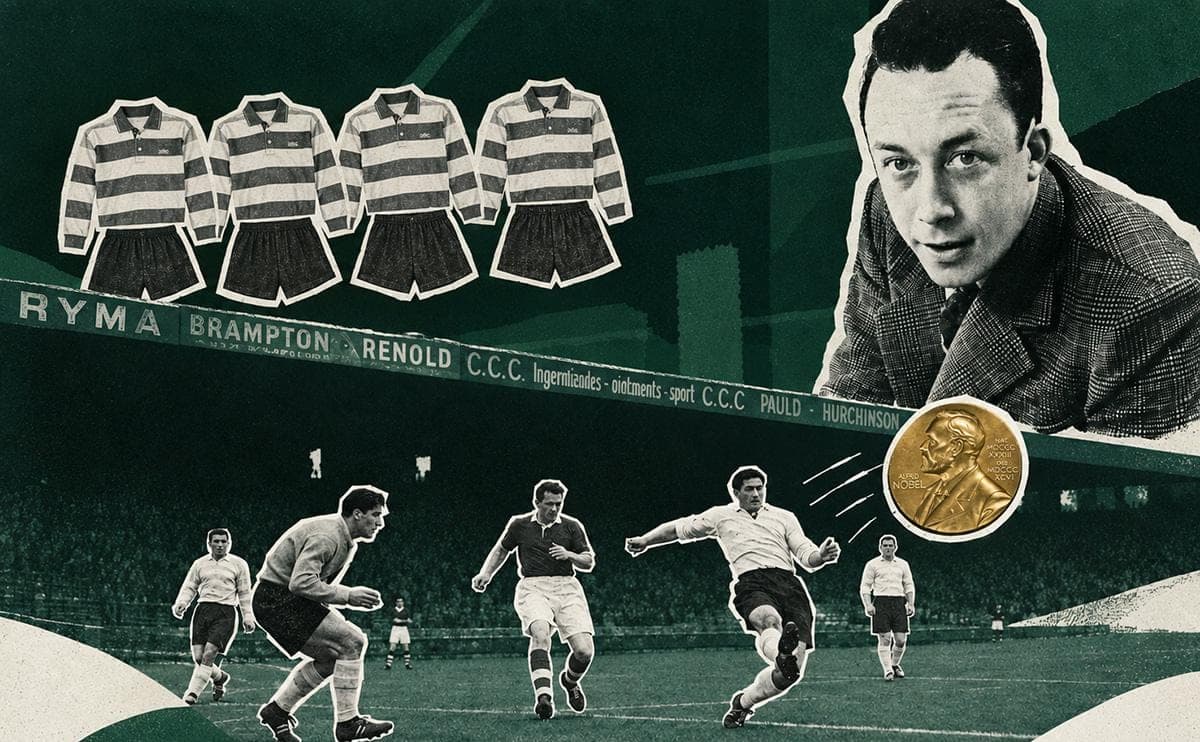
Writer and philosopher Albert Camus was dining at the Brasserie Lipp restaurant in the Paris district of Saint-Germain-de-Prés on October 16, 1957, when a representative of his publisher approached him with good news. The young man told Camus, 43, that he had been awarded the Nobel Prize in Literature "for an important literary work that illuminates with clear seriousness the problems of human conscience in our time.".
A week later, the writer gave an interview on this occasion to the French TV channel. But not in a cozy studio, but in the legendary stadium "Park de Princes" crammed to capacity. He was answering questions in the midst of a crowd of 35,000 who watched the match of the most popular at the time Paris club Racing Cleb de France against Monaco.
The interview begins with the moment Racing concede a goal due to a gross goalkeeper error. Then the camera switches to the stands, where Camus sits surrounded by spectators.
Reporter: Mr. Camus, what do you think of this mistake by the Racing goalkeeper?
Camus (ironically smiling): Don't blame him. If you were there, you would realize how difficult it really is. You have to go to his place to see how difficult it can be.
Camus knew firsthand what it was like to be a goalkeeper. He played in this position himself, although at first he played the opposite role of a striker.
The future writer performed in the 1930s for the student team “Racing University d’Algeria” (RUA). Match reports often praised Camus, noting that he played "boldly and with total dedication.".
After the Nobel Prize, Camus escaped public attention to Algeria for a while, and on the way from the airport, the taxi driver recognized him not as a famous writer, but as a former RUA goalkeeper.
In Paris, Camus started cheering for local Racing because the club played in the same blue and white striped form as the RUA. Perhaps there is another reason: Racing sports clubs in France were associated with the working class, and the writer was leftist until his last days, although he was disillusioned with communism.
Albert Camus (1913-1960) was a French writer, philosopher, journalist and one of the key representatives of the philosophy of the absurd and existentialism. Among the famous works: “The Stranger”, “The Myth of Sisyphus”, “The Plague”, “The Rebel Man”.
“Literary newspaper” claims that Camus played for the national team of Algeria – the matches were unofficial, since at that time Algeria was a colony of France. There is no official confirmation of this.
But Camus has always been associated with football in Algeria. In 1958, the eminent writer stood up for Algerian football players who were faced with the choice of going to the 1958 World Cup as part of the French national team or fighting for Algerian independence.
The leaders of the French national team of Algerian origin Mustafa Zitouni and Rashid Mekloufi at the last moment refused to participate in the 1958 World Cup and joined the National Liberation Front in the struggle for Algerian independence. Zituni for the same reason also refused to move to Real Madrid.
Camus was obsessed with football. At the time of his tragic death, he was working on the autobiographical novel The First Man, where he told the story of a boy named Jacques, who was passionate about football. An unfinished manuscript was found in the trunk of a crashed car in a fatal accident involving Camus. The novel states that Jacques became familiar with football by playing on poor Algerian pitches with "a ball made of rags.".
Like many of the greatest players, Camus found an escape from poverty in football. He was a war orphan raised in the slums of Algeria by an illiterate half-deaf widow. The grandmother constantly scolded the boy because of his passion for football, because there he spoiled expensive school shoes.
In 1930 he had to quit football. Tuberculosis put an end to the 16-year-old's dreams of not only a football career but also a military one. Some family members were convinced that tuberculosis was a consequence of playing in the cold. He had to avoid physical activity for the rest of his days.
However, Camus did not give up football. Before leaving Algeria, he wrote match reports. Before one, he also made a report on the poverty of Algerians from Kabylia, the coastal region where Zinedine Zidane's parents lived.
While working as a journalist in Paris, he also wrote football reports. While working as a Parisian teacher in 1941, he coached the school team.
When the Allies landed on the beaches of Normandy in June 1944, he was suddenly outraged by the cancellation of the championship match in France. And in 1949, during a lecture tour of Brazil, the writer's curators were delighted when their guest asked to attend a local team match.
A year before receiving the Nobel Prize, Camus gave an interview to the RUA Graduate Bulletin, where he said: “Everything I know for sure about morality and human duty, I owe to football and ... RUA.”.
In 1976, football fan and future Nobel laureate in literature Joseph Brodsky wrote: “Of all the laws issued by Hammurabi, the most important are penalties and corners” (“Developing Plato”). And according to the version of the writer Dmitry Bykov (recognized by the Ministry of Justice as a foreign agent), these lines bear the opposite meaning of Camus’ words: the superiority of animal, herd principles over law, a sense of morality and justice.
Camus died in a traffic accident in 1960 in his publisher's car at the age of 46. The Nobel laureate was buried in the French city of Lourmarin (the region of Provence-Alpes-Côte d'Azur). The coffin of the writer at the funeral was carried by local football players.