
How to score in tennis: a simple explanation for beginners
The system of scoring in tennis is different from most other sports: the match consists of sets, sets - from games, and inside the game is used for playing.
The scoring system in tennis is different from most other sports: a match consists of sets, sets - from games, and inside the game uses an unusual sequence of 15, 30 and 40. We understand how the tennis score is arranged and what the terms “evenly”, “more” and “tie-break” mean.
What the match is made of
Tennis match consists of points, games and sets:
glasses form a game;
game-set;
sets are a match.
The winner is the player who has won the required number of sets. For men, in Grand Slam tournaments, you need to win three games, and in women's matches and most other competitions, two.
How are glasses counted in game
Inside one game glasses are designated as follows:
0;
15;
30;
40;
winning the game.
For example, if a player wins two draws, the score will be 30-0. If one player wins two points and the other wins one, the score is 30:15.
Winning the game
The player wins the game if he scores four points and is ahead of the opponent by at least two. For example, a score of 40:30 means that the player has only to win the next draw. And at the score of 40:40 one point will not be enough - you need to win two in a row.
What is "even" and "more"
If both athletes scored 40 points, the situation is “even” (deuce). To take the game after the score of 40:40, the player must:
win the next point and get an advantage – more (advantage);
then take another prank.
If a tennis player loses the next ball with an advantage, then the score on the scoreboard again becomes 40:40. Such a game can go on for a very long time. Sometimes, more often in the doubles category, the rule of the decisive point is applied: after the score of 40:40, the next draw determines the winner of the game. This format is often called no-ad.
What counts as a net account
Usually the set is won by the one who first took six games with an advantage of at least two: 6: 0, 6: 2 or 6: 4. If the score becomes 5:5, then the tennis player needs to take the next two games - for example, bring the numbers on the scoreboard to 7:5. With the score 6:6, a tiebreak is held.
What's a tiebreaker
A tiebreak is a special shortened game in which points are considered ordinary numbers: 1, 2, 3 and so on. Usually, this segment is won by the one who first scored seven points and is ahead of the opponent by at least two: 7:3, 7:5, 8:6, 10:8, 12:10, etc.
If the difference of two points is not reached, the tiebreak continues.
In the decisive set, many major tournaments use a super tie break of up to 10 points with a score of 6:6. Therefore, before the match, it is important to clarify the rules of a particular competition. In doubles, a super tie break often replaces a full-fledged third game.
How to determine the winner of the match
The winner of a tennis match is determined by the games won. For example, with a format of up to two winning segments, the following results are possible: 2: 0 and 2: 1. If the confrontation goes up to three sets, then it can end with the score: 3: 0, 3: 1, 3: 2.
At the same time, the final protocol indicates not only the final score for the games, but also the result of each set: 6:4, 1:6, 7:6.
How to understand tennis score
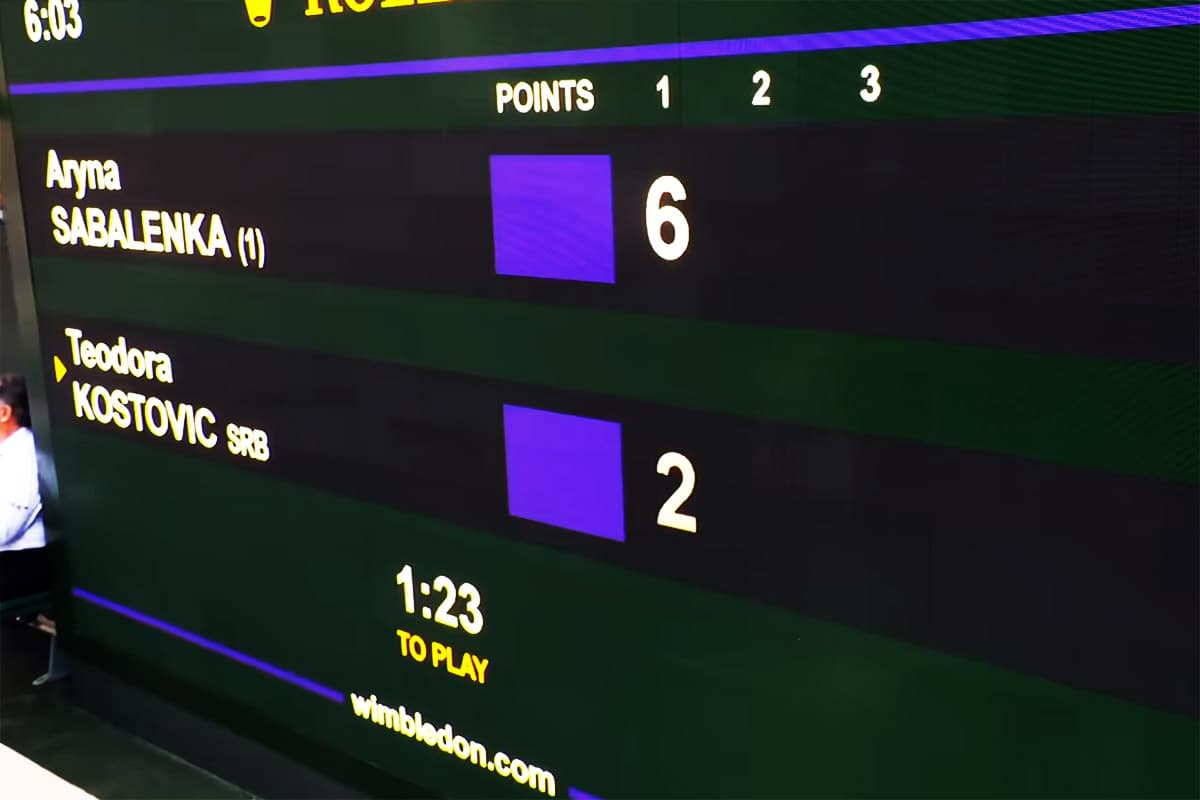
The numbers 6:4, 7:6 (9:7) on the scoreboard mean that:
the first set ended with a score of 6:4;
й the second set ended in a tiebreak;
in the tiebreak, the winner won with a score of 9:7.
If the match is still going on, then the current set score is usually displayed first, and then the result of the previous games.
At the same time, it is important to remember that in tennis there is no strict time limit for the whole meeting or for its individual parts. The match is completed only when one of the opponents wins by winning the required number of sets or gaining the required number of points within a particular segment.
The longest match in the history of tennis was played on June 22-24, 2010 in the first round of Wimbledon by American John Isner and Frenchman Nicolas Mayu. The meeting lasted 11 hours and 5 minutes. According to the rules of that time, there was no tiebreak in the fifth set at the Grand Slam tournaments - the duel went on until one of the players broke away for two games. The final game lasted 8 hours and 11 minutes. The final score of the entire match: 6:4, 3:6, 6:7 (7:9), 7:6 (7:3), 70:68 in favor of Isner. Thus, the tennis score may seem complicated only at first glance. The main thing is to remember its structure: points → games → sets → the winner of the match.