How Russian Artists Discovered Paris and the French Discovered Russia
In the House of Russian Abroad named after Alexander Solzhenitsyn opened the exhibition "Russian Paris"
Russia and France began their cultural enrichment at the most inopportune moment, immediately after the capture of Paris in 1814. The fact is that the Russian army did not perceive France as a hostile state: what can we say if our intelligentsia suffered from hallomania? The Russians were on their way to save a country close in spirit from the Napoleonic dictatorship, and the French were quick to see the liberators in recent “savages.”.
This is not fiction: friendly attitude was reflected in the art of those years. In the work of George-Emanuel Opitz, it is not difficult to notice this. In the painting “Cossacks on the Champs-Elysees in April 1814”, the German artist depicted the first timid acquaintance: French women bring children to look at foreign soldiers cooking at the stake. No hostility is observed, and the troops are stationed on one of the main streets of Paris! On the canvas “The Removal of the Statue of Napoleon from the Vendôme Column on April 8, 1814” we will not see popular unrest: onlookers peacefully watch the dismantling, the cavalier explains something to his lady, and the boys buy toys from the merchant.
The change in the attitude of the French to the Russians is well conveyed by the history of the artist Horace Vernet. Being a Bonapartist, he took the arrival of the Allied armies hard. But years will pass, and he will visit Russia, find many connoisseurs of art and customers here, and later even receive several high awards from Nicholas I. The exhibition features several works by Verne depicting Russian soldiers.
The biography of Prince of San Donato Anatoly Demidov is noteworthy. Although he was born and lived in France, he often donated money to hospitals, libraries and churches. During one of the rare trips to the Crimea, the patron was accompanied by the artist Denis-Auguste-Marie Raffe, who painted his portrait. Demidov is widely represented at the exhibition: in addition to portraits, there are several funny caricatures.
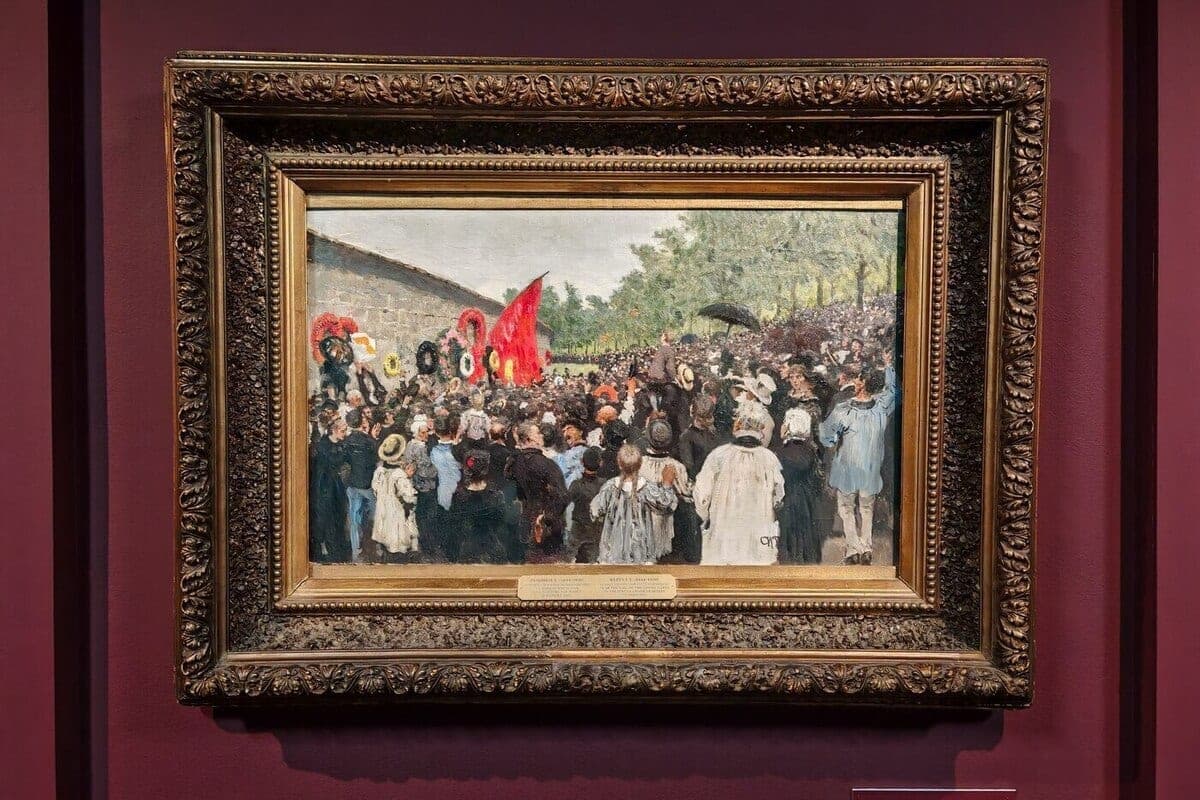
Of course, it was not only the French who painted the Russians. Our artists often visited their lands, where they captured many interesting scenes: dances and music of the evening city at the “Folk Festival on the Day of the Bastille” by Vladimir Makovsky coexist with a mourning procession at the “Annual Memorial Meeting at the Wall of the Communards at the Père-Lachaise cemetery in Paris” by Ilya Repin. A lot of landscapes: from the miniatures of Peter Gansky to the most detailed canvases of Apollinariy Vasnetsov.
The exhibited portraits deserve special attention. Among them are the images of Russian emperors on paintings, plates and engravings, physiotraces of officers (this curiosity was very popular among guests of France), as well as female images on the canvases of Yuri Leman and Konstantin Makovsky. The latter has repeatedly painted his wife, but separately I want to highlight “Fragile Creation” (Fragile) – an incredibly delicate, skillful sketch depicting his wife in the interior of the Parisian artist’s studio.
The exhibition "Russian Paris" covers several centuries of our common art with the French. And these days, it's a very bold but necessary gesture to remind you that boundaries for a real culture are only conventions, and ultimately mean nothing.