In memory of Shamsha Kaldayakov
A new award appeared in Kazakhstan: in August 2026, the republic established a state medal named after Shamshi Kaldayakov, a composer whose work entered the national cultural heritage of the country
Continuity
The new award will be awarded to Kazakhstanis for their significant contribution to the development of the country's culture. The establishment of the medal was timed to the birthday of the outstanding composer, author of the music of the national anthem of Kazakhstan Shamshi Kaldayakov.
And the other day, according to the established good tradition, on the stage of the Palace of the Republic, a concert “Shamshi alemi” was held, dedicated to the work of Kaldayakov. Familiar and beloved by many generations, the songs of the maestro, which have long become an integral part of the musical heritage of Kazakhstan, resounded from the stage performed by soloists of the Abai Kazakh National Opera and Ballet Theater. Behind the remote of the symphony orchestra was the son of the composer Mukhtar Kaldayakov - a musician, violinist, conductor of Abai KazNTOB. His participation gave the evening a special emotional and symbolic significance, combining the musical heritage of Shamsha Kaldayakov and the continuation of his creative tradition.
We met with Mukhtar Shamshievich near the Palace of the Republic to remember his father, to talk about why it is important to preserve and popularize the heritage of one of the best composers of Kazakhstan.
- My father’s works have always been of a high artistic level. His songs were performed accompanied by the pop and symphony orchestra of the State Television and Radio of the Kazakh SSR, the works were heard throughout the country and broadcast throughout the Soviet Union, says Mukhtar Kaldayakov. Three years ago, we founded the Shamshi Alemi Foundation, whose main activity is to organize concerts, promote and develop my father’s creative heritage.
Not afraid of criminal prosecution
Shamshi Kaldayakov was born on August 15, 1930 in the state farm "Temir" of South Kazakhstan (now Turkestan) region. Today it is the village of Shamshi.
- Father believed that the birth near the place where the great scientist and thinker al-Farabi was born, where he spent many years thinking about the meaning of life of Sufis Khoja Ahmet Yassawi, helped him to prove himself in music, says Mukhtar Kaldayakov. He was proud to be a fellow countryman of these outstanding personalities, believed that the Turkestan land has a special spiritual significance, as well as music, which has become part of the world that forms the spiritual basis of our life.
Shamshi Kaldayakov’s creative heritage includes more than 300 works and about 50 songs, and the first was “Ak Keles”, which he wrote while studying at the College of Livestock and Veterinary Science. By the way, in the postwar years Shamshi Kaldayakov worked as a veterinary paramedic. Once, seeking to help fellow villagers who were going through a difficult time, he took a big risk: he distributed part of the flock to the residents of the village. He could have lost his freedom, but fortunately that didn’t happen, and people were able to survive the hunger years.
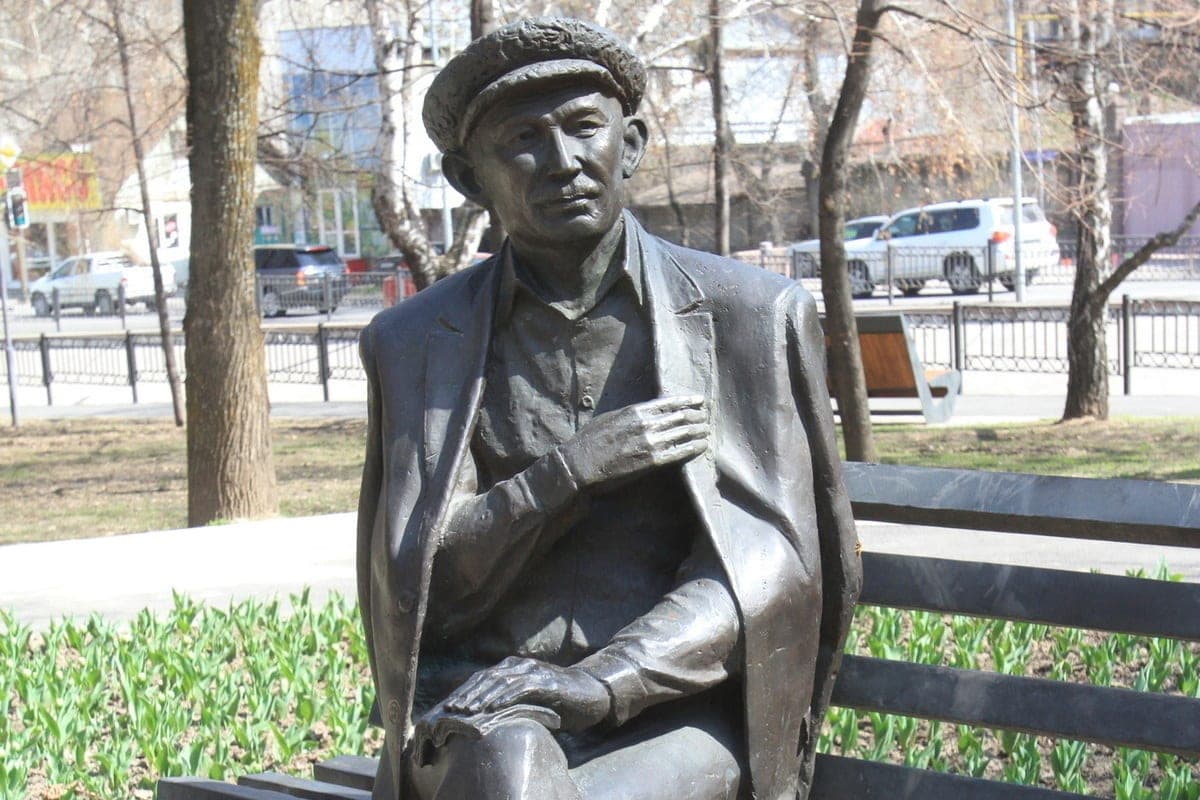
In Shymkent, he also lived, in memory of Shamshi, a street and a philharmonic are named there. There is also a monument installed on the balcony of his house.
Shamshi Kaldayakov left behind not just a huge musical heritage - he gave the people songs that sound love for their native land, human kindness and faith in the future of Kazakhstan.
A special place in his work is occupied by the song “Menin Kazakhstan” – “My Kazakhstan”, which became the anthem and symbol of the country. He wrote it at the age of 26 on the poems of 21-year-old poet Zhumeken Nazhimedenov. Performed by Jamal Omarova, the song was often played on the radio and gained extraordinary popularity throughout the republic.
Also among the favorite songs are such lyrical works as "Ak sunkarym", "Karakoz", "Kayyikta", "Ak bantik". Each of them has its own story. So, “Kyz sagynyshy” is dedicated to Mayra Aimanova, at that time the young wife of actor Asanali Ashimov. And “Tamdy Aruy” on the poems of Kadyr Myrzaliyev Kaldayakov dedicated Kazakhs who lived in Uzbekistan. “Suluy cheese”, “Arys Zhagasynda” appeared from the impressions received during travels on the Kazakh land.
His songs were performed by almost all generations of Kazakh singers - from the famous in the 1950s Rishat Abdullin to young artists of our time. But the main performer of Shamshi’s music remained the people themselves: his songs quickly went beyond the concert halls and became part of everyday life. At the same time, the most popular composer of Kazakhstan remained outside the official professional community for a long time. Recognition came to him only after his death - in the years of independence of Kazakhstan, when he was posthumously awarded the title of member of the Union of Composers. The title of People's Artist of the Republic Shamshi Kaldayakov received just two months before his death.
Many do not know that Kaldayakov’s son is a conductor
Asked how many people know that he is the son of the famous Shamsha Kaldayakov, Mukhtar Kaldyakov replied: In my environment, everyone knows, and so no one has or is interested. Since childhood, my life has been closely linked to music. I learned to play the violin, grew up with my father's songs. In my youth, I worked as a violinist in the orchestra of the Zhambyl State Philharmonic. Therefore, the continuation of the family’s musical tradition, the preservation of my father’s legacy and the opportunity to introduce new generations to his work for me is not just a job, but a lifelong work. My father raised me and my brother. During his lifetime, I graduated from the Conservatory, then entered my second higher education. He never dictated anything to us or spoke to us edifyingly; he was himself an example of an organized, disciplined man. Therefore, for us, studying at the school named after K. Baiseitova, and then at the conservatory was perceived quite naturally. He never forced us to go down that path - we just grew up in an atmosphere where education, music and work were an integral part of life. At the same time, he was a very soft man, but behind his softness there was an inner strength, a core, an amazing organization. He knew how to be demanding first of all to himself, was always busy with his musical creativity. Music wasn’t just a profession, it was his life. And, probably, it was his attitude to music, work and life that brought up the main thing in us: the desire to develop, work and remain faithful to his work. He talked about his business trips and talked a lot about discipline. Without him, we could watch TV, but in his presence we tried to behave with special respect. The house was always clean and neat. Everyone had their own area of responsibility, their own place, and everything was in order. For him it was very important that we constantly do something, if not music, then another useful thing. Perhaps that is why we have formed an understanding since childhood: time is a value, and it should be used wisely.
Is it just the king of the Kazakh waltz?
Shamshi Kaldayakov is called the king of the Kazakh waltz, and a stereotype has developed around his name. What if you look at his work from the other side?
- In fact, Shamshi Kaldayakov is primarily a great melodist and songwriter. His work is mainly songs. For comparison: many composers have two or three, five songs, while they write operas, ballets, cantatas, symphonies, instrumental plays. If we take Mozart, we know his piano works, symphonies, cantatas, oratorios, the famous Requiem. But he has a collection of songs that few people know about and almost no one performs them. I looked at them – they are quite static works, they do not have the flightiness, the incredible melodic beauty, harmonic richness and polyphony that we used to associate with Mozart. It was in this, in my opinion, that his genius manifested itself - he conquered the whole world. But his songs did not receive such fame. The song is a very complex genre. We know composers and songwriters, for example, Paul McCartney, a contemporary of my father, Yuri Antonov and others. They have beautiful songs that have become part of musical culture, but they didn't write Swan Lake like Tchaikovsky. Rachmaninoff has wonderful romances, but here we see a very special creative destiny. My father came to music as an adult. He graduated from a military school, served on Sakhalin and in the suburbs, and when he entered the conservatory, he was a formed personality. And the man of the song he was from childhood - felt its nature, soul. He was lucky to hear his own performances on the country’s biggest stages, including on the radio. It was very important: his songs really lived, sounded, reached people and became part of their lives.
That is why he is called the king of the Kazakh waltz. But this definition itself came a little later and, rather, was connected with the tradition of calling outstanding authors certain titles. In European musical culture, for example, there is the image of the king of waltz Johann Strauss. And in Kazakhstan, our famous musicians picked up this definition and called Shamshi the king of the Kazakh waltz, in particular, on his 60th anniversary. And we can really call him that by right - Shamsha Kaldayakov has many famous waltzes, beloved by the people, this genre occupies a special place in his creative heritage.
Charles de Gaulle and the meeting with Kunaeva n
Many people know that Shamshi Kaldayakov had a personal meeting with Dinmukhamed Akhmedovich Kunaev, First Secretary of the Communist Party of the Kazakh SSR - the leader of the republic, but almost no one knows what French President Charles de Gaulle influenced this event.
- During one of his trips to France, Kunaev met Charles de Gaulle, and suddenly de Gaulle asked: “How is Mr. Shamshi Kaldayakov?” Kunaev replied that he was fine, but returning to Kazakhstan, he decided to ask the composer himself about how he was doing and invited him to his meeting. The famous composer Nurgisa Tlendiev helped to find Shamshi Kaldayakov and lead to the first leader of the republic. According to his father's recollections, he was supposed to spend no more than two minutes in Kunaev's office, but in the end the conversation lasted about fifteen. Of course, Dinmukhamed Akhmedovich Kunaev, my greatest respect for him, told his father that Charles de Gaulle was interested in his fate and asked about him. Having asked how and where the composer lives, Kunaev ordered to allocate an apartment to our family in the house on the central street of Lenin. We lived there for the last few years and my mother still lives there. There is a memorial plaque on the house. Now it's Dostyk Avenue.
That's the story. Shamshi Kaldayakov’s music remains a living part of Kazakhstan’s cultural space. His melodies continue to sound from the stages of concert halls, transmitted from generation to generation and remind of the unique beauty of the Kazakh song.