Old age or specialty? What is valuable to a book collector
Why do so many old books cost a penny and why is it not the book that is more interesting sometimes, but the paper from which the cover is compressed?
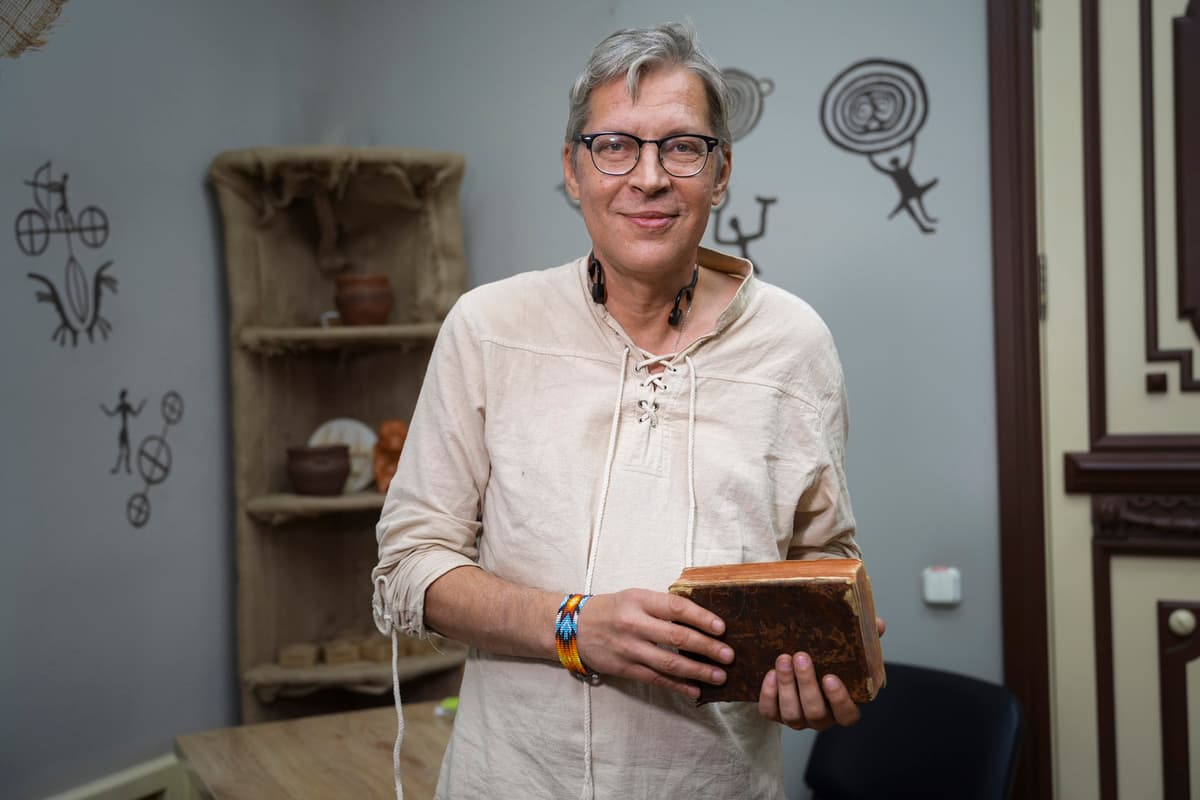
On Radio Science in the latest issue of the author’s program of Andrei Trushnikov “Talking” the guest was a collector, candidate of philosophical sciences Andrei Lavrov. "MK Chelyabinsk" publishes one of the fragments of this conversation, the recording of which took place at the site of the museum-reserve "Arkaim".
Waiting for takeoff
Andrey Gennadyevich, everyone in the frame is used to seeing you as a political scientist who analyzes all kinds of events. But besides, you're a collector of all sorts of publishing stuff. I wouldn't say you're just a collector of books, because I've seen old magazines, old newspapers, and postcards in the house.
- Like Umberto Eco. For me, the sample of his library is entwined, absolutely huge. And he did collect all the yellow press and the like.
- But still about collecting books. The book as a collectible, how popular is it today or has it already been forgotten in the mezzanine?
- In fact, it's one of the biggest declines since I started collecting books. In the eighties, nineties, for us, the book was something completely different. It wasn’t just about collecting books. It was a source of information. I personally knew that I would not find a book anywhere else, for example, Lazarev, Losev or Berdyaev. They were not published in the USSR. From here, I had an appeal to the search for pre-revolutionary books. Today's generations don't want to fill their apartments with books, they want empty space. I understand that perfectly, and in this case there is no judgment, it is just a different way of life.
- That is, you bought and bought this book not because the date there was a distant written and small circulation and the cover was shabby, but because there is a specific name and text there?
- That's right. It was necessary then, what was not published. We had filters. Much was not published in Russian after the revolution.
- But any downturn usually always ends in a new upswing, of course, unless there is a complete doom. Sometime in the foreseeable future, will we see a rise in interest in book collections?
- He will be reborn, take a different form. You know, I don't want to be pretentious, but it could be like collecting pipes, let's say. Every phone you pick up and remember who picked her up, you have a real idea who she was with or could be with. And books, too. I have a small volume. It was published in Holland in 1694. And I understand that Peter the Great could even buy it there.
Prohibited value
- How do you feel about a book that was published in 1694? Awe?
- Yeah, a little. I take it in my hands with awe. It's not even a thrill, though. I just want to sit in the chair calmly, bend over with a magnifying glass.
- For a collector, what determines the value of a book? As a layman, I can only say that, most likely, the circulation matters, the publisher, the year of publication.
- A ban on it, for example, makes the book valuable. I have several books that were banned in Russia. And they're immediately considered interesting. A book with autographs or with the author's inscriptions for collectors has significance, the unique situation in which it was published. There was such a textbook, “Gray Horse” was called, all philosophers of the Soviet era studied it. Now it is not even close to being useful as a textbook, time has passed. But at the same time, one of his volumes is worth some crazy money. You know why? This volume, devoted to German classical philosophy, was published in the early summer of the forty-first year. It does not have historical value, but, say, the value of the moment.
Rareness matters. It’s like in philately, when the entire circulation was destroyed, and only two stamps remained. Therefore, they are considered valuable. The same thing happened with the collection “From the Deep”. In it Ilyin and all our philosophers were gathered together. The Bolsheviks came, were outraged, the authors were sent to the steamer and the circulation was destroyed.
Some traces of existence also make the book valuable, or some of its features. I have my first book on philosophy in Russia. It was published in the 18th century under Emperor Catherine the Great. But for whom the book is written - "For the Tsarevich Grand Duke Pavel Petrovich." In fact, from a scientific point of view, the content of this book is not of particular value, it is, in general, a translation of one of the Protestant books from among moralizing. Here's the interesting thing. Then they made cardboard for covers from what had not previously been sold, dusted in warehouses, just pressed old books and made cardboard from them. So on the cover of this book pressed something unique - the first page of the first ode of Lomonosov on the ascent of Elizabeth. This sheet is more expensive than the whole book.