The shrine arrived in Kazakhstan
The Orthodox Church of Kazakhstan found the cross of the XVIII century with particles of relics of the revered saints of God – Poshekhon cross
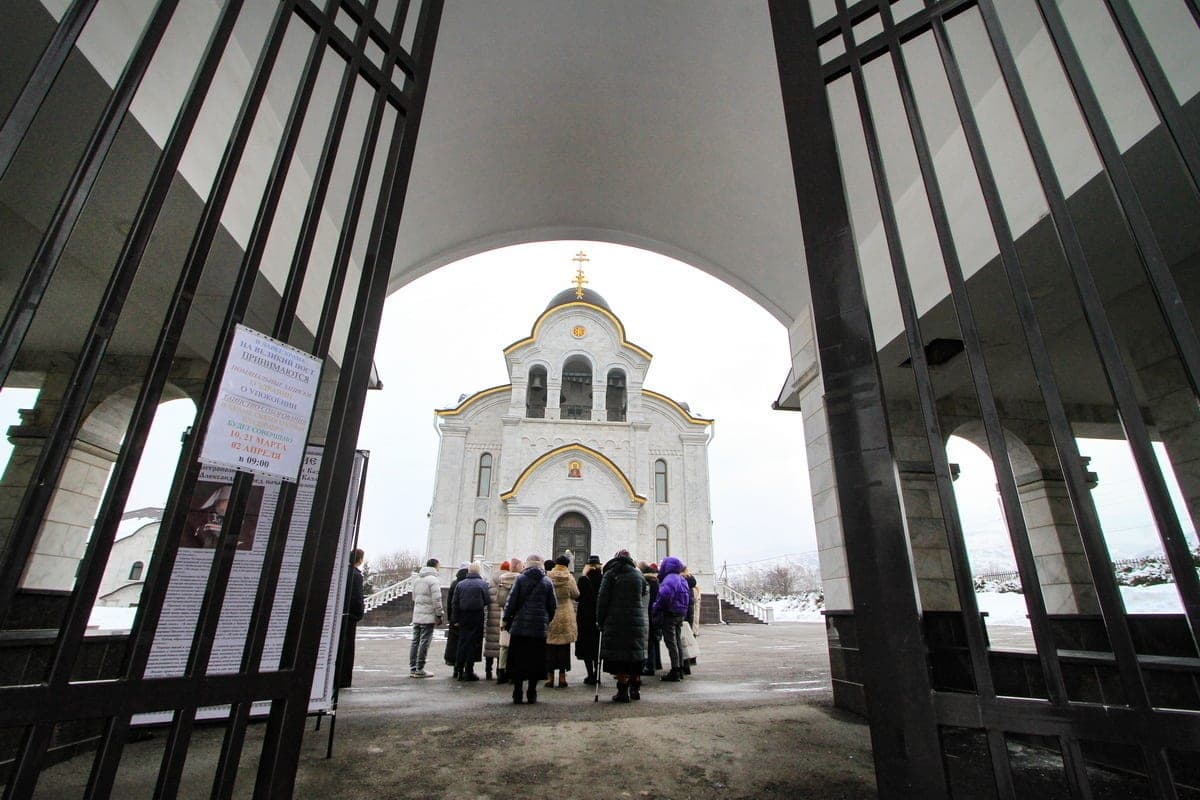
On September 27, Almaty met a special shrine with a centuries-old history. It is dated approximately, and has a special spiritual significance for believers. The cross was handed over to the church by the parish ctiator Sergei Kiselev. The shrine is intended for prayerful worship of believers and will become one of the relics to which parishioners will be able to turn for spiritual support, help in life trials.
The relic was transferred to the church at the request of Metropolitan Alexander of Astana and Kazakhstan. The silver cross was made in 1791 by the master A. Tukalov in Yaroslavl and was located in the Pyatnitsky Church of Poshekhonje. The inscription on the cross reads: “This Life-Creating Cross with Relics contributed to the Friday Church in Poshekhonya, in the Beloselskaya volost, from the parishioner and landlord Matryona Muratova, from zeal for the Holy Church, to eternal memory.”.
After the revolution of 1917, the shrine was taken abroad, and for more than a century it moved around Europe, remaining for a time in Germany, then in Britain, until it was acquired for Kazakhstan.
The solemn introduction of the shrine took place on the feast of the Exaltation of the Holy and Life-giving Cross of the Lord.
The special significance of the Poshekhon cross is given by the composition of the relics of saints revered by Orthodox Christians for many centuries: the Holy Apostle Andrew the First-Called, St. Nicholas the Wonderworker, the Great Martyr Barbara Iliopol, St. Alexis - Metropolitan of Moscow and All Russia, the Blessed Prince Roman of Uglichsky and the Reverend Nile of Stolobensky.
The appearance of the Poshekhon Cross in Almaty has not only ecclesiastical, but also historical and cultural significance. The cross belongs to the number of ancient Orthodox shrines and is associated with the tradition of veneration of holy relics - one of the most important components of Orthodox spiritual culture. In the Orthodox tradition, the relics of the saints are perceived as evidence of the reality of the Christian faith and the continuation of the spiritual presence of those who, through their life, feat and service of the Church, have become an example of Christian holiness. That is why particles of relics are placed in crosses, icons, relics and other shrines intended for prayer worship.
The very name Poshekhonsky cross is associated with the historical area of Poshekhonje. Such shrines are part of the centuries-old history of Orthodoxy and preserve the memory of generations of believers, for whom the cross was not only a symbol of the Christian faith, but also a visible testimony of spiritual continuity.
Of particular interest is the composition of the shrine. Each of the saints, whose particles of relics are placed in the Poshekhon cross, takes its place in the history of Christianity and the Orthodox tradition.
Andrew the First-Called is one of the 12 apostles, the first called by Christ to the apostolic ministry. His name is associated with the preaching of Christianity among the peoples who lived in the territories of Eastern Europe and the Black Sea region.
Nicholas the Wonderworker is one of the most revered saints of the Christian world. He lived in the III-IV centuries and was bishop of the city of Myra Lycian. Church tradition has preserved numerous testimonies of his mercy, help to people and protection of those who were in trouble. The veneration of St. Nicholas spread far beyond Asia Minor and became one of the most stable traditions of the Orthodox world.
The Great Martyr Barbara of Iliopol is an early Christian saint who accepted a martyr’s death for confessing her faith. Her veneration for centuries has been preserved in various Orthodox traditions, and the image of St. Barbara is associated with courage, loyalty to the Christian faith and spiritual steadfastness. With special trepidation, she was venerated by the canonized Nicholas of Almaty.
Alexy, Metropolitan of Moscow and All Russia, is one of the outstanding Russian hierarchs of the XIV century, who played a significant role in the history of the Russian Church. He was a metropolitan at a time when Moscow was gradually strengthening its importance as the spiritual and political center of Russia. His church ministry fell on a difficult epoch, and the memory of him is preserved as a wise pastor and prayer-giver.
Prince Roman Uglichsky. His name is associated with Uglich and the history of the princely dynasties of Russia. The veneration of noble princes in the Orthodox tradition reflects the idea of the possibility of Christian service not only in monasticism or spiritual rank, but also in state and public life.
St. Nile Stolobensky is a saint of the XVI century, famous for his strict ascetic life. He asceticized on the island of Stolobnoye on Lake Seliger, where later the Nilov Desert appeared - one of the famous spiritual centers of Orthodoxy. The memory of the Monk Nile is especially connected with monastic feat, prayer and ascetic life.
The transfer of the Poshekhon Cross to the Vladimir Church opens up an opportunity for Orthodox believers in Almaty to venerate a shrine connected with several epochs of Christian history at once – from the apostolic time and the first centuries of Christianity to the history of the Russian Church.
In this sense, the cross unites the memory of different generations of Christians and different spiritual traditions. In one shrine there are particles of the relics of the apostle, ancient martyrs and saints, Russian princes and saints.
The appearance of an ancient shrine in Almaty also becomes part of the ongoing history of Orthodox life in Kazakhstan, where parishes, churches, monastic communities and traditions of veneration of Orthodox shrines have been formed for decades.
Now the Poshekhon cross will be located in the Vladimir temple of Almaty, giving believers the opportunity to come to the shrine for prayer and worship.
The finding of the cross in Kazakhstan is also a meeting of modern church life with the spiritual heritage of past centuries, preserved in the shrine of the XVIII century and transferred today to new generations of believers.
The sacred gift will be located in the Vladimir Church next to the main temple shrine - the Tikhvin Icon of the Mother of God.
The Church of Holy Equal-to-the-Apostles Prince Vladimir is located in Almaty, the foothills of the Trans-Ili Alatau, on the outskirts of the Baganashyl microdistrict. It amazes with its architectural grandeur and skillfully executed interior details.