Economist Maslennikov explained why Nobel gave the Americans
The winners of the prize in economic sciences in memory of Alfred Nobel for 2026 were two American economists – Robert Hall (83 years) and Michael Woodford (71 years)
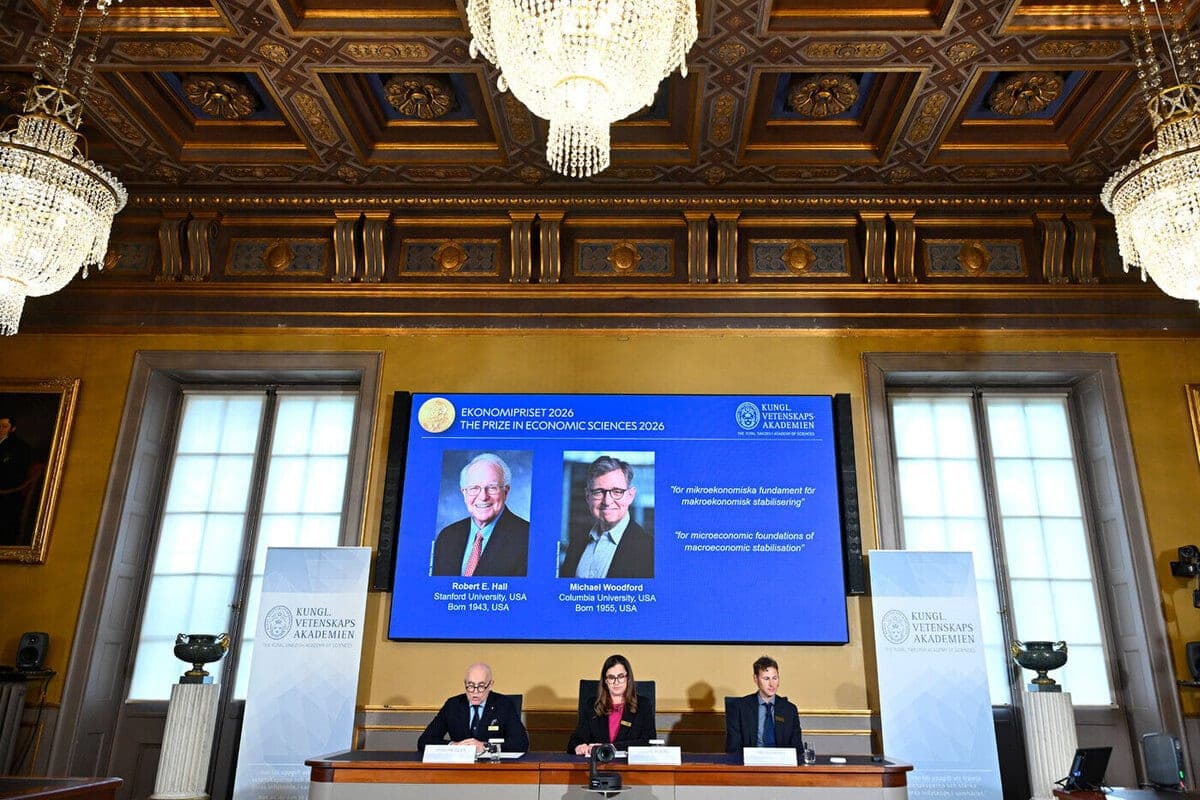
The main merit of Hall and Woodford is that their research is highly applied. As explained in the press release of the Nobel Committee, the laureates developed new macroeconomic models that have made it possible to overcome large-scale crises much more effectively, “to smooth out the ups and downs of the economy through timely fiscal and monetary measures.” Their work has been extremely useful and in demand during the pandemic and energy volatility of recent years.
The prize in economics ends the Nobel week, which traditionally takes place in early October. Unlike all other nominations, this award was not provided for by the will of Alfred Nobel, it was established in 1968 by the Central Bank of Sweden. The winners are selected by the Royal Swedish Academy of Sciences and the awards ceremony takes place on December 10. This year, in honor of the 125th anniversary of the award, the prize fund was increased to 12 million Swedish crowns (approximately $ 1.2 million) per category.
“In the case of Robert Hall and Michael Woodford, the Nobel Committee hit the top ten, in the bull’s eye,” says Nikita Maslennikov, a leading expert at the Center for Political Technologies. On the one hand, we are witnessing a slowdown in global GDP growth and a huge number of various shocks. And just now, in 2026, two of the most powerful shocks have converged and intertwined – supply (due to interruptions in the supply of Middle Eastern oil) and demand (due to the forced introduction of artificial intelligence, AI). Since nothing of this magnitude has happened before, this is a major challenge for macroeconomists. The situation is somewhat comparable only to the effects of the pandemic, and it was then, in fact, in 2020, that Hall and Woodford made their fiscal policy recommendations to both central banks and governments.
What does the Nobel Committee define as “microeconomic foundations”?
In fact, the committee pointed to the fact that the formation and formation of a new technological order in the world economy begins at the micro level, with the actions of each individual company, primarily in the field of AI. This process has developed, it has its downs and ups, but it is already irreversible. And it will determine for regulators the entire configuration of their further economic policy. In a sense, the current Nobel Prize in Economics continues the line of previous years, including 2025, when the awards were awarded to Americans Joel Mocir, Frenchman Philippe Agion and Canadian Peter Howitt – “for explaining innovative economic growth.”.
In recent years, the laureates have consistently been those who study the impact of structural transformation on the global economy, on the behavior of central banks and governments. Their work allows us to more correctly assess the likelihood of risks (such as the collapse of the AI investment bubble), and, most importantly, the consequences of these risks.
So all economics is moving in the direction that Hall and Woodford have indicated? Not just them, though.
The choice of the Nobel Committee is far from accidental. The 2026 prize does not apply so much to these two scientists as to the whole vector in the development of economic thought. We are talking about many problems that are not yet fully understood and studied, but require close attention. These are, in particular, the consequences of the widespread use of neural networks, which significantly increases the risks of corporate (due to the debt of companies) and state (due to underreceipt of income tax for the state budget) debts. Governments, the IMF, the World Bank, and other international financial institutions face fundamental questions: how to respond to shocks, and which is better – targeted assistance to households or subsidies to economic sectors?