
The Beast of Monuments: From Lenin to Solzhenitsyn
There is such fun in Russia – to argue about the past, events and figures
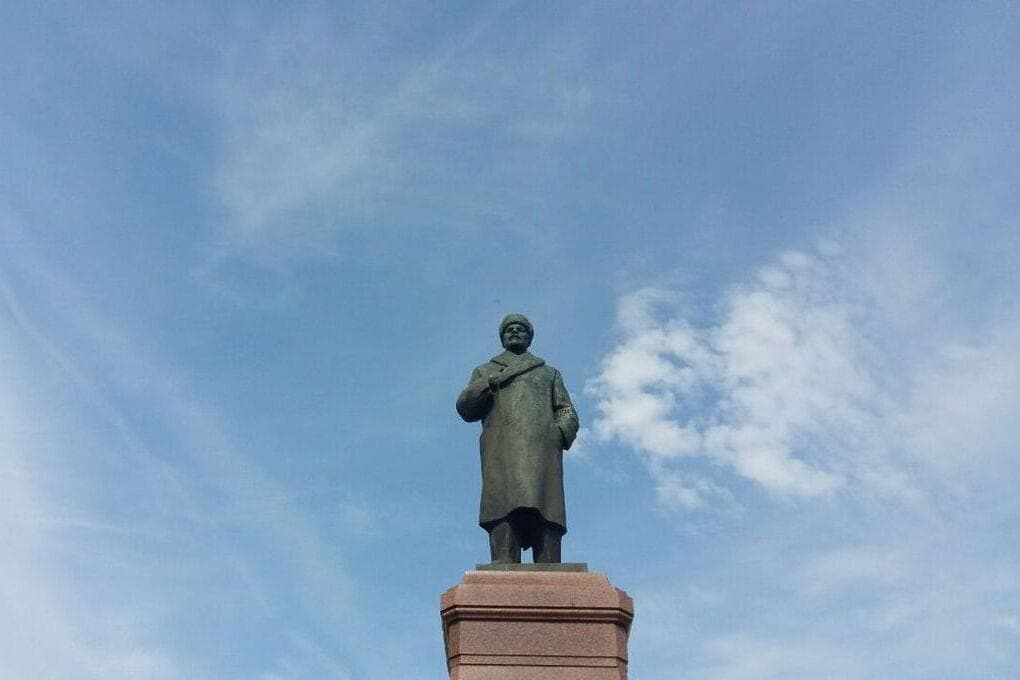
Something similar happens regularly. Disputes around the monument to Dzerzhinsky, for example. Around the monument to Ivan the Terrible. And, of course, Stalin. And, of course, Nicholas II. People collide with their foreheads, because they are faced with these foreheads, and sparks are carved, from which sometimes fires. So a new scandal ripened: in Vladivostok removed the monument to Alexander Solzhenitsyn. Here we go.
However, as the classic said, there are nuances. The monument to Solzhenitsyn was not completely eliminated, but moved from the Ship Embankment, where it was located since 2015, to the square of Faith and Hope. And then they actually returned to the site to do the dismantling later. So what's all this for? We were informed that the Pacific Fleet leadership and veterans demanded to remove the monument. They thought it was inappropriate. There was another explanation: historians and local historians believed that finding the monument to Solzhenitsyn on the embankment was incorrect, since he arrived in Russia in 1994 after returning from the United States, where he had lived in exile since 1976, not by ship, but by plane.
Soon it turned out that the claim for the demolition of the monument to Solzhenitsyn in Vladivostok was filed by a resident of Tynda Andrei Guk – a businessman, like a poet and an active participant in lawsuits. Such lovers of lawsuits are often found in Russia - we know. The question is: why did the authorities agree to move the monument to Solzhenitsyn? And there is a much larger layer of aspects behind this than just the initiative of one particular person. I would call them the damned ones that come up whenever we in Russia face the past and fight in the present.
First, the figure of Alexander Solzhenitsyn himself. It's been a long time. This is what is often blamed on him. Solzhenitsyn hated the people and wished them dead. He proposed dropping a nuclear bomb on the Soviet Union. His texts were prepared in secret CIA laboratories. In summary, the main accusation against Solzhenitsyn is a traitor who was responsible for the collapse of the Soviet Union.
The Soviet Union died, and this led to the tragedy of millions of people. And it really is. Is Alexander Solzhenitsyn guilty? Including. But then I recall the phrase of another noble overturner of the foundations of Herzen: “We are not doctors – we are pain.” When Solzhenitsyn’s novel “One Day of Ivan Denisovich” was published in 1962 in the magazine “New World”, headed by Tvardovsky, a bomb exploded. Why?
Yes, because what was described there hit pain points. And if it were divorced from reality, it would not have such an effect. It so happened that writers diagnose pain by putting, forgive the stamp, damn questions. Was Leo Tolstoy a traitor to the Russian Empire, who published The Sevastopol Story? Was Thomas Mann a traitor to Germany when he wrote Dr. Faustus? What about the Frenchman Louis Ferdinand Selin? That's a really nasty guy!
Solzhenitsyn was never an enemy of the Russian people. To say that, to say the least, is irresponsible. Solzhenitsyn was primarily an enemy of communism – ideological, furious, consistent. And yes, unfortunately, sometimes his actions can be described by the famous phrase of Alexander Zinoviev: “They went to communism, but got to Russia.” Or I would say that, to the Russian people. However, Solzhenitsyn is distinguished from other anti-Soviets by one very important quality: he was a truly ideological man.
Yegor Letov has a phrase: “I will always be against.” It can largely explain the psychology, mode of action and way of thinking Solzhenitsyn. He rebelled against communism. Then he moved to the United States. They gave him everything, put him in a “golden cage” – brand the Soviet Union for the rest of his days and live comfortably. What did Solzhenitsyn do? It has fallen on the American way of life, on capitalism. Read his articles, speeches of the eighties of the last century.
After that, Solzhenitsyn returned to Russia, so he thought, with triumph. He believed and hoped that he would be listened to as a prophet. Solzhenitsyn was traveling around Russia and people cheered him. But the authorities didn't care. Look at Solzhenitsyn’s speech in the State Duma: not only was he not listened to, he was laughed at. Because the capitalism of Russia of the 90s turned out to be worse than both Soviet and Western capitalism. Yes, at first Solzhenitsyn was given the floor, but then – this too should not be forgotten – was banned on television.
He wasn't needed. And he realized that. And his disappointment was terrible. Therefore, Solzhenitsyn refused to receive the state award from the hands of then-President Boris Yeltsin. "I'll always be against it." Alexander Solzhenitsyn was a really big beast - an ideologist writer, and there are few of them all over the world. I would use this image: Solzhenitsyn was an architect who created his universe through the word. Hence all his flirting and experiments with the Russian language. But here’s the paradox: the new Russia, such a person, in general, was not needed.
Solzhenitsyn was a major writer and in 1994 he arrived after 18 years of emigration to Vladivostok. The monument is a reminder of that event. I am not saying all this in order to remember Solzhenitsyn or to speak in his defense. No, of course not. I have a lot of questions for him. His role in history and his status cannot be denied. I'm sorry, this is stupid. But it's even dumber to remove monuments.
This shows the immaturity of people and society. And isn’t it better to take something away, to demolish, to carry, to think: do we need this or that monument at all? We have it in the same way as in the history of Zadornov, where each new government attached new heads to the monuments. In the literature, this is especially noticeable. There was a great Soviet writer Maxim Gorky – it was canceled. Canceled and “How steel was hardened” by Nikolai Ostrovsky. Or here is the opposite flank - white - Ivan Shmelev; also despised. Here are only personalities may be different, but their works remain.
Russian literature and Russian history are immense and inexhaustible. Perhaps that is why we so freely, and sometimes neglect our heritage, every ten or twenty years thinning it, like root crops in the garden. Does it raise the dead and reconcile the living? No, of course not. So in conclusion, I want to quote the Russian thinker Alexei Losev, although realizing that not all of me will hear him: “We know the thorny path of our country, we know the agonizing years of struggle, lack, suffering, but for the son of his Motherland it is all his, inalienable, native.”.


