
How in Petrozavodsk put the theater in a suitcase
To be honest, when we first started, we didn’t have any portable scenes or experience of such trips
To be honest, when we first started, we didn’t have a portable scene or experience of such trips. There was an idea and a team that really cared about it. Today, after seven trips, one festival and hundreds of grateful eyes, we can say: "Scene in a Suitcase" is not just a title. It's a way to get the theater where it's waiting.
How did it all start
The project was written by the whole team, and there were no “main” and “secondary” – everyone invested in the application and soul, and understanding of who and why it is needed. Oksana Anatolievna Konopleva, a college teacher, and Angelina Aleksandrovna Stankevich, an adviser to the director for education, brought pedagogical flair and knowledge of the student environment. Nadezhda Vasilievna and I have been part of this work since day one: I was responsible for the organizational and financial logic of the project, she was responsible for the parent community, for making the voice of the family heard. For us, this was not a formal application, but a common cause, in which everyone really invested.
The production was taken over by college teachers Alexei Shalaev and Alexander Aniskin. It was they who turned Chekhov’s biography into a live action – Chekhov. The performance took the viewer through the entire life of the writer: childhood, youth, time at the institute, first stories, theater plays. And through this life – through Chekhov’s irony and Chekhov’s sadness – the main appeal was heard: Do not lose heart. Because Chekhov himself seems to have held on to that when it was difficult.
The project was implemented by students of the 4th year of the specialty “Social and cultural activity”. For them, it was not a learning task, but a real practice: write a script, conduct rehearsals, think through costumes and scenery, collect props, and then go with it to the viewer. And not just go out, but make the viewer believe.
The suitcase that became the stage
The main finding of the project is portable equipment. The project “Scene in a Suitcase” is implemented using the cash prize of the “Knowledge” society. We sincerely thank the society "Knowledge" for holding the competition of parent communities - thanks to this support we have acquired light and sound equipment that fits in suitcases and unfolds in the stage anywhere: in the school office, in the recreation center for children, in the assembly hall of the boarding house. It's not just convenient - it changes the quality of productions. Previously, venues without equipment “eat” the visual aesthetics of the production, changed the emotional tone, distorted the character of the characters. Now we bring light and sound with us, and the play sounds exactly as the director intended.
The road to the viewer
We held all the planned trips – seven shows in social institutions of Karelia. The first were the wards of the psychoneurological boarding school “Cheremushki”. Next – boarding school No21, Petrozavodsk boarding school for veterans, the center for helping children “Hope” in Petrozavodsk and Kondopoga, boarding school No23. Our viewers are children left without parental care, children with disabilities, the elderly. For some of them it was really the first experience of live theatrical action, for others – another meeting with the theater, but in any case it became an important part of their lives. After all, not everyone has the opportunity to get to the theater, but here the theater itself came to them - in the usual walls, without tickets, without fees and without a long road. And this feeling of “the theater came to us” was for many the most valuable.
Reviews of viewers of different ages have become a separate source of heat for us. Children from help centers and boarding schools after the performance approached the artists, asked how the stage was arranged, asked to show the props. The teenagers said it was funny and "real" rather than "like in a textbook." Older viewers in the boarding school for veterans thanked for the familiar intonations and for coming to them, not forgetting. Teachers and employees of institutions noted that after such meetings, children’s mood changes, interest in reading and theater appears. For us, these responses are not just feedback, but confirmation that the theater can really be close and understandable to everyone, regardless of age and life circumstances.
Parents nearby
The parent community has become a reliable support for the project. Parents helped in the preparation, accompanied students on the road, participated in the organization of screenings – someone in the role of an escort, someone helped with props and costumes, someone just was there at the right time. We did not aim to measure this participation in numbers: more importantly, the project gave parents the opportunity to see the creative results of children on stage, to better understand the specifics of college education and the physical and emotional stresses that students experience. And for children from districts, such support is especially valuable - the theater expands the cultural horizons, develops emotional intelligence and taste, and parents feel it.
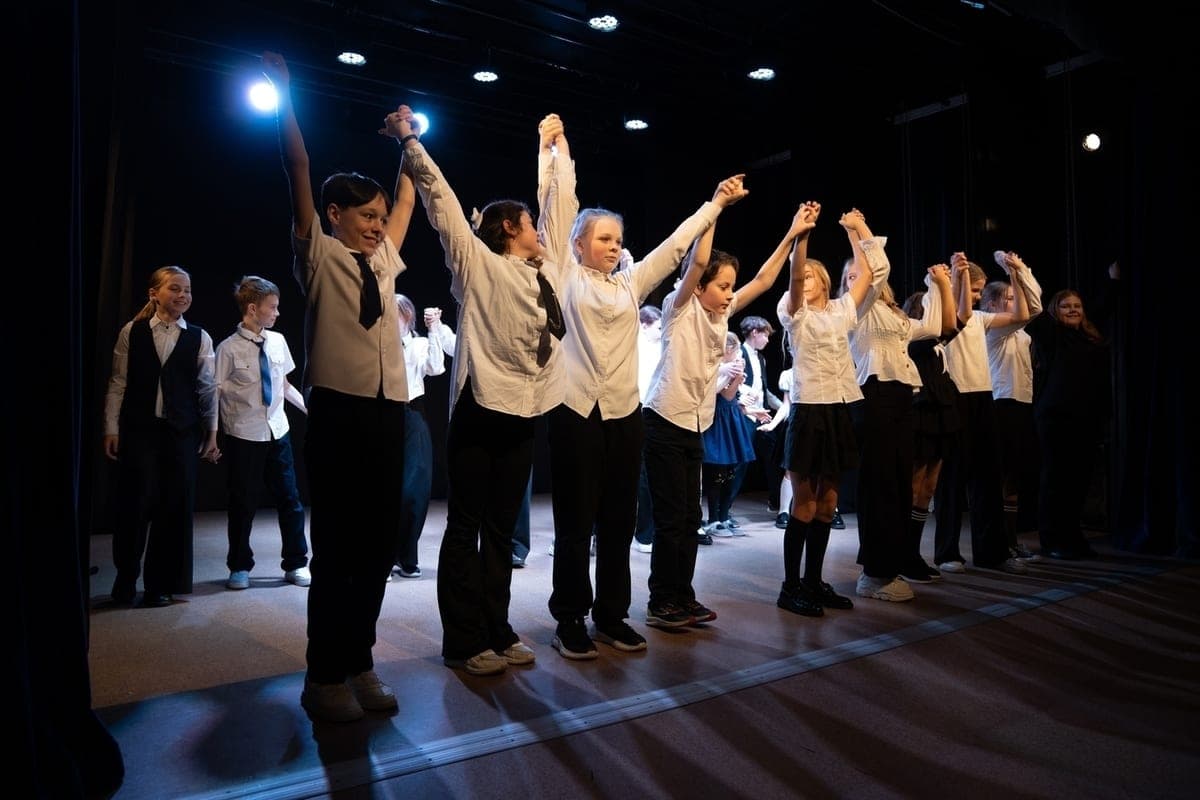
The project ended with a family theater festival on November 14. For the participants, we organized not only a creative program, but also an educational part, as well as a lunch. The participants were 100 children from theater groups of the Republic of Karelia. In total, more than 450 people took part in the project: 30 students, 60 parents, 240 spectators from social institutions, as well as everyone who came to the festival.
What it meant for the team and students
For us, the team of the project, “Scene in a Suitcase” was not just a realized application, but a living experience that changed a lot in ourselves. We saw an idea written on paper transform into light, sound, costumes and the eyes of the audience. We have learned how to negotiate with partners, build logistics, quickly respond to changes and keep quality in all conditions.
For students of the 4th year it was a real professional school. They didn’t just play on stage – they were responsible for the props, for the installation and dismantling of the equipment, for the performance to take place on an unfamiliar site. They saw that their work was not for evaluation, but for a real viewer who waited and believed. It’s an experience you can’t get in an audience: it gives you confidence, responsibility, and understanding why you chose this profession. Many of them felt that they were not students, but artists and organizers, and this became a point of professional growth for them.
There was one unplanned, but pleasant turn: at the initiative of the team, we organized an additional show of the play right in college for the teaching and student staff. This made it possible to introduce the production to a wider audience, get feedback from colleagues and students, once again test the stage solution in the conditions of the internal venue. In fact, this was an additional presentation of the project and increased the involvement of the educational community.
What next
Now that we have the equipment and the new partnerships, we can do these things on a permanent basis. Moreover, we plan to expand the list of specialties: if now students of the specialty “Social and Cultural Activities” participate in the shows, then in the future we can attract students of choreographic, ethno-artistic and theatrical creativity. The new equipment will generally improve the quality of the shows.
And most importantly, we think replication of our experience is a great story. “Scene in a Suitcase” proved that theater can come to any house. All you have to do is put a team together and put the stage in a suitcase. We thank everyone who was with us: students, parents, partners, spectators.


