
From open surgeries to robotic interventions: Minsk transplantologist on the development of surgery
Previously, many things seemed inaccessible, but now they are commonplace, says the head of the transplant department of Minsk region.
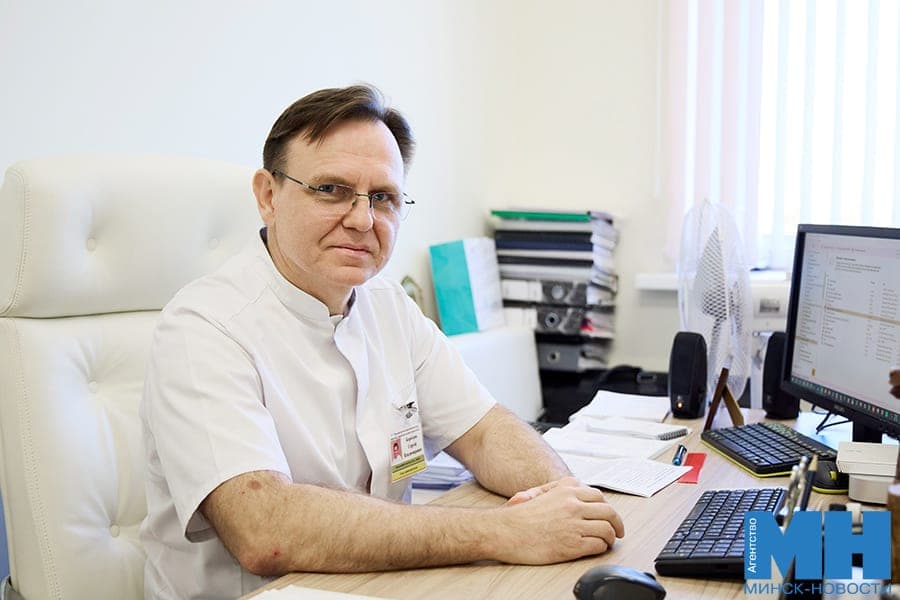

Previously, many things seemed inaccessible, but now they are commonplace, says Sergey Korotkov, head of the transplantology department of the Minsk Scientific and Practical Center for Surgery, Transplantology and Hematology. About how since the beginning of the XXI century Belarus has made the way from open operations to robotic interventions – in the material of the correspondent of the agency “Minsk-Novosti”.
A legitimate solution
— Sergey Vladimirovich, why did the choice of profession fell on medicine?
- My dad was a surgeon, my mom was a therapist. I, like many children of doctors of that time, often visited the hospital and clinic where they worked. When he was already studying at the Belarusian State Medical University (then an institute), the authority of his father influenced the choice of a surgeon’s specialty. As well as personal beliefs: this job requires a male character. I got into transplantation by coincidence. I worked in the capital’s 9th hospital, on the basis of which I was going to implement a transplant program, which also affected my further professional fate.
- You're over 25 years in medicine. How has this sphere changed in our country?
- Previously, many things seemed inaccessible, something from the field of fiction, but now it has become commonplace. When it comes to surgery, advanced technology has made it less traumatic. When I started, there were open operations. Then there was the stage of laparoscopic surgery, and now surgical interventions are already performed using robotic installations. In addition, today innovations are used both in the treatment of patients and in diagnosis.

Teamwork
- Can a robot completely replace a doctor?
- A feature of robotic installations is that the tools are very mobile and allow the specialist to work in anatomical areas difficult to access for laparoscopic or even open surgery. Also, good visualization, three-dimensional (3D) high-definition image significantly improve the accuracy of manipulations and ensure the safety of patients.
However, the robot does not know where and how to make an incision, can not identify tissue, although it has the ability to assess blood flow, perfusion in the organ (the process of passing blood through tissue). - Author's note. Moreover, when dealing with liver and bile duct surgery, the doctor sees that normal anatomy occurs in about 50% of cases, in the rest there are abnormalities. It is in such unusual situations that the machine is powerless. It operates according to a given algorithm and is not able to orient itself in the individual features of anatomy, especially if they were not detected at the stage of diagnosis. When the real picture on the operating table differs from the results of preoperative examinations, the choice of further tactics is the task of a specialist. Modern technologies allow you to perform operations qualitatively, but completely without human participation to carry out everything is still impossible.
- Does the doctor have the right to make a mistake?
- The doctor must do everything in his power to prevent this from happening. And also constantly work on yourself, including increasing the level of knowledge. Do not be afraid to consult with a colleague on problematic issues, and perhaps not with one, to hear an outside opinion. Then mistakes can be avoided.

Medicine is a calling
- How do you manage to combine work in the operating room with scientific and teaching activities? Which of these areas is your favorite?
- I would not share these concepts: it is a single whole, and each component complements each other. For example, doing science allows you to keep your finger on the pulse and be at the forefront of modern medical technologies. I love working with young people. Young colleagues are well oriented in information, quickly learn new things and learn advanced methods. This is a two-way road: we teach them the basics of our profession, and they encourage us to improve and not stop there. In addition, future doctors question even the opinions of authorities. This is good in any field, and especially in medicine: science always requires testing.
- What character traits should a doctor have and who does not belong in medicine?
- First of all, it is responsibility, patience, compassion for people, the desire to constantly learn and master new things. In addition, a doctor of any specialization should be a psychologist: understand the patient, be able to support and reassure him. Do not choose this profession for those who consider it only as a source of income or a way to get a certain status in society. Medicine is a calling. Working in this field, you give more than you get in return.

- You are the author of more than 100 scientific publications and seven patents for inventions, participate in the project “School of Hepatobiliary Surgery”. How do you find time and where do you like to relax?
- Scientific work began in the 1st year. After graduation he continued this activity. Publications and inventions are the natural result of many years of work.
As for the School of Hepatobiliary Surgery, I am one of the organizers of this training program, not the sole supervisor. My colleagues and I have been treating patients with liver, bile duct and pancreas pathology for almost 20 years, including liver transplantation, extensive resections and artificial circulation operations. The accumulated knowledge decided to pass on: on the basis of the center organized training of surgeons in this area. In 2026, several visiting seminars were held with lectures in regional centers. We plan to continue this work in the district centers.
As for rest, family and home are what allow you to recuperate and relax. When you return home after a difficult day and are greeted by relatives who understand the peculiarities of your profession and can support you, you do not need more.
- Did the children follow your path?
- The eldest son works as a surgeon. The middle student is in the 2nd year of BSMU, and the daughter is still a schoolgirl. If your children have chosen the difficult path of a doctor, this is probably the best confirmation that you are doing everything right.
For reference
S. Korotkov – Candidate of Medical Sciences, Associate Professor, Head of the Transplantation Department of the Minsk Scientific and Practical Center for Surgery, Transplantology and Hematology. He is called the pioneer of Belarusian technological medicine. In 2008, he joined the operating team that conducted the country’s first liver transplant. And in 2026, with his participation, a robot-assisted liver resection was performed for the first time in Belarus. In addition, S. Korotkov, together with a team of specialists, conducted 22 transplants abroad, including the most complex operations for children in Kazakhstan, Armenia, Uzbekistan and Kyrgyzstan.
Photo by Denis Kulagi and Sergey Lukashov


