
Salamatta Mektep. The main thing is health
Children still come every day for lessons, but what used to be considered extra workload or beautiful reporting, now trying to turn into a daily norm
New project
Its essence is simple and at the same time ambitious. The school should not only teach, but also preserve the health of the child. In early April 2026, the Ministry of Health and the Ministry of Education approved a plan of measures to promote the health of school-age children. The document received the official name “Salamatty Mektep”. Behind this formulation is a fundamentally new approach. Health is no longer a separate block of “medical interventions” or one-off promotions. It should become part of normal school life – what the child eats, what he breathes, how much he moves and how calm he feels in the walls of the school.
The idea didn't come up suddenly. Kazakhstan has been participating in the international initiative of the World Health Organization “Schools for Health Promotion” for about ten years. However, the previous stages were largely reduced to everyday lectures, contests, bright stands and monthly reports on the number of events held. On paper, everything looked decent, but static. In fact, the child continued to sit in a poorly ventilated classroom, eat the usual sweet pastries in the buffet and spend most of the day in a static position. Professional examinations revealed problems, doctors sent parents papers about the event with recommendations to register with a narrow specialist. That's it. Then often nothing happened. The results were recorded in the reports, and the environment that created these problems was almost unchanged.
The new plan, developed by the ministries, is aimed at a basic change in the established system of monitoring the health of schoolchildren. Now the main criterion of effectiveness is real change within a particular school.
Today, the project covers 6349 general education schools out of 8048. That's almost 79 percent. Education and health coordinators have been appointed in each region. A single algorithm of work appeared, which was approved by the expert council of the Salidat Kairbekova National Scientific Center for Health Development. Local executive bodies are required to report quarterly on the implementation of the plan. A formal approach is no longer welcome.
What exactly will be checked
The first and most important is school food. From September 1, 2025, the country has updated standards. The sugar content was reduced by 3.6 times, salt - five times. From the menu removed sausages, smoked products, spreads and sweet drinks. Instead, vegetables, fruits, dairy products, fish and whole grains appeared. Schools are instructed to form a habit in children to choose healthy food. The inspectors are obliged to check the dining rooms not only for the availability of the menu, but also for the real performance, the quality of products, the range of buffets and the availability of free drinking water. Even the index of inedibility was introduced. If children leave food on plates, this is a signal that the diet needs to be adjusted.
The second area is sanitary safety. Here the list of requirements is quite specific. Illumination of study rooms, regular ventilation, temperature, quality of drinking water, sanitary condition of toilets and recreations.
Particular attention is paid to hand hygiene. Children should be taught how to wash their hands properly, and schools should be encouraged to do so. Cold toilets, lack of hot water, or dirty sinks are no longer considered minor drawbacks. They have a direct impact on health.
The third area is physical activity. The school should not just conduct physical education classes, but create opportunities for movement during the day. Changes, sports grounds, availability of equipment - all this is in the spotlight. Prolonged sitting at the desk without the opportunity to stretch is recognized as one of the factors affecting vision, posture and general well-being.
The fourth area is psycho-emotional well-being. It is about creating an atmosphere in which the child does not experience constant stress. School psychologists, the opportunity to seek help, work with bullying and overload become part of the overall picture. Health is now understood more broadly than the absence of disease. It is also a condition in which the child can learn.
How it used to be and why it matters
Prior to the new plan, many schools did indeed carry out preventive measures. We invited lecturers, arranged health days, handed out booklets. Everything looked decent on paper. In fact, there has been almost no systemic change. Food was left to the discretion of the suppliers, ventilation to the conscience of the administration, and psychological assistance was often reduced to formal conversations.
“The decisions made today will determine the health of the future adult population and the health needs of the health system for decades to come. Our common task is to make healthy nutrition, movement and timely access to help become a natural and accessible part of a child’s daily life, said First Vice Minister of Health Timur Sultangaziyev.
Figures from the first half of 2026 show the scale of the problem. 3.6 million children underwent preventive check-ups. The disease was found in 302 thousand. More than 119,000 were put on dynamic observation. Among the most common problems, doctors recorded caries, anemia and visual impairment. This is one of the arguments in favor of a systematic approach. Treating consequences without changing conditions is pointless.
Health Minister Akmaral Alnazarova has repeatedly stressed that health is formed not only in the clinic. “It is from childhood that a culture of health is formed, and this is our strategic priority,” she said. According to her, the new standards of nutrition and the development of school medicine are aimed at improving children during the most important period of body growth. “All these measures are aimed at improving the health of children in the most important period of growth of the body and the formation of a culture of care for their health from an early age,” she said after visiting schools in Astana, where they checked the introduction of the new menu.
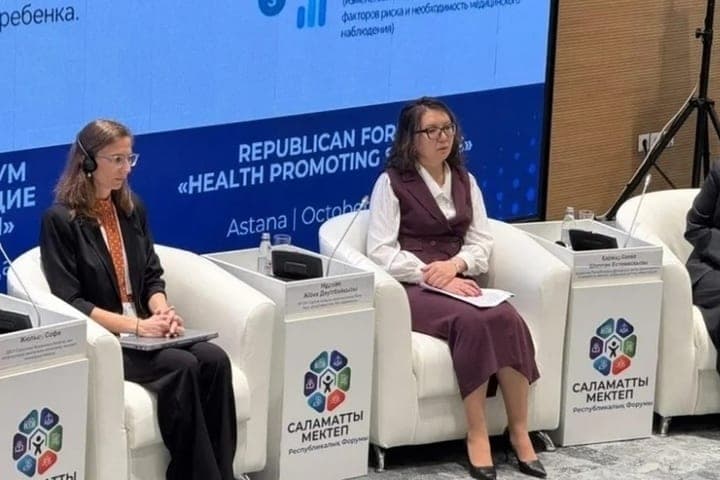
At the Republican forum “Salamatty Mektep”, which was held in Astana in early October 2026, participants directly spoke about the need to move away from formalism. Effectiveness will now be measured not by the number of actions taken, but by the qualitative changes in each school. The digital portal HPS was upgraded to record the real state of the environment, and not just count participants.
- It is important not just to conduct preventive examinations, but to ensure their high quality. To do this, it is necessary to train medical professionals in new approaches and provide them with modern diagnostic tools, said Magripa Embergenova, Director of the Department of Maternal and Child Health.
What it changes in practice
There is additional responsibility for teachers and directors. The school can no longer say, “Food is the provider’s business and health is the health of the clinic.” Now all the links are connected. Nutrition unit, medical center, class teacher, administration and parents work in the same system. This requires coordination and, frankly, more work. But it is this kind of bundle that should give the result.
Parents also get more tools. They may ask whether the menu meets standards, whether the school has drinking water, how the change is organized, and whether psychological care is available. Transparency becomes part of the process. If before many issues were solved behind the scenes, now there is a reason to demand specific changes.
Of course, serious questions remain. Not all schools have the same opportunities. In remote areas, it is more difficult to provide a full hot meal or a modern sports hall. The shortage of school psychologists and nurses has not disappeared. Some schools still do not have normal conditions for basic hygiene. Yet the very fact that the state recognizes health as part of the educational environment is already a game changer.
The Salamatta Mektep project does not promise instant miracles. It is designed for three years and involves a gradual change in habits and infrastructure. But if it works as planned, in a few years the Kazakh school will be evaluated not only by the results of the UNT and the Olympiads. It will also be evaluated by how healthy the children come out of its walls.
The health of a child consists of many small things. From what he eats in the dining room, from the air in the classroom, from the opportunity to run at recess and the feeling of being heard. Salamatta Mektep is trying to bring these little things together into a single system. Time will tell if it works. But the direction is right. A school in which a child spends most of the day should be healthy. And the sooner this becomes the norm, rather than the exception, the fewer children will leave school already with chronic problems.


