
How much pocket money to give a student: amounts by age and expert advice
How much pocket money to give a child in Belarus, at what age to start and what to choose - cash or card? We understand how to determine the amount, teach the student to save and not turn money into a reward for grades and household duties.
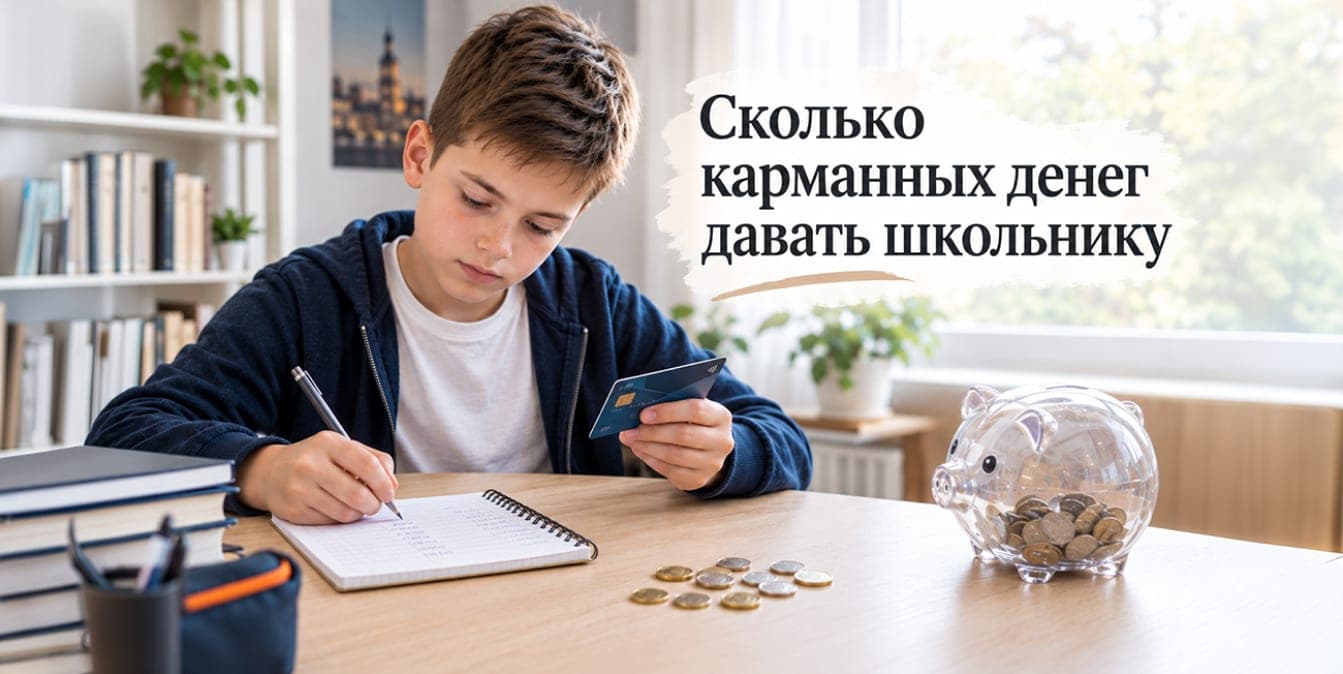
You can remind your child every day that money does not grow on trees, but it is much more useful to give him a small amount and the opportunity to decide what to spend it on. Financial consultants believe that pocket money is not needed to pay for all the desires of the student, but that he learns to plan, choose and save in practice.
There is no universal amount for all families. It depends on the age of the child, the family budget, prices in a particular city and what expenses parents pay separately.
How much to give by age
Psychologist Inna Polyukhovich recommends starting with small amounts from about 5-6 years. At this age, a child may already understand that money is a limited resource, and buying one thing means giving up another.
These amounts are not mandatory. For example, a teenager who pays for travel, lunches or small gifts to friends will need more money. If the parents separately pay for everything necessary, the allowance may be less.
Therefore, it is better to formulate the question not as follows: “How much do they give other children?”, but as follows: “What expenses should the child cover himself?”
Should money be given out every day
For younger students, the daily issuance of small amounts can be convenient: the child sees the connection between buying and reducing money faster. However, financial advisers advise to gradually move to a weekly format.
So, Tatiana Sviridova, Candidate of Economic Sciences, curator of the School of Financial Literacy for high school students of the Faculty of Economics of BSU, believes that it is better to issue the first pocket money with a small daily amount. As the child grows up, the frequency can be changed: first give out money every day, then once a week or month. The expert suggests that children give money for 5-10 rubles a week, schoolchildren 8-10 years old - 10-15-20 rubles a week, and from about 11-12 years old to switch to a larger amount, which the child learns to distribute independently.
So the child learns not only to spend, but also to calculate funds for a longer period. If he spent the entire amount in the first two days, the parents are not obliged to replenish the budget early: this is a natural consequence of the financial decision.
Cash or card
Tatiana Sviridova also recommends combining cash and a bank card. Cash helps the child see and feel money, and the card introduces non-cash payments and allows parents to set limits.
“Money is always about responsibility. It is important to teach children how to manage them, the expert notes.
For younger students, cash is better. The child sees bills and coins, can count them and clearly understand how much is left after the purchase.
Experts advise switching to a children's bank card at about 10-12 years old, when the child already knows how to count, plan and use the application. The card is convenient for controlling expenses and digital payments, but should not be perceived as an unlimited wallet.
Should Parents Control Spending
Control is necessary, but total control is harmful. Before starting regular payments with the child, it is worth discussing in advance:
- 1.what amount and on what day he receives;
- 2.that parents pay separately;
- 3.which purchases are prohibited;
- 4.is it possible to borrow money;
- 5.which part should be postponed;
- 6.what to do if you lose your card or send a suspicious message.
Do not require a report for each gum. If the child spent money on a failed purchase, this is an opportunity to calmly discuss the consequences, not an excuse to take the remaining amount.
“It is possible to discuss costs and make recommendations, but nothing more. A child can spend money on something unnecessary. But don't adults ever do that? It is better to learn to analyze your expenses in childhood than in adulthood, when it is more difficult to do it, says Oksana Blank, a psychologist at the Center for Successful Relationships.
Experts suggest using the rule of three envelopes:
- 1.50% - on current expenses;
- 2.30% - on savings;
- 3.20% - for gifts, good deeds or help to others.
For a small child, the proportions can be simplified. For example, 7 rubles out of 10 to leave for personal expenses, and 3 rubles to put in the piggy bank for the selected goal.
Whether to give money for assessments
Regular pocket money is better not to associate with assessments, behavior and ordinary household duties. Otherwise, the child can be fixed model: any responsibility should be performed only for remuneration.
Psychologist Inna Polyukhovich emphasizes that pocket money should not depend on assessments, behavior or the performance of ordinary household duties. Otherwise, the child may decide that schooling and family support are only for the sake of payment.
The best approach is to divide the two types of payments:
- 1.the child receives basic pocket money regularly, regardless of grades;
- 2.additional earnings are possible for initiative or work in excess of normal duties.
Cleaning your own room and washing dishes is part of family responsibility. But help with general cleaning, preparation of a family event or the implementation of a separate project can be paid by prior arrangement.
“When it comes to grades, we use monetary incentives to convince the child that grades matter most, and they don’t. In addition, for the sake of money, the child begins to try to get grades in any way that brings up not quite the right personal qualities. I would advise parents to give their children more autonomy and initiative. Then they will perceive learning as their degree of responsibility, says Oksana Blanc.
How to teach a child to save
The accumulation must have a specific purpose. The phrase “put aside for the future” usually works worse than “let’s collect 60 rubles for headphones or a gift.”.
You can ask your child to record income and expenses in a notebook or app. It's important that he sees:
- 1.how much did you get;
- 2.how much did you spend;
- 3.what did the money go for;
- 4.how much is left;
- 5.how long will it take to accumulate for the purpose.
The main rule for parents
Pocket money should be regular, feasible for the family and understandable to the child. Do not copy the amount that classmates receive: children may have different expenses, and families have different opportunities.
This is not a tariff or a mandatory norm, but a starting point for a conversation. The older the child becomes, the more important is not the amount itself, but the ability to distribute it, give up impulsive buying and save for your own purpose.
Read also:
- 1.How to prepare a first-grader for school: advice from an experienced teacher
- 2.What will change in schools in Belarus from September 1, 2026
- 3.In Minsk, a child in the garden can be left around the clock: where such gardens work and how to get there
Photo: Generated by neural network


