Anatoly Vasiliev made a silent movie about the way to nothingness: he inserted his photo into the mourning frame
Theatrical director Anatoly Vasiliev sometimes makes films, interest in which originated in childhood
The festival has a separate section dedicated to the theater and film versions of famous performances, which are usually shown in small halls. The most amazing thing is that Vasiliev’s painting was presented in the format of work in progress in the so-called main festival hall of the country. That is, on a huge screen was the film of an elite director and a great experimenter, who never claimed to a wide audience, rather laboratory searches.
The assembled audience testified that the real viewer will not finally finish off the dominance of blockbusters. It is curious that in parallel there was a festival screening of video clips of Alehi MC, and somehow all this coexisted on the scale of one evening. A day later, there was a rare opportunity to see the French television version of Masquerade in 1993, which Anatoly Vasiliev had put in Comedy Française a year earlier. Our foreign colleagues gave us that chance.
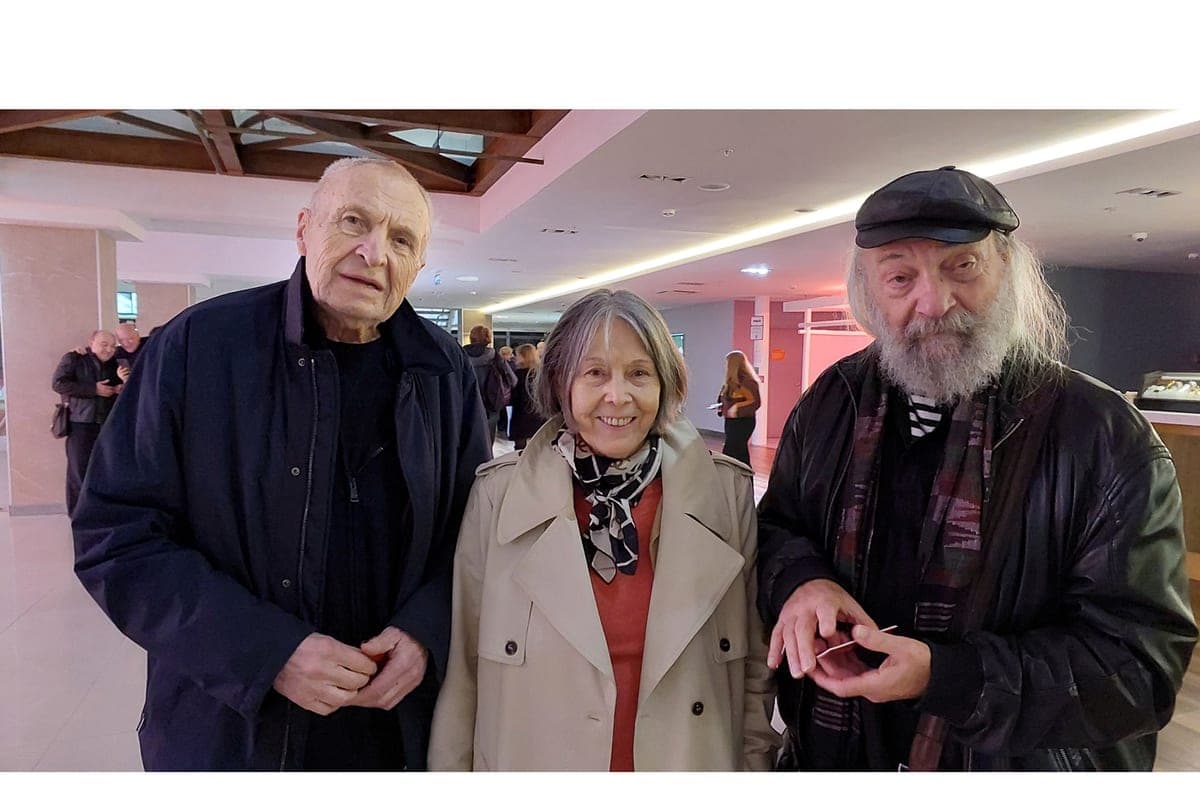
It is clear that Vasilyev’s disciples, direct and spiritual, came. Kirill Pirogov brought a group of young people, probably his students, and then explained something to them at the cinema. The screening was attended by film director Andrei Smirnov with his wife Elena Prudnikova, Galina and Nikita Tyunina, people who surrounded Vasilyev during his active work in Moscow. He even kissed his hand as a priest. The audience admitted that they felt the greatness of the moment during the show. For 1 hour and 40 minutes, the film was watched in complete silence. You can't remember that in this room. I could hear the neighbor's breath.
The movie is really powerful. It seemed that one of the filmmakers of the new generation, for example, Tikhon Pendyurin, as an operator who shot one of the novels, helped with the editing. However, Vasiliev did everything himself.
Before the session, Anatoly Vasiliev admitted: “I am generally afraid.” The usual. It's okay for a director to be afraid. I'm afraid to show you this work and at the same time I really want to show it. Thank you for offering such a grand hall, where we once showed the film “Donkey”, and it made a great impression on me.
The world premiere of “The Donkey” took place in 2017 at the Rotterdam Film Festival. Around that time, Vasiliev was working on a theatrical version of The Tale of an Unknown Man in France, shooting Venetian shots for it, now included in his film.
Over the “Donkey” work was ten years, and only when the main character appeared, everything worked out. Vasiliev presented the history of the donkey as an autobiography, which he spoke about in Rotterdam. This unusual hero had to speak, and then the language of silent cinema came to the rescue.
Something similar happened to The Story of an Unknown Man. “This movie is silent,” said Anatoly Vasiliev. The actors don't talk here, but the sound comes gradually. A genre can be defined as a poem, an elegy of death that comes sooner or later. "The Story of an Unknown Person" is subtitled. All the text you see on the screen is Chekhov. There is also a fragment from Dante, which is the 2nd and 4th songs from Paradise.
Vasiliev reads the text from the Divine Comedy in the first part of the film Portrait. On the screen is a picture of his friend Boris Zaborov, whom he calls a great Russian artist who found himself in France. He was born in Belarus and lived almost all his life in Paris, worked as a costume designer at Vasiliev’s Masquerade.
This part, which appeared recently, allowed to complete the picture, closed the circle. On the screen is a picture of Zaborov, an old man with an old woman at a memorial table with vodka and snacks. On the table is a rub of young Vasiliev, which he pasted into a mourning frame. “I thought it was risky, but saying it was worth the risk,” Vasiliev said
The second part, the most incredible, Vasiliev shot in 1975 in a village on the Mezen River. “I’ve always been involved in photography, but this is my first amateur film, shot with a camera “Kyiv” on 16 mm film,” – said the Director.
Village women (very few men) escort a loved one to the last journey, go with a coffin through the meadows to the village cemetery, where part of the crosses are wrapped in cloth. The grass makes noise in the wind, as if in the steppe, and this is such a force of shots that a rare filmmaker can do.
The third part was shot in Venice on camera by a talented cameraman Sasha Kulak, who worked with Vasilyev on the “Osla”. It was she who filmed the actors in a gondola walking through the canals of Venice. Vasiliev led the process on the shore. “This material was filmed for a performance I was rehearsing in Strasbourg at the time,” he said. It was an adaptation of Chekhov’s The Tale of an Unknown Man. I wanted to do an episode in Venice, an amateur documentary that would go into the play. He came in, but all the footage pulled for more. Time passed and it only came together because I had a 1975 Mezen and had a clear idea of what a movie could be.
A man and a woman swim in silence. In the credits, their internal monologues appear, sometimes turning into a dialogue. Where they are headed is not clearly stated. “If I had said that, I would have turned everything into something ordinary. It is clear where two men are headed in a boat led by the one who runs the boat. The effect is that actors don't improvise. We hadn’t even started rehearsing Chekhov yet. We filmed in Venice in October and rehearsals started in December. I was given improvisational material for every episode. It is not related to the novel, it is an impression of art and life.
On the screen are two serious artists of the city of Paris. You will see Valerie Drevil in the 1992 Masquerade as Nina. She's 30 years old. And here's 2017. (We saw another performance of Vasiliev, Medea Material, with her participation in Moscow in 2001 at the third World Theatre Olympiad – S.H.).
I also rehearsed with Stanislas Nordej. We were friends. Based on my assignment, the actors improvised on a particular topic while travelling in a boat. She also followed a certain route. The most difficult thing was to cross the big canal”.
Here, for the first time, the sound of oars and water will appear when a boat driven by a gondolier (one of Vasiliev’s assistants) enters the Grand Canal. There are almost no other boats nearby, which is incredible and only possible at dawn. The moment the gondola passes the strait between the islands of San Giorgio Maggiore and Giudecca, for a short time the color will flash and the trees will green. Vasilyev sounds Mahler, as it was in the film “Death in Venice” by Lukino Visconti, from whom he learned a lot.