About the Holocaust in the style of cabaret: it is possible, if seriously
The Shalom Theatre staged the Ghetto based on the play of the same name by the Israeli playwright Yeshua Sobol about the creation of a theater in the Vilnius (Vilnius) ghetto in 1942
The play, written in the early 1980s, is based on the diaries of ghetto prisoners, particularly librarian Hermann Crook, and is staged festively and easily, though seemingly as possible.
I remember the premiere of the film “The Blossom of Yesterday” by Chris Kraus (Austria-Germany) at the Tokyo Film Festival, which then received the Grand Prix. The director called his picture a grotesque about the Holocaust and tried to shed all the speculative husk stuck to the tragic events of the Second World War.
Lars Eidinger, known to many by his role as Nicholas II in Alexei Uchitel’s Matilda, played a Holocaust researcher and grandson of a Nazi criminal. His hero is constantly frowning, and brings him out of this state a Frenchwoman with Jewish roots, fatally suffering from the death of her grandmother in the gas chamber of Auschwitz. She does not drink German beer, because it is produced in the country that killed a relative, falls into hysteria, recalling her affair with a German. Heroes travel to Latvia, where a French woman in a red coat is photographed against the background of the burial of Holocaust victims with an expression of grief on her face. Everything is hypertrophied and taken to the extreme, and therefore ridiculous. Chris Kraus was able to talk about serious events using a seemingly forbidden technique, without offending anyone.
In Shalom, the characters ask about the difference between a cow and the Holocaust. The answer will exceed all expectations: a cow cannot be milked for 80 years. The text of the play is updated with today's realities. In the dialogues, the names of the infamous Harvey Weinstein and Jeffrey Epstein appear.
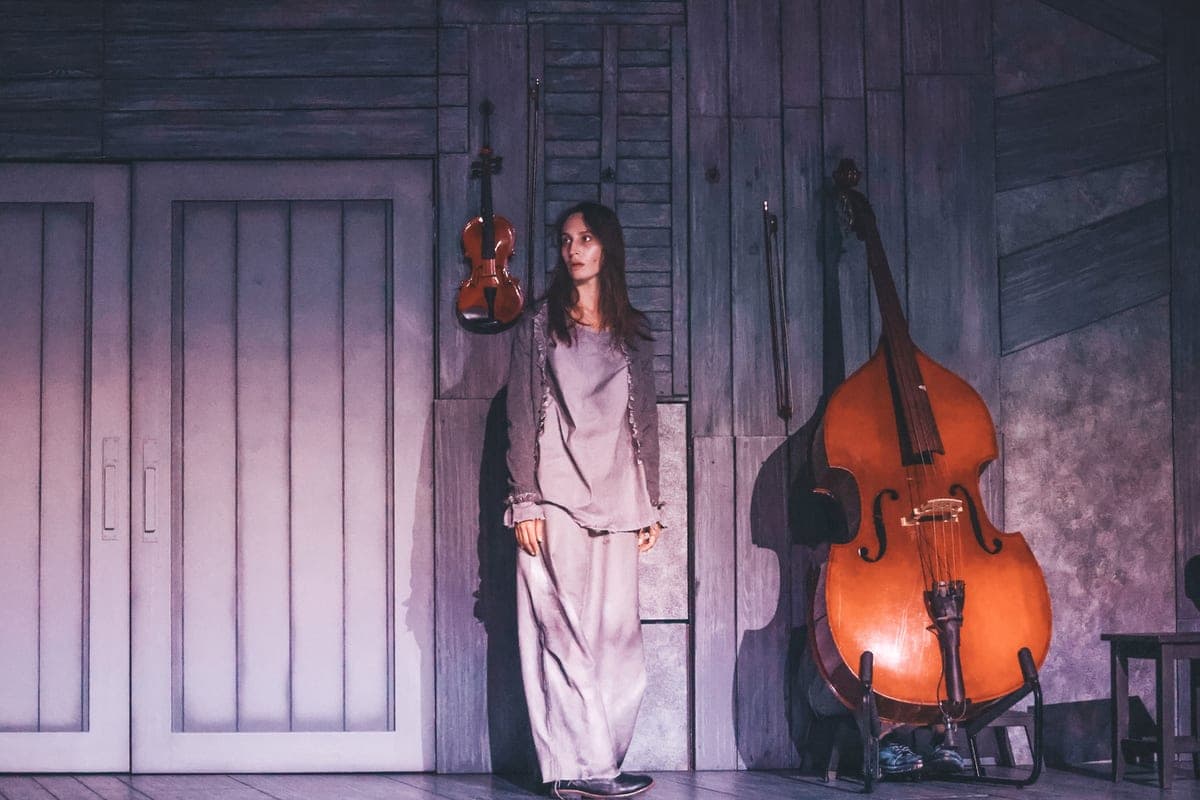
Vladimir Kimmelman staged Sobol's play in the spirit of cabaret, with songs, some of which were written in the ghetto, live music (on stage - piano, double bass, violin), elements of a puppet show, which creates a contrast. Life conquers death, and that is important.
The inhabitants of the ghetto, and among them there are artists, singer, artists, stage performances with the permission of the German authorities. And thus save themselves from hunger and destruction, receive rations and respite from death, give hope to the audience.
All the characters seem to get out of the crevices and windows in the gray walls, and then dissolve as well. They are nothing to the Germans, and dressed in gray clothes, almost colorless. Artist Sofia Egorova studied old photographs and tried to revive the spirit of that place and time. The costumes are modern, although they are very conventional.
Some of the characters in the play have prototypes. For example, the real police chief Jacob Gens, a complex personality, behind whom there were good deeds and total evil. According to the memoirs of the librarian Herman Crook, a play was written. He disapproved of the idea of a theater in a cemetery, and the ghetto was nothing but a place of death.
The only German on the stage is the head of the ghetto, officer Kitel performed by Nikolai Baloban. He is a great lover of art, and his prototype even studied at a theater school. He pays attention to a Jewish singer caught stealing beans, and in a sadistic way continues to write off her debt.
I just don't know what those feelings are. There's no love. Especially on her part, and this is not the fault of the actress, but miscalculations of the director. But the scene of violence against the victim or lover was decided by choreographer Natalia Terekhova and played by the actors virtuoso and devoid of materiality. Kitel relishes the day when the ghetto will be liquidated and its inhabitants destroyed. Then he will play Schumann's composition on the piano right at the gate.
In the role of the singer Chai is the magnificent Zhenya Romanov, a plastic, deep actress capable of conveying pain. And next to her is a gentle soul, Srulik, played by Nikolai Tarasyuk. His hero does not part with the glove doll, and together they can at least temporarily muffle the pain, forget about the horrors around, fall out of reality.
Every moment can be the last for the inhabitants of the gray ghetto. At the same time, the performance is spirit-lifting, and the modern viewer will not escape from self-preservation from the colossal disaster he sees on stage.