Tansulpan Garipova: There was no strength left for life when she finished Burenushka
People's writer of Bashkiria Tansulpan Garipova held a creative meeting with readers
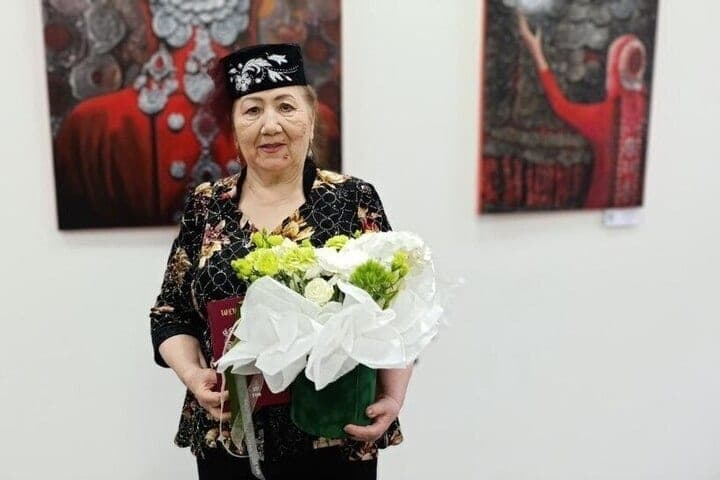
Tansulpan Garipova is a novelist and playwright whose works are full of a deep understanding of the Bashkir people, moral values and vivid images of strong women guardians of the hearth. Particularly noteworthy is the epic novel “Burenushka”. According to this cult novel, covering the history of the Bashkir family during the XX century, a performance of the same name was staged in Bashdramtheater.
Your childhood was in the difficult post-war years. Tell me, how did you grow up?
Everyone, even those who had a difficult childhood, still have the happiest years. My childhood is a time after the war, devastation, we did not eat enough bread. I remember in 1951 I dreamed of bread. There was even such a case: we were visiting Shibai. My father was still alive at the time, and we rode a sled on one horse. On a visit, the owner of the house gave me a white flour bun. She was so beautiful, rosy, crispy. I was sorry to eat it, because two sisters and a brother were left at home, and they had never seen such a bun in their life. I bit off the edge, bit off, and then put it in the pocket of my mother's coat. Later, the girls were cleaning the house and found this bun in their pockets. They laughed and I cried, I remember. In short, I didn't bring a bun home. And then years went by, and I wrote a little story called "White Kalach." That was the time.
Tansulpan Hizbullovna was seven years old when her father died.
- He died saving people. My father is a soldier, three wars have passed. My older sisters, who were born before the war, got married, separated, my brother served as a border guard in the Far East. My mother was old and sick, and she gave birth to me at 45. And all the hardships of village life came upon me. Nevertheless, although I say and write that I buried my childhood with my father, there were many good and interesting things. I discovered the world every day. I studied the animal world and human psychology. We talked a lot with people, with neighbors, our doors were always open. The need, perhaps, forced, and the fences were low, we all communicated, and each opened himself in his own way. During these years, I think I opened the world to a future writer. So my childhood was beautiful.
How did you know that literature is your calling?
If teachers are real teachers, then the school gives a lot. And the fact that I later became a writer, a playwright, is the merit of the school and teachers. I started writing very late, at 30. In the year of my thirtieth birthday, we moved to Uchily. After the institute, I was left in Ufa at the Academy of Sciences, I worked there, had to defend my PhD. I passed the Ph.D. minimum, but we had no housing, and my mother was with me. She was old, had two children, and we had to leave. We left for Baymak, but my husband did not like the Baymak district, and he moved to Uchaly even before me.
The writer notes: “Where the needle is, there is a thread.” So a year later she went with the children to Uchily.
I did not have a job there, I was not allowed to teach at school. I even went to Rono, but they didn't talk to me. The head of Rono did not raise his head when I spoke to him. I was very sad because no one even looked at my workbook. I started to think of myself as a missing person. Neither my education nor my skills were appreciated. And before entering the university, I worked for two years as the head of the club, library, was a deputy. In the real sense of the word, he is a leader. And suddenly no one needs me in Uchily, I became very sad.
Tansulpan Hizbullovna remembers putting the children to bed and sitting down at 12 a.m. and writing her first story.
- Loss and anguish have done their job. It must have been a shock that started beating me and I wrote my first piece. And it was with this first story that I became famous. Probably because I had a life experience, I saw a lot. Without a father, an orphan life in the countryside, hard rural labor will make anyone a writer. In short, this is what life has made me.
Tansulpan Garipova admits that due to lack of free time, she took a vacation to write books.
- I've conceived my seven-volume book, and five volumes came out smoothly. The sixth, but the seventh, is the most difficult. But the rest is sweet. This book has reviews in Russian, Tatar and Bashkir. It turns out that a professor from Altai even studied the novel "Burenushka". I didn't even know about it. There’s a new book that was written literally last year. There are 20 stories, black and white life is my life. Bright passages from life that can not be carried with me, I wrote and put in this volume. In addition, she placed in the book an article by Ruslan Kizaev, head of the information and analytical department of the Center for Folk Art of the Chechen Republic. He read the novel and he says, "And one more little touch." Garipova reminded me something of Gorky Danko, who ripped out his heart to light the way for people. Already at the end of her epic work, she introduces a psychological game into the plot, from which again a woman emerges as a winner, and it seems as if the republic, the people, and nature itself together with her. The red thread of the epic novel was as clear and understandable as possible. Love your country. Love your people, your culture, respect nature and the common man of your land, and then all this will come back to you a hundredfold. Those are the words.
After the author finished this piece, she wrote every year.
So I'm taking a vacation and writing one part. I take a month off and then I work for 21 days, and at the beginning of the vacation I just lie dead, in my thoughts, in my mind. You see, you can not forget even a single small detail, otherwise if at the beginning of the novel the hero's eyes are blue, and then gray or brown, the reader will say "Ah, breaks." It's got to be right, so I spend a week revisiting old novels to write the next one. And then I sit down and write, I don't talk to anyone, I don't go anywhere. That's how I worked when I was at Vatandash magazine. The circulation of "Vatandasha" to "Burenushka" was 2000 copies. After I finished "Burenushka", the circulation became 8000. The circulation grew, and people were even given photocopies, because readers took the magazine, but did not return to the library. I got very old while writing, and on the days of finishing work I was afraid to look in the mirror. In the bathroom, I closed my eyes to avoid looking. Like a dried lemon, squeezed, and no strength left for life. I gave everything to these heroes.
- How long did you write?
- I wrote one piece every year. Then I couldn’t finish the fifth part and I wrote the fifth part, the vacation is over, and the novel doesn’t end, and I’m afraid, my blood pressure is high, I’ll die, I say, the novel will remain unfinished. And I had to quit my job to finish the novel. Together with the breaks, it took 12 years. If I were a man, I would have a wife, she would cook, do laundry, and if there were daughters, they would help me. I was always jealous of Nuguman Musin, who wrote and wrote all the time, his wife worked in the library and provided his materials. Two daughters helped. He lived in a four-bedroom apartment, not like me in a dorm, in the same room. I lived on Youth Boulevard for nine years, where there was nowhere to put a desk in the dormitory, the coffee table was only small. That's where I slept and I peed at this table. It was in these conditions that she created a novel. Not a very easy job as a writer.
“Adamant women have always been in Bashkir folklore.”
- Did the book extend your life anyway?
The book is now extending my years. I gave birth to heroes, but they did not give me peace for a long time. I couldn't get away from them. They were always with me, alive, characters. When you create character, heroes begin to live their lives. I conceived Hashim as a negative hero. I took a name so rare that no one would say anything to me. And he turns out to be almost a saint. I told the editor-in-chief of Agidel magazine about this. Why didn't you, Hashim? I wanted to marry him, but he didn't. Two women led to him... I did it for him, and he never married anyone. He is a saint, he loves these little children, even though he knows they are not his children. He forgave all of Gulban's sins. Isn't he a saint after that? The writer Bulat Rafikov then told me that Hashim is the name of almost a prophet, and the name does not allow him to fall. He keeps his image, and because of this Hashim became a saint.
According to the author, Samira did not intend this either.
Heroes lived and acted as they wanted, according to the logic of their character. There was even a case in Baimak where only three more parts of the novel came out. The meeting is big, in the village, one man got up from the hall says: now it's milking time, the milkmaid could not come herself, because milking can not be left, but she said hello, told Garipova to revive Almukhamat, Hashima she was able to revive. I could not revive Almuhamata, of course he died, because when he died, Madina became stronger. If there was a husband, would Madina be so strong? I'm sure there would be no success.
- You have a lot of bright female images in the work. Did these women have real prototypes?
To say that it was such a woman, I wrote off her entire portrait and fate – I can not. An artistic work is a generalization. I create character. Such adamant women have always been in Bashkir folklore. And Bashkir women chose a very strong pair. It was so, because the family must continue, which means you need to marry a strong man. And then after the war, thanks to these strong women, life continued. My 24-year-old neighbor with three children was a widow. I wrote two stories about her. She taught me to mow and chop and do everything. Women have always been so strong both physically and spiritually, and they are always an example to me. So my books have a collective image.
How are all these episodes born to you?
“My head is like this – born and born,” laughs the writer. - Well, it was, it's not like that anymore.
- There's a lot of violence and pain in Burenushka. I don't even want to believe it. Are the events described true?
When I lived in Baymak for two years, I worked as a head teacher in the educational part in high school. Sometimes I would take my students to my house for the night, knowing that nothing good would happen to them. I wasn’t creative at the time, so I couldn’t write. At that time, two girls disappeared. One older, the other younger are sisters. The children’s shoes and clothes are all at home. My mother drank, they talked to my father, they didn't live. Everywhere they looked for children, people went out to find them, but they never found them. Years later, when I was not even thinking about the affair, I asked my son-in-law, who worked in the police, about the incident. The son-in-law said they were killed by a neighbor who had already served several times in prison. While looking for the girls, he did something to get him locked up, but not for long, for about a year. And then he bragged, said he was drunk, his mother wasn't home, the girls were alone. He raped the eldest, the youngest woke up, started crying, ran out of the house, and he strangled them both, and then buried them in his yard. I made a bed on the grave and planted cucumbers there. And he said, they say, the police looked at everything several times, searched the yard and did not even doubt who in August planted cucumbers on the garden. That was the case. You see, writers don't collect wealth. We collect such information, fateful moments are not forgotten. And this is all stored in memory, and then the whole novel turns out. All writers do. I used this case in my novel. I wish it was true.
Why did the image of Burenushka become so important in literature that reflects the XX century?
There are accidents in the life of a writer, too. I didn’t think I would write a pentalogy, I started it as a story. Roman didn't have time to write. My husband is a sculptor, I worked in his workshop. I've always worked in two places, because working in one place doesn't feed the kids. And just in these years the son entered the St. Petersburg Academy of Cinema. And this is the nineties: who lived then, understand what it is. I was not up to the novel, so then I began to write a story, working as a teacher. It was published in the magazine "Agidel", I became the winner of the year. The name of the work was different, it does not sound in Russian, somehow awkwardly comes out "Moose-moose goes cow." In the Bashkir language, the meaning is deep. The title echoes the folk song.
A woman and a cow are breadwinners at all times, at all ages.
They are inseparably bound by their destiny. The man and the horse are also connected: it is war, the fate of the country. And so I had no doubt about the title at the time, because it revealed the whole meaning of the work. The pen brothers didn't let me calm down. Writer, winner of the Salavat Yulaev Prize Rashit Sultangareev, head of the prose department in the magazine "Agidel" announced that the magazine will publish a continuation of the work. I felt like I had deceived all my readers. I don’t write and I don’t even think I should write. People started coming later. One day a tall man came into our office, he shouted straight from the doorstep: "Who is Garipova?" Why did you, Garipova, kill your protagonist? How are you going to continue the affair
The author recalls that "women wrote that they wanted to read the sequel.".
Even the mother of the head of Shibai came and said, "Let me read the draft, I want to know the sequel." So I had to start writing a sequel. But there was absolutely no time. I lived in Shibai and worked hard on dramas. Then the Arslan Mubaryakov Sibay Drama Theater staged four of my plays. It was a completely new genre for me, I was in a creative upsurge. And when I moved to Ufa in 2000, worked for a year in the magazine "Vatandash", the editor told me to take a vacation and write a sequel for our publication. I did that – on vacation, I sat down and wrote a sequel to “Burenushka”, seven years later.
- And why did you entrust the translation of Marcel Gafurov into Russian, and did not begin to translate yourself?
I was born in a Bashkir village. There was not a single Russian in our village. In the post-war years, you can imagine: we didn’t even have a radio, let alone a TV. The Russian language was only in class at school, and even then these lessons were half in Bashkir. I remember in first grade we were in two classes together, the first and the third. And the teacher asks how one Bashkir word is translated into Russian. Everybody's quiet. And we've been studying with a village idiot for a year. In the autumn, when it was still possible to walk barefoot, he went to school, then stopped, but every year he came in September to study. Suddenly he says "water." And all because he went to Magnitogorsk to sell berries with his sisters. He knew the Russian translation of the word.
Tansulpan Garipova admits that she even thinks in her native language.
I dream in my native language, write in my native language, communicate in my native language with my children and relatives at home. And I taught my native language, folklore, Arabic writing, stage speech at school, but not Russian. And Marcel Gafurov is Russian-speaking, and being a poet himself, he caught my tune. He translated the novel subtly. He also translated my story and four stories. Rashit Sultangareev was a master of storytelling, he always said: "I am the father of the Bashkir story, and Tansulpan Garipova is the mother of the Bashkir story." I have everything in Bashkir, even my sons were born in the city, grew up, Bashkir language was not studied at school, but they also speak Bashkir.
Tansulpan Hizbullovna told an interesting case when they translated Burenushka into Russian.
Marcel Gafurov made a very good translation, and I heard about it in Moscow. Russian book lovers noted this translation. Then "Burenushka" was published in the magazine "Belskie expanses". I was in Beloretsk for a meeting with readers. There was an elderly woman in the room. And when the meeting was over, she came up to me, holding "Belsky Spaces", and asked for an autograph. I said I'll show my son. And then she asked me to touch me, and she said she'd tell her son. I asked the librarian who the woman was. No one knew her, and she never visited the library. Why she came, how she learned about the meeting and the work - it is unknown, as well as unknown why the son did not come himself. As far as I know, she did all this for him. I thought my son might be disabled, not walking. Perhaps to please my son, she came to meet me herself. But I don't know if that's true. There are such moments, you can write a separate story about them because there were so many of them. Thanks to my readers, I am writing and I don’t want to leave yet, I want to continue my Black and White Life and write this book.
Do you want to electronically release "Burenushka"?
I stayed in the twentieth century, unfortunately. But the book is sold on marketplaces, and the publisher tracks that the book is ordered outside of Bashkiria.
- Did you take part in the production of the play "Burenushka" at the Bashkir Drama Theater?
After the theater with me made a contract for the production, three years have passed, and the performance is not. I approach director Ayrat Abushakhmanov and ask when the performance will finally appear. I could have died in three years. I had covid disease twice and had heart surgery twice. I didn't have a stent then, and now I have four stents, and I don't have a performance. And finally, in the fourth year, I find out that rehearsals have begun. My heart is warm. And then I said, no proposal gets on the stage without my review, without my editorial, without my control. Ayrat Abushakhmanov says, “Tansulpan, why is Shakespeare great?” I say he was born great, therefore he is great. No, says Ayrat, Shakespeare doesn't interfere in the director's affairs, so he's great. I understood immediately, laughs the writer. When they started writing the script, they started doing it in Russian. That's what saved me. They write and then come straight to me. I sit up till night, I do everything myself. And in some places together decided how and what is better to convey. That's how we wrote this script. Together, it works. And really without me there was no offer.
Those who have seen the play and read the book know that the production is only a small part of the work - three parts. Were there any other options for the show? Can I tell you more about Madina?
Since we worked on the script together, I knew that Madina didn’t open in the production at all, she stayed there as a child, not until Madina. She's not in charge. A pentalogy cannot be placed in one performance. It's just impossible. Ayrat Abushakhmanov made the impossible possible. Only this kind of director can possibly do it. What he did was a miracle. I watched a performance with them in St. Petersburg, in the Alexandrinsky Theatre. This show was created for the St. Petersburg audience. It was something so incredible that happened on stage and in the souls of people, the audience and artists merged. There was such a tandem, a connection, such a ringing silence in the hall. And the St. Petersburg spectator has seen everything, especially the Alexandrinsky Theatre has existed for almost three centuries. Everyone was there: Pushkin and Lermontov.
According to the writer, “both St. Petersburg audience and St. Petersburg critics of international level accepted the performance.”.
And such words were good about the production, about the performance of artists. After the intermission, many for some reason immediately realized that the author was present in the auditorium, although this was not written anywhere. I guess my Bashkir face immediately became clear. Many came up, asked questions, we talked. A respectable man came up to me afterward and said, 'So big a crowd, but why are we seeing you for the first time on stage?' With such reviews left Peter our artists and our theater. It was impossible not to be proud. You know, if I hadn't heard people say such warm words about my work, I would have stopped writing long ago, because I never had time.