
Germany: Five and a Half Grains of Truth
In autumn, German markets and supermarkets are littered with pears - green, yellow, reddish, hard and already soft. Against the background of the ubiquitous apple, they look almost everyday. Meanwhile, one average fetus contains about 5.5 grams of fiber - almost a fifth of the recommended adult daily minimum of 30 grams. For Germany, this is not a trifle: many adults do not gain even 22 grams of dietary fiber per day. German news in Russian
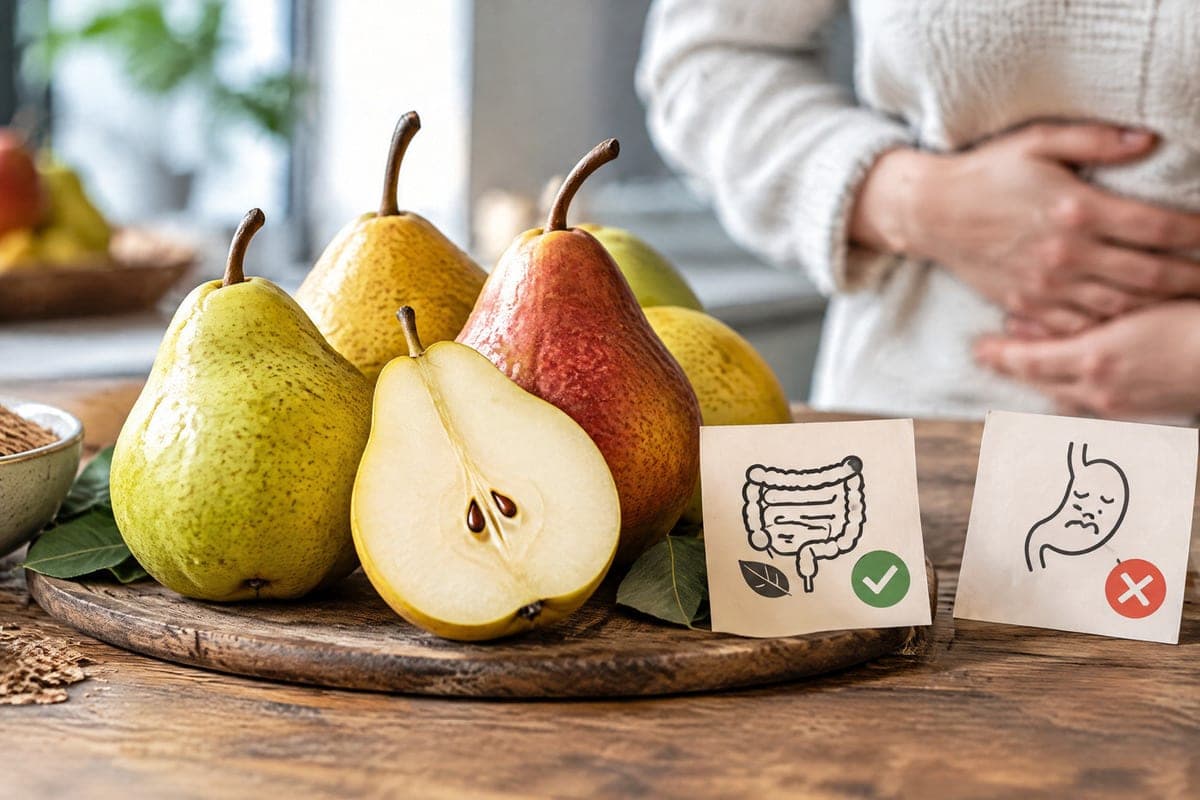
The simpler the product, the harder it is to sell a beautiful legend around it. The pear grows nearby, is inexpensive and does well without the halo of superfood. Perhaps that’s why she gets less attention in fashion ratings than she deserves.
In autumn, German markets and supermarkets are littered with pears - green, yellow, reddish, hard and already soft. Against the background of the ubiquitous apple, they look almost everyday. Meanwhile, one average fetus contains about 5.5 grams of fiber - almost a fifth of the recommended adult daily minimum of 30 grams. For Germany, this is not a trifle: many adults do not gain even 22 grams of dietary fiber per day.
There is no promise of miracles. The pear does not cure diabetes, does not “clean the vessels” and does not replace medications. She does a much more prosaic, but useful work - adds dietary fiber and variety.
While the buyer is hunting for seeds from Peru, berries from Brazil and powders from Japan, a decent product lies quietly on the next shelf. A pear is useful. But not magical. That is why it is more interesting to talk about it without myths.
The gut is the job
In the flesh there are both soluble and insoluble dietary fibers. The former, including pectin, bind water and are partially processed by intestinal bacteria. The second increases the volume of intestinal contents and helps its promotion. Together, they are able to maintain the normal functioning of the digestive system and microflora. But the formula “eat a pear, forget about constipation” is too good to be true. For a regular stool, an equally important role is played by a varied daily diet, and adequate drinking, and movement. Moreover, a sharp transition from a fiber-poor diet to a very rich one can end not at all with ease, but with bloating and heaviness.
Cholesterol on the pulp will not pass
Pears are often credited with the ability to reduce “bad” cholesterol. It is more correct to say otherwise: soluble dietary fiber in a balanced diet can help reduce the absorption of cholesterol and bile acids. I mean, there's a contribution. But turning one fruit into an edible tablet from high LDL is not worth it. The whole food system works - vegetables, legumes, whole grain products, nuts and fruits.
Sweetness counts, too
The ripe pear tastes really sweet, although its glycemic index is relatively low. Water and dietary fiber slow down the flow of carbohydrates into the blood. But “low index” does not mean “no limits.” The average fruit is about 27 grams of carbohydrates and about 17 grams of natural sugars. For people with diabetes, portion size, combination with other foods and individual body response are important. The practical option is to eat a pear along with natural yogurt, cottage cheese or nuts.
Juice takes cream off
The form is no less important than the composition. The whole fruit has to be chewed, dietary fiber is preserved, saturation comes faster. In juice, a significant part of them is lost, but sugars are absorbed much faster. With canned options, pouring decides everything: in your own juice - one story, in sweet syrup - quite another.
All the benefits are under the skin?
If digestion does not protest, the pear can be eaten with the peel. It is in it and directly below it is a part of dietary fiber and plant substances. Well enough to wash the fruit. But turning the skin into an obligatory attribute of healthy eating is also not worth it. With a sensitive stomach or intestines, a peeled and sometimes lightly cooked pear can be tolerated better.
Belly has veto power
This is where the downside of a useful product begins. The pear contains a relatively high amount of fructose and sorbitol, therefore, it belongs to products with a high content of FODMAP. For people with irritable bowel syndrome or impaired fructose absorption, the effect may be the opposite of what is expected: bloating, pain, diarrhea. It turns out almost gastronomic irony: what helps one intestine, the other can bring out of balance.
Apple won't be given the crown
The dispute “what is more useful – an apple or a pear?” is perfect for Internet ratings and almost useless in real life. The pear usually wins in fiber content. The apple may be slightly ahead of vitamin C and individual polyphenols. But the difference is too small to make the fruit basket a World Cup. In a normal diet, not one fruit wins, but diversity.
Autumn without superfoods
There is another simple advantage to the pear - it is now its season. In autumn in Germany there is a harvest, so it is especially affordable and easily fits into the usual menu: oatmeal, yogurt, salad, nuts or cheese. No magic is required for this. The pear does not cure high cholesterol, does not replace medications and does not solve bowel problems at a click. But about 5.5 grams of fiber in one average fetus – the argument is quite weighty. Sometimes a healthy diet does not require exoticism. It is enough that in autumn lies on the nearest counter.
This is what Germany says:
Germany - Agent 0080? Ex-BND head sent to jail on suspicion of serious crimes against state security
Germany – Do not take out the garbage from the house? Sometimes necessary. Why domestic violence is not considered a private affair
Germany is rubbish with a markup. €550 a tonne: Environmental tax could reach store price tags
Germany - 44 write, 48 in mind. Four unexpected ballots have made the election of the first chairman of the AfD Landtag a political mystery
Germany - Beard, tattoo, 110. Invisible man from Marle: police hope that a special sign will lead to the trail of the suspect
Germany is a button for the brain. Nobel Prize awarded to scientists who turned a beam of light into a tool for precise control of neurons
Germany is a bit map. DeutschlandCard is leaving the market: it is time for millions of customers to decide what to do with the accumulated points
Germany is the purse or life. Three of the casket: prices, taxes, refugees. The main concerns of the Germans are increasingly connected with the family budget and the possibilities of the state
The bureaucracy knows no borders. Life on German soil does not cancel powers of attorney, pension issues and confirmation of citizenship
Germany - Merkel's ghost roams Berlin. The ex-Chancellor again breaks the ovation, although he is not going to return to power
Germany – How Much Common Sense Costs Why budget assistance sometimes changes the order of things: first there is money, then there is a reason to spend it
Germany - There is a wall. “Green” suddenly admitted that the previous fight with the right did not work