Savitsky on the arithmetic of the Mogilev region and strategic maneuvers with corn
The efficiency of the agricultural sector is measured not by abstract records, but by clear calculation and flexibility of solutions. Today, the Mogilev region is doing ...
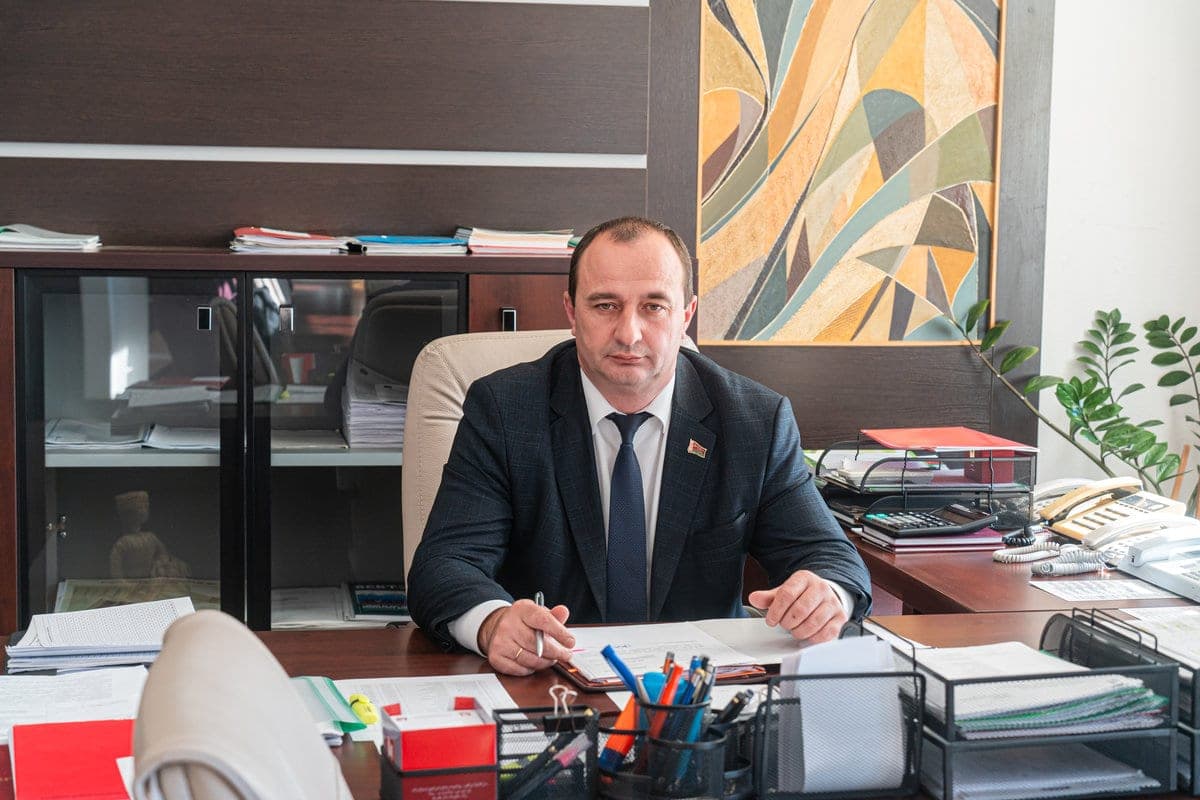

The efficiency of the agricultural sector is measured not by abstract records, but by clear calculation and flexibility of solutions. Today, the Mogilev region relies on well-calibrated crop arithmetic, where each hectare should work for the financial stability of farms and ensuring the fodder base. How does the region manage to maintain a balance between the state order and the needs of livestock and through what managerial maneuvers does the region insure itself against the vagaries of the weather? This and not only on the eve of the regional festival-fair of workers of the village "Dazhynki-2026", which will be held on October 10 in Shklov, in an interview with "SG" said the first Deputy Chairman of the Mogilev regional Executive Committee Sergey Savitsky.
- The grown and harvested crop is the result of professionalism, high responsibility of each employee of the agro-industrial complex and clear organizational work. All this made it possible to obtain the gross grain harvest taking into account rapeseed at the level of 1 million 220 thousand tons, while rapeseed production was increased to 184 thousand tons - and this is the best result for the years of its cultivation. As for corn, we have already threshed more than 25 thousand tons, and every day this figure is growing, corn is good, better than last year, both in terms of yield and volume. Betting on corn in the Mogilev region became not just an agronomic decision, but a strategic maneuver. The region has almost doubled the area under this crop by grain: if last year it was allocated 25 thousand hectares, this year - 44. At the same time, we understand: we do not need to chase the shaft, we will approach the issue in a balanced manner. We will assess the situation on the ground: if there is enough rough feed and silage in a particular farm, we will remove all planned corn volumes exclusively for grain. If there is a shortage of feed units somewhere, we will quickly redirect the flows.
- The pursuit of maximum gross fees often hurts the economy of the farms themselves. What is the optimal and economically justified figure for the region to cover all state and domestic needs?
- This year showed stability in production. I believe that for the region the weighted average figure is about a million tons of grain without corn and rapeseed. This volume is enough to fulfill the state order, provide public livestock and harvest seeds for the next year’s harvest. Today we calculate the arithmetic of the region according to the long-term formula: 1 million tons of grain, 200 thousand tons of rapeseed oil and 300 thousand tons of corn per grain. The region has already developed an optimal structure: we need annually 230 thousand hectares of winter crops and 100 - spring grains, a total of 330 thousand hectares. It is around these basic parameters that we need to maneuver. It is impossible to break the established crop rotation. Our task now is to point-by-point adjust the yield and structure of sown areas within specific areas and farms. The formula of success of the agro-industrial complex of Mogilev region is as follows: stability in the cultivation of basic crops, flexibility of managerial maneuvers and loyalty to the land.
Raps has long been considered a complex and capricious culture. How did we achieve record levels this year?
- If we analyze the general trend, the yield and gross rapeseed harvest in the region have been steadily growing over the past years. This year has really been a record year. But I sincerely hope that this is only an intermediate result. Without natural disasters, I have no doubt that we will continue to grow. The main change of the year is psychological: we see how the heads of farms have awakened a genuine interest in this culture. Rapse has ceased to be an obligation from above, because today in crop production it is the most lively, money crop. Oilseeds are a serious, fast and reliable source of direct income for agricultural enterprises. Economic pragmatism was a better incentive for farmers than any administrative requirements. When farms saw the real profitability of culture, the very approach to technology changed.
As a result, a solid foundation has been laid for next year’s harvest in Mogilev region. Winter sowing was carried out in perfect agrotechnical terms, and the total area of the wedge has grown from 70 thousand hectares last year to more than 80 this year. And the bar on squares, the local leaders now raised themselves. As for the yield, 40 centners per hectare in advanced farms today will not surprise anyone. On average, we received 24 centners per hectare in the region, and this is a significant result. Moreover, in some organizations, the yield of rapeseed was even higher than that of classical grain crops.
The leaders in the threshing of oilseeds of rapeseeds were Shklovsky district with a gross harvest of 31.6 thousand tons, Mogilevsky - 29.7, Goretsky - 15.4.
- The region faces the task of milking 1 million tons of milk by 2030. Is there enough food that we get from the fields?
- In agriculture, there is such a thing as “feed consumption per unit of production”. At the moment, on average in the region, we spend on the production of one centner of milk a little more than one centner of feed units. However, there is a direct dependence: the higher the productivity of the dairy herd, the lower the specific consumption of feed. In the strong, technologically advanced farms of the region, where high milk yields from cows are received, this figure is already about 0.8 feed units or less. At the same time, where productivity is low, the figure reaches 1.2. Our goal is to bring everyone to the level of progressives. And the stake here is not so much on increasing the number of animals as on improving the efficiency of the industry. The intensive development path allows you to convert quality feed into milk with much greater returns. In order to fully feed the existing livestock and grow steadily due to internal efficiency, we need to lay 2-2.5 million tons of hay and silage. The region has a feed base for these tasks, and I am absolutely sure that the bar of 1 million tons of milk by 2030 is quite achievable for the Mogilev region.
- What areas and specific agricultural enterprises of Mogilev region became the absolute flagships of the harvesting campaign - 2026, demonstrating the highest yield and pace of work?
- The highest hammers, more than 100 thousand tons, were overcome by farmers Mogilev (158.8 thousand tons), Shklovsky (149.7) and Goretsky districts (111.3). Among the agricultural organizations, the best indicators for grain production were achieved by JV Gazovik-Sipakovo and OJSC Aleksandriyskoye of Shklovsky district, where 70.5 and 69.6 centners were collected from each hectare, OJSC Dawn named after K. P. Orlovsky - 56.2 centners per hectare, CJSC Agrocombinat Zarya of Mogilevsky - 68.6, SEC Giant of Bobruysky - 52.4, Belichsky - 51.3 SPC.
In the harvesting campaign, 990 harvesters were involved, in addition, ten mechanized detachments were formed to provide operational assistance in cleaning to agricultural organizations with a high load, staffed by 42 grain harvesters, of which 17 crews were from among the employees of the Internal Affairs Department of the Regional Executive Committee and the Emergency Management. More than a thousand vehicles were used to deliver crops from harvesters, grain processing was carried out at 221 grain drying complexes.
- You often emphasize that the enterprise is successful, where technical re-equipment and modernization of facilities are constantly underway. How was the machine and tractor park updated?
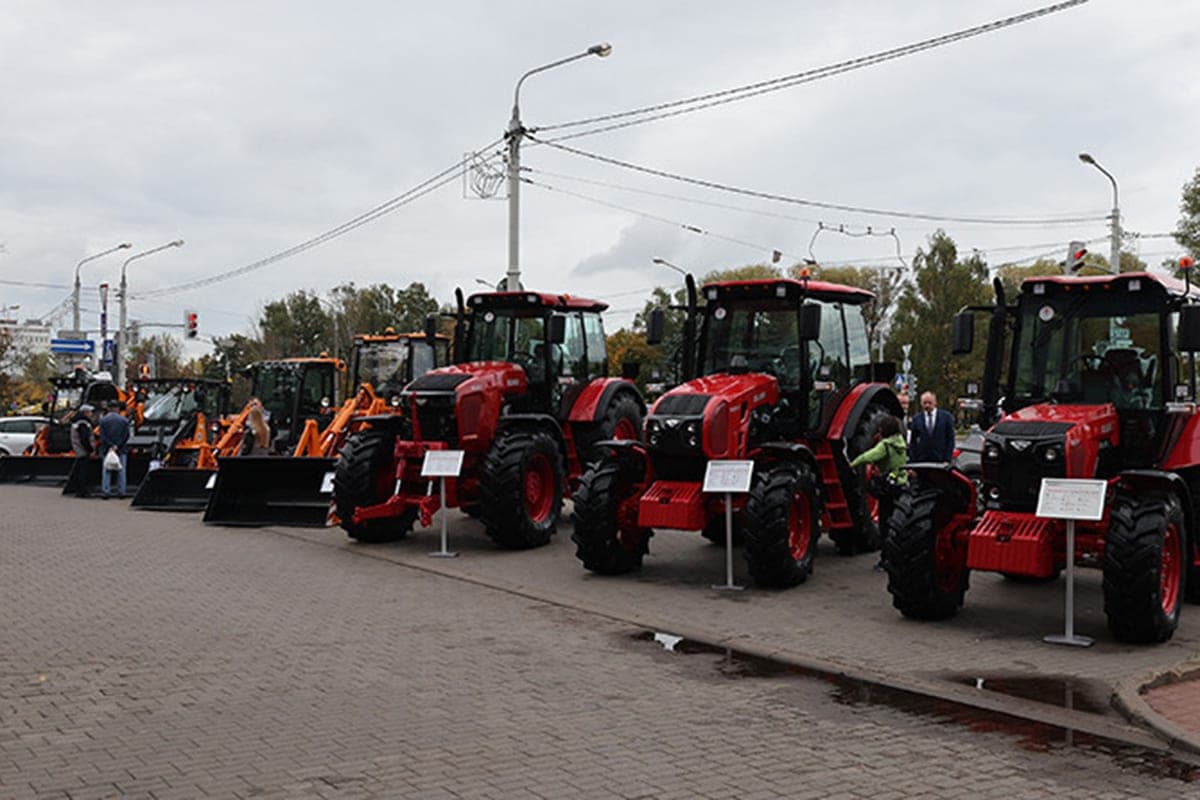
- This year there was a good renewal of the machine and tractor fleet. In this matter, you can not stop, for example, only on harvesters. Today it is wrong to evaluate only one position. There are about 17 thousand units of equipment in the region, which participates in all agricultural production. And the most important task is to keep the bar at 10 percent of updates annually. From the point of view of engineering, this correct regulatory bar of renewal is maintained for the second year. It is expected that we will upgrade even 1800 units of equipment this season. So, we bought 57 grain harvesters and 20 forage harvesters, about 100 energy-saturated tractors, 70 trucks. These are the most expensive positions.
The most important factor of high yield is quality seeds. What share in the sowing campaign this year fell on elite seeds and varieties of domestic selection?
- We made a bet on the development of our own seed base, and this strategy justified itself. A powerful pool of advanced enterprises has been formed in the region, which produce the necessary volume of high-quality seed material for farmers. Among them - RUE "Uchkhoz BSHA" of Goretsk district, Belynichsky SEC "Kolkhoz "Homeland", SEC "Giant" Bobruisk, OJSC "Experimental base "Spartak" Shklovsky, as well as farms. Quality seeds are provided in full. There are strict technological requirements: for timely renewal by the elite and higher reproduction, at least 25 percent of all areas should be sown, and preferably 30. We strictly adhere to this bar, which guarantees a stable potential for field productivity for future seasons.
— Sergey Konstantinovich, behind each Dazhynak labor record are specific names. And if the lists of harvesters-thousanders are on everyone’s lips, how does the region assess the contribution of those who remain outside the framework of the parade reports, but right now holds the main test for strength in the fields?
- Of course, the harvest is the pinnacle of the agricultural year. And the results of our leaders are really impressive. Hammer of 1000 tons of grain produced 381 crews, including 27 family and 33 youth, 3 thousand tons threshed 6 crews, 2 of them youth. The bar of 7 thousand tons was overcome by the harvester of Servoix Agro CJSC of Mogilev district Sergey Mai, more than 5 thousand tons by Grigory Bokach, a combiner of the same agricultural enterprise. Among the young combiners, more than 5 thousand tons were threshed by Ivan Zdorovikov from Zarya Agrocombinat CJSC, Mogilev district. 187 drivers transported more than a thousand tons of grain, 60 - 2 thousand and more, 26 - more than 3 thousand, 12 - more than 4 thousand and 4 - more than 5 thousand tons. The greatest results were achieved by the drivers of CJSC "Agrocombinat "Zarya" Mogilev district Alexander Andreychikov, who transported 7,171 tons of grain, Yuri Mankevich - 6794, Dmitry Mogilevtsev - 6372 tons.
The work of machine operators in harvesting grain is hard, and we deservedly congratulate the guys right in the fields. But we must not forget those who plowed and sowed. They created this crop, and harvesters harvested it qualitatively.
Let's look at the numbers and objectively assess the load. Grain crops on an area of 300 thousand hectares we cleaned a whole 1000 harvesters. And right now, 150,000 hectares of corn (of which 115,000 go to the silo) fall on the shoulders of just 200 forage crews. On a modern high-performance harvester, threshing 1000 tons of grain per season is an achievable task. But to withstand the colossal stress on the harvesting of silo and silage, operating with tens of thousands of tons, is fundamentally different volumes and a completely different level of responsibility. It is on these autumn fields, without excessive pathos, that the food security of the entire region is finally being forged and the foundation for the future of big milk is being laid.
The Dazhynki Festival traditionally draws a line under one agricultural cycle. What strategic and economic benchmarks do you define for the agro-industrial complex of the Mogilev region for the future, 2027?
- Today, the main task that we face is dictated by reality: the number of people employed in agriculture is objectively decreasing. Therefore, our only way is the maximum technical re-equipment. We are obliged to introduce modern technology to minimize manual labor and dependence on the human factor, performing the same volumes with smaller forces. Both in the field and in livestock facilities. If we bring an exemplary order to the livestock industry and form the necessary plume of modern machines, we will be able to further reduce the number of people employed in the agro-industrial complex, while getting results much higher than current ones.
Let me give you a concrete example. We set a goal to reach a million tons of milk per year. Divide this figure by 365 days and get an average of 2,740 tons of milk per day. It is possible to produce this volume on hundreds of small farms, where 2-3 tons of milk are produced. And we can go along the path of globalization and enlargement of objects, which is laid down in our strategy. Now, within the framework of the Presidential Decree No. 143, we are launching a pilot project: we are starting to build a complex for 2,500 heads of milking herd in the Klichevsky District Sovkhoz Dobrovolets. Take a minimum yield of 30 kilograms and get 75 tons of milk per day from one object. And now divide our daily 2,700 tons by 75. It turns out we only need 35 of these state-of-the-art complexes to cover the entire million tons. At the same time, people at such facilities will need many times less. Our strategy is aimed at optimization: we started with 400 dairy facilities, and we should reach a maximum of 270-300 large modern complexes, where decent conditions for work have been created.
The second critical point is the structure of local governance. When the head of state spoke about the vertical of power in agriculture, he laid a double message. On the one hand, if a strong farm takes under itself a weaker one, there must necessarily remain the manager in place. The main specialists - an agronomist, a zootechnician - can coordinate processes from the center, but on the ground you need a master. On the other hand, the President clearly stressed that it is necessary to preserve the central estates around which people live in villages. The presence of a manager just keeps life around this estate. Therefore, our goal is to improve the management system. The total number of senior staff will not grow, but we will clearly distinguish roles: there will be strong chief specialists in the center and responsible heads of precincts on the ground.
I would like to express my gratitude to all those who contributed to the common victory in the grain field and helped us to successfully complete the harvest. Workers of culture - for supporting the morale of combine harvesters, journalists - for honest and bright coverage of labor, as well as representatives of the power unit, who ensured safety, clear order and safety of the harvest. Thank you to the residents of Mogilev and Bobruisk, who sincerely responded, put their shoulder in the hot season and proved that this loaf is our common, truly national success!
sedunova@sb.by