
Belarus can become an anchor supplier of complex industrial solutions for the entire Eurasian region
The Eurasian Development Bank has conducted a comprehensive study on the architecture of the industrial transformation of developing economies with an analysis of how developing countries are developing.
The Eurasian Development Bank conducted a comprehensive study on the architecture of the industrial transformation of developing economies with an analysis of how developing countries move to the category of high-income countries and sustainably gain a foothold in this group. Based on the study of the historical experience of industrialization, modern theories of industrial policy and modern approaches, EDB analysts propose a three-stage architecture of industrial transformation, which allows countries not to choose between “commodity exports” and “high technologies”, but to build a phased realistic transition that relies on available resources and market demand. According to experts, Belarus can become an anchor supplier of complex industrial solutions for the entire Eurasian region.
Industry is once again at the centre of the long-term development agenda. The world economy is entering a new phase of industrial development associated with the transition from Industry 4.0 to the emerging Industry 5.0. The model, based primarily on cost minimization and extended global chains, is inferior to a more technologically saturated and sustainable configuration, in which physical production is combined with digital systems, artificial intelligence, automation, new materials and environmentally efficient solutions. Geoeconomic turbulence, fragmentation of markets and restructuring of supply chains are increasing the demand for reliability of supply, localization of critical competencies and the ability to quickly master and scale new technologies. Manufacturing, therefore, is once again becoming a source not only of output and employment, but also of productivity, technological learning, innovation and strategic sustainability: advanced economies are returning to re-industrialization, while developing economies are able to form their own industrial base and move towards more complex redistributions.
For many emerging economies, the challenge today is not just to sustain growth, but to change its model. Many have built basic infrastructure, urbanized, shifted labor to more productive activities, accumulated capital, and adopted imported technologies. But as income increases, the returns from these factors decrease. The economy needs to move from capacity expansion and resource advantages to productivity growth, technological mastery and innovation. The scale of the challenge is significant: 108 economies with about 6 billion people are middle-income, and since 1990 only 34 have moved from it to high-income. This does not mean that every country is already trapped, but points to the widespread risk of a median income plateau.
- A developing economy needs its own industry to transition to high income. It is not autarky, it is not a rejection of foreign investment, it is not a desire to produce everything domestically. It is about the ability to select technologies, operate them reliably, adapt them to local conditions, improve, develop suppliers and design more efficient products and processes over time. Openness remains necessary, but its impact should be measured by the extent to which equipment imports, foreign direct investment and participation in value chains increase local value added, competencies and sustainability of production.
Industry associates investment with innovation because it turns production into a continuous learning process. It creates demand for standards, metrology, engineering services, production management, suppliers and skilled jobs. Enterprises are forming the human capital necessary for the technological transition: highly skilled workers, technicians, engineers, technologists, quality specialists, production managers and applied researchers. They transform imported equipment from a physical asset into production knowledge. The logic is consistent: the industrial base forms skills; skills ensure the mastery and adaptation of technologies; technological prowess opens the way to own innovation. According to UNIDO, 64 percent of economic growth episodes over the past 50 years were associated with the development of the manufacturing industry. One manufacturing job on average supports another 2.2 jobs in related sectors, expanding demand for transport, logistics, construction, service, education and applied science. Industry accounts for 53 percent of global R&D activity, and in 2023 industrial companies owned nearly 60 percent of green patents. Its importance is therefore determined not only by direct release, but also by the ability to form ecosystems, disseminate knowledge and increase the productivity of other industries, the bank added. As for the Eurasian region, according to EDB analysts, Belarus and Russia today form the most developed industrial core. They are distinguished by a relatively complex structure of manufacturing industries, engineering school, accumulated competencies and stable ties with the regional market.
Russia ranks 33rd in the UNIDO Industrial Competitiveness Index and Belarus 56th, while showing the highest per capita manufacturing output in the region at about $1,470 at constant prices in 2015. Therefore, for both countries, the main issue is not the initial launch of industrialization, but the renewal of the production platform and the spread of productivity.
Belarus has a smaller economy, but a more pronounced export orientation of the manufacturing industry. The industrial structure relies on engineering, transport and agricultural equipment, chemical industry, oil refining, woodworking, food industry, individual electronic and electrical segments. Belarus holds the strongest position in the region in exports of medium and high-value products: according to EDB estimates, the corresponding figure reaches $1,489 per capita, which is significantly higher than regional and global median benchmarks.
- This is due both to the historically formed industrial specialization and the high integration of the Belarusian industry with the Russian market. The resource base of this group is heterogeneous. Russia has the largest set of natural resources in the region: oil, gas, coal, metal ores, non-ferrous and ferrous metals, forest and agricultural resources and a significant energy base. This creates a material basis for the development of processing, metallurgy, chemistry, materials and energy-intensive industries. Belarus, in turn, is not a major raw material economy in the oil and gas or mining and metallurgical sense. Its resource profile is primarily related to the agricultural base, woodworking, potash fertilizers, oil refining infrastructure and industrial competencies developed around mechanical engineering and chemistry, the EDB analysts added.
Therefore, the starting advantage of Belarus is not so much in natural resources as in production competencies, industrial specialization and access to the regional market. In regional trade, Belarus and Russia combine the functions of the market and the production core. They generate demand for second-stage refining products and simultaneously supply equipment, components and technological solutions for cross-country chains.
- For Belarus, the regional orientation is particularly pronounced, and for Russia, despite a larger domestic market and a wider geography of trade, Eurasia also remains a significant direction for the sale of industrial products.
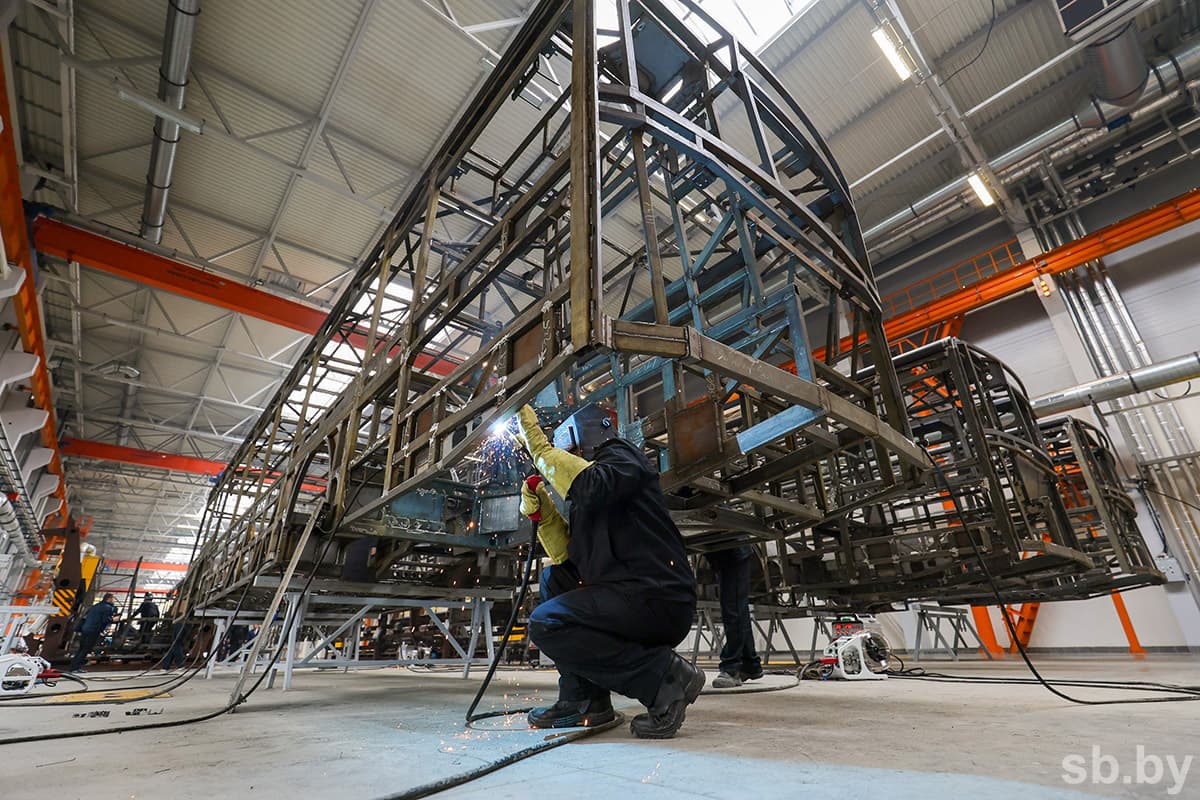
EDB experts note that Belarus and Russia have the prerequisites for performing the functions of countries with the most developed industrial base and complex technological competencies of the region.
- For Russia, the broadest profile is defined: industrial engineering, transport components, chemistry and polymers, metallurgy and metalworking, power equipment, nuclear technologies, critical materials, industrial service, automation and industrial software. For Belarus, the most relevant engineering, agro- and irrigation equipment, transport components, industrial service and engineering, chemistry and polymers, food industry, fertilizers and agrochemistry, electrical engineering and cable products. Consequently, the contribution of this group of countries should not be limited to the production of finished products. No less important are complex components, equipment, standards, engineering solutions, service, testing, certification and training for regional chains. Russia and Belarus can develop and maintain the most complex parts of the materials-components-equipment-finished products chain. Analysts emphasize that cooperation has material industrial meaning for the Eurasian region. Large markets give a start-up scale to a wide range of industries while maintaining competition and external openness, while small and medium-sized economies gain access to more capacious demand, technologies, suppliers and standards.
- Therefore, regional industrialization should not be built as a set of isolated national programs, but as a system of interoperable and distributed value chains. Existing trade flows show that the region is an important market for second-hand products, EDB analysts said.
According to experts, on average, the Eurasian region accounts for about 59 percent of sales of such products, and for some countries the value is especially high: over 85 percent for Kyrgyzstan, about 70 percent for Belarus, 57 percent for Kazakhstan, 53 percent for Uzbekistan, 43 percent for Armenia and 39 percent for Tajikistan.
- The greatest effect of cooperation is expected in the chemical complex, metallurgy and mechanical engineering. It is advisable to expand this cooperation through electrical engineering, industrial service and engineering, packaging, pharmaceuticals, power equipment and individual niches of new materials. In the applied strategy, it is important to consider cooperation primarily as a mechanism for the formation of regional production chains, the EDB analysts added.
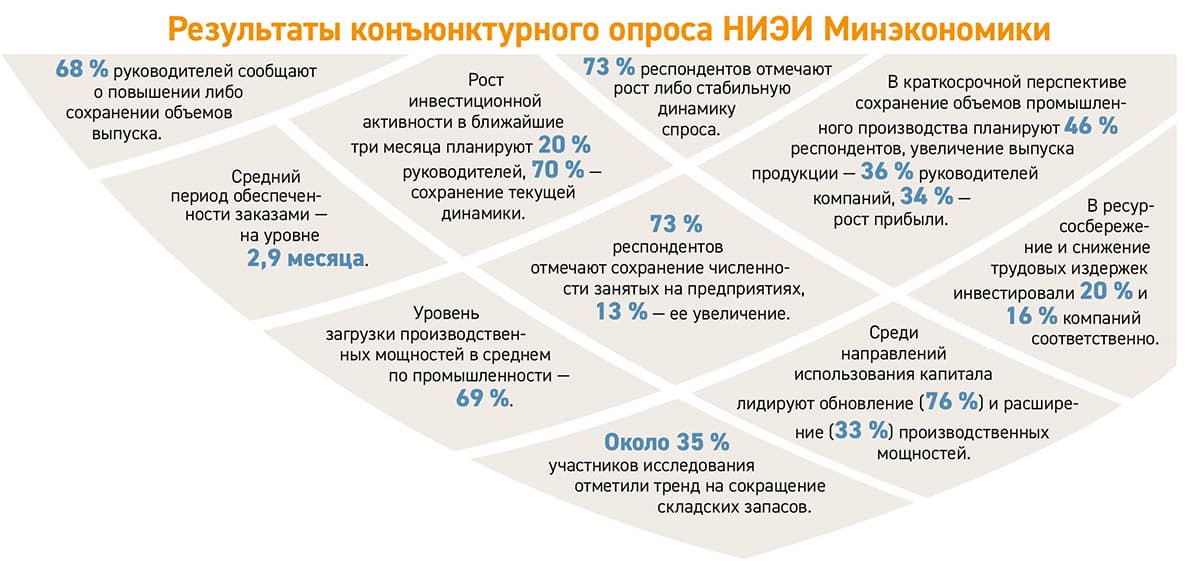
Investment activity of industrial enterprises remains at a high level
Today, the Belarusian industry is dynamically developing. Enterprises produce 93 percent of equipment used by domestic agricultural producers: for sowing, harvesting and obtaining products. Such equipment works in both transport and road construction sectors.
For the nine months of 2026, the volume of industrial production is 97 percent. At the end of the year, it is planned to reach production volumes in industry more than 100 percent by 2025, and for exports - 103.4 - 103.5 percent. There is every reason to believe that the positive trend will continue. This is evidenced by the results of a recent survey of heads of industrial enterprises conducted by the Economic Research Institute of the Ministry of Economy. It is based on a single European method of testing conjuncture. Standardized business activity tests are used. Participants are managers and top managers of industrial, construction, trade and small/medium-sized organizations. Respondents fill in special questionnaires, assessing the current state and changes in key indicators - production and output, dynamics and level of demand, investment activity, finished product stocks and capacity utilization.

Catherine Stohl. We have been conducting these surveys for about 30 years. Previously, they were held quarterly, and since 2009 – monthly. We monitor the dynamics of how Belarusian industrial enterprises assess their activities and what they expect from the future. The latest survey showed that forecast estimates continue to be optimistic. There is optimism among industrialists. We ask you to assess how much their economic situation will improve in the next three months. And, accordingly, on the basis of these answers, we receive operational data faster than official statistics come, said Ekaterina Stohl, head of the economic research department of the NIEI of the Ministry of Economy.
Experts send questionnaires to more than one and a half thousand respondents. At the same time, the responses of about 370 heads of enterprises of the country are used for a representative sample. The results of the latest survey show that investment activity of Belarusian industrial enterprises remains at a high level. Its growth in the coming months is planned by 20 percent of managers, 70 percent noted the preservation of the current level. 68% of respondents reported an increase or preservation of output, and 73% noted an increase or stable dynamics of demand.
- According to the study, the key areas of capital use are the renewal and expansion of production capacities. Investments in resource saving and reduction of labor costs are also growing, Ekaterina Stoll added. The majority of the study participants pointed to the preservation of the current level of employment: 13 percent of respondents reported an increase in the number of workers. In the short term, 46 percent of respondents plan to maintain industrial production, 36 percent of company managers plan to increase output, and 34 percent plan to increase profits.
sichevich@sb.by