
Can AI replace a living mentor at work?
According to surveys of representatives of Russian companies, three-quarters of respondents already use artificial intelligence to create educational materials, tests and adapt content
According to surveys of Russian companies, three-quarters of respondents already use artificial intelligence to create training materials, tests and adapt content. And a study of the work of customer support employees showed that access to an AI assistant increased the number of solved questions per hour by an average of 15 percent. AI is increasingly being used to train and adapt new employees. At the same time, the need for an experienced mentor persists: the digital assistant also needs to be trained, and its recommendations are checked and correlated with the company’s practice.
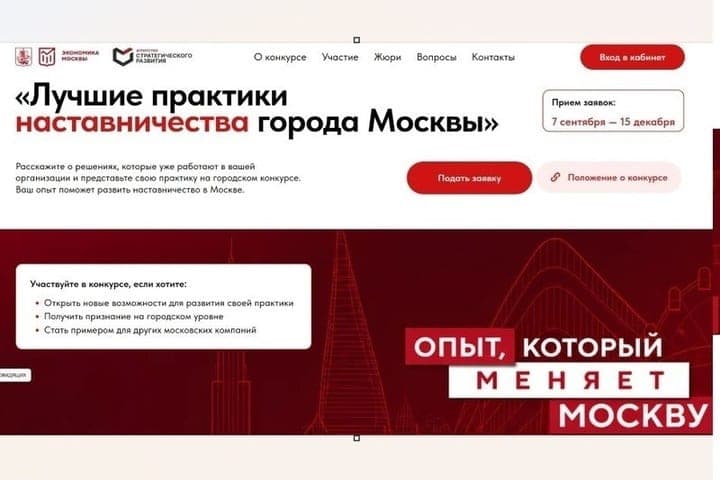
How to combine the capabilities of technology and the experience of a living mentor is one of the questions that Moscow organizations can answer with their practices at the competition “Best Practices of Mentoring in Moscow”. Companies using digital assistants in training can show how these tools complement the work of experienced colleagues and help beginners become independent specialists. Applications are accepted until December 15, 2026, including nominations for production, business and professional start-up of young people. The operator of the competition is ANO “Mosstrategy”. Terms of participation are published on the contest website.
Practical experience of such interaction is becoming more and more popular: 76 percent of respondents to the iSpring survey among representatives of 132 Russian companies already use AI to create training materials, tests and adapt content. Abroad, technology is also part of the daily work of training professionals: in the international study AI in L&D: The Race for Impact, more than half of respondents reported active use of AI.
While one of the main areas of application of AI remains the creation of educational content. But companies are already entrusting neural networks with practical exercises: a beginner can rehearse a complex conversation with a digital client and get an analysis of errors before the first real call. Whether a person after such training is able to work without prompting is one of the main questions for assessing such training.
In the Moscow metro, the digital assistant project became part of a program in which an experienced colleague is assigned to a new employee. The mentor is involved in training and intermediate control, and the chatbot helps to settle into the organization. In the description of the practice, the authors report a reduction in adaptation time by 30 percent and mentoring costs by 15 percent. In this case, the bot is used as an additional tool of the mentor.
A chatbot to get acquainted with the company and a neural network capable of disassembling work situations solve different problems. An example of the second approach was described by Sber’s team. The company developed an AI mentor based on GigaChat: the system analyzed transcripts of conversations of client managers and suggested how to improve communication. Reports were sent to managers to check recommendations and sift out model errors. So an experienced employee had prepared material for analyzing specific conversations.
However, the report itself was not enough. A month after the first pilot, the team found a drop in conversions and found that the recommendations stopped working as planned. The pilot restarted, refined the system and clarified the procedure for using reports. After the changes, developers reported an increase in conversions. This episode shows how much the outcome depends on what happens after the prompt appears: who checks it, discusses it with the employee and helps apply it in the next conversation.
Another way to leverage employee experience is to turn it into training situations. In March 2026, T-Technologies introduced Robocoach, an AI-based dialogue simulator. He plays the role of the client, reacts to the replicas of the employee and gives feedback. Scenarios can be created based on real calls: complex episodes become material for exercises, successful conversations become examples for training beginners. The employee gets the opportunity to repeat the exercise, and the content of the training remains related to the practice of the company.
The benefits of AI for beginners are also being studied by researchers. Eric Brynjolfsson, Daniel Lee and Lindsey Raymond analyzed data from 5,172 customer support employees. Access to an AI assistant increased the number of questions solved per hour by an average of 15 percent. Less experienced employees improved both speed and quality of work; the authors also found signs that using the system promotes learning. Thus, digital assistance in certain circumstances can support the development of the profession.
But quick access to a solution doesn’t always mean the employee figured out how to get it. In the Anthropic experiment, published in January 2026, developers mastered an unfamiliar software library. On the test after completing the task, the group with AI received an average of 50 percent points, the group without it – 67 percent. The researchers found no statistically significant acceleration. But among participants who worked with AI, higher results were shown by those who asked questions about the principles of operation and asked to explain the proposed code. This observation provides a guide for the organization of training: if the employee only gets the right answer, the employer has yet to find out whether he is able to repeat the decision himself and recognize the situation in which it does not fit.
When AI and mentor work together, this verification can be built into conventional learning. A digital assistant offers an exercise, finds the right material, or helps to disassemble a task. Then an experienced colleague asks the employee to explain the decision, changes one of the conditions and observes how the employee acts.
Moreover, the digital assistant needs to be configured taking into account the specifics of a particular enterprise: pick up working examples, prepare training materials and check recommendations. Therefore, an experienced mentor can participate not only in the training of beginners, but also in the preparation of digital tools that they use.
Moscow organizations can present their approaches to training employees at the competition “Best Practices of Mentorship in Moscow”. Applications are accepted until December 15, 2026, including nominations for production, business and professional start-up of young people. The operator of the competition is ANO “Mosstrategy”. Terms of participation are published on the contest website. For companies implementing digital assistants, this experience provides an opportunity to show how technology helps employees become independent specialists.
