
Access to medicine and education gave the residents of Western Belarus the day of September 17, 1939
The newspaper “Evening Minsk” has launched a project dedicated to the reunification of Western Belarus with the BSSR. The editorial staff tell us what trail...

The newspaper “Evening Minsk” has launched a project dedicated to the reunification of Western Belarus with the BSSR. The staff of the editorial office tell what mark in the lives of their relatives left the events of Sunday, September 17, 1939.
Hard work
In the 1920s-1930s, my ancestors lived in the village of Kachki, Svisloch district. Her grandmother, Lydia Kachko, was born exactly three months after the liberation campaign began on December 17, 1939. The family is large, eight people. Grandma grew up on stories about how it was “push panach”.
In the West of Grodno people lived differently than in the East of Western Belarus. The problem of landlessness in the villages was acute. Animals are horses, cows, chickens. Garden, a strip of field area of two hectares behind the house and part of the forest.
The villagers earned by working on the pan land. Someone took a risk and rented an allotment. It was possible to get a good harvest and stay in debt in an unhappy year. Many were employed as agricultural workers. From spring to autumn, they worked in the fields, and in winter – in the pan’s estate. Farms generally required brute male strength. Preference was given to those who had two horses. In winter, they brought firewood, ice for glaciers, goods to cities and towns.
In Poland, the right to land was confirmed by various donations, merchants and other documents. The residents of Kachkov had a document on the right to use the surrounding forests, hays and grazings. They got it in the XIX century, when the village itself was built. The land was distributed among all families.
According to her grandmother, in the 1930s there was a real puzzle of allotments around the village. Every meter was attached to the house. The village was surrounded by a forest, so there were many berries. Even after the war, they went for mushrooms in their former forest allotment, where they knew every bit. All the surrounding forests became the property of the Soviet state. People had equal rights to visit and collect gifts. The most mushroom places were near the new border with Poland.
Female share
Not every family could give their daughter a dowry. Many girls tried to earn it themselves.
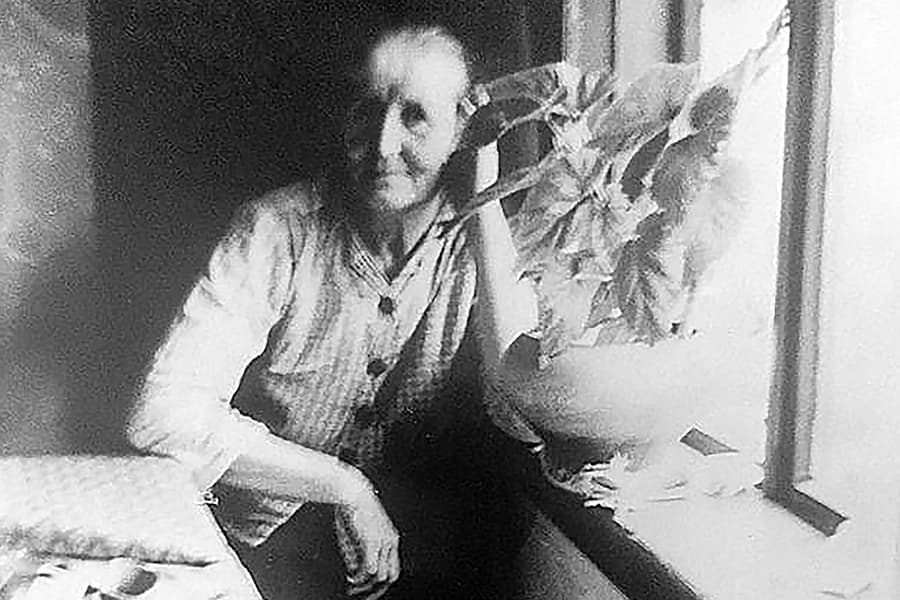
My great-grandmother Vera Skepko (pictured) worked as a maid in the house. There were troublesome days. Before the holidays, I had to pull all the rooms to shine, prepare a rich table for guests, and then wash the dishes.
The girls were completely dependent on the hostess, who decided their fate. Therefore, they walked in gray mice, dressed in baggy clothes. They were especially afraid to get caught talking with the pan: if the lady is jealous of her spouse for the servants, she will kick her out with a bang. They won't work anywhere else.
Working as a maid, it was possible to collect a good dowry in a few years. Usually, housewives allowed them to take what they no longer needed: old down, worn-out bed linen, out of fashion clothes, trimmings of the canvas, unpaired items from sets. Sometimes not as a reward, but as a reward.
My great-grandmother worked for the lady until she met her future husband, Ivan Kachko. Young women were taken as maids, because after marriage, women formed families and settled their lives. Such workers were not needed.
Before and after
Western Belarus was hit hard by the economic crisis of the 1930s. My great-grandmother said that it was three times harder and it was getting worse every year.
The war rush also went through the skating rink. In 1941, the Nazis destroyed the farm of their great-grandfather. They wanted meat - went into the barn and dragged a pig, shot chickens and geese. On August 3, 1942, punitive forces broke into the village. Six adult men were arrested and taken to a quarry. There on that day 42 civilians were shot from nearby settlements. The village is empty. Someone fled, and someone with the whole family was stolen to work in Germany. During the raid, the police burned down the house of their great-grandmothers and hummically. I had to build a dugout and live in it until the end of the war.
At the same time, they constantly compared how young people now live easily - not that earlier, "behind the Polish hours." For example, "Traba da dohtura, Bo's sick?" The verses of the book are: “The Quran, the Quran, and the Quran, the Quran, and the Quran, the Quran.” “Adna on the бо And you're dead! Grandmother Lydia knew she had given her and her children the day of September 17, 1939, a social guarantee of access to medicine and education. She always emphasized that she was the first to be born “ б Balnitsa, not , Haze.” Many diseases that were previously considered a sentence were curable. Medical care has saved many mothers and newborns.
My grandmother always looked at the kids in kindergarten. Her generation was deprived of a happy and carefree childhood.
Photo from the author's archive and from the Internet


