
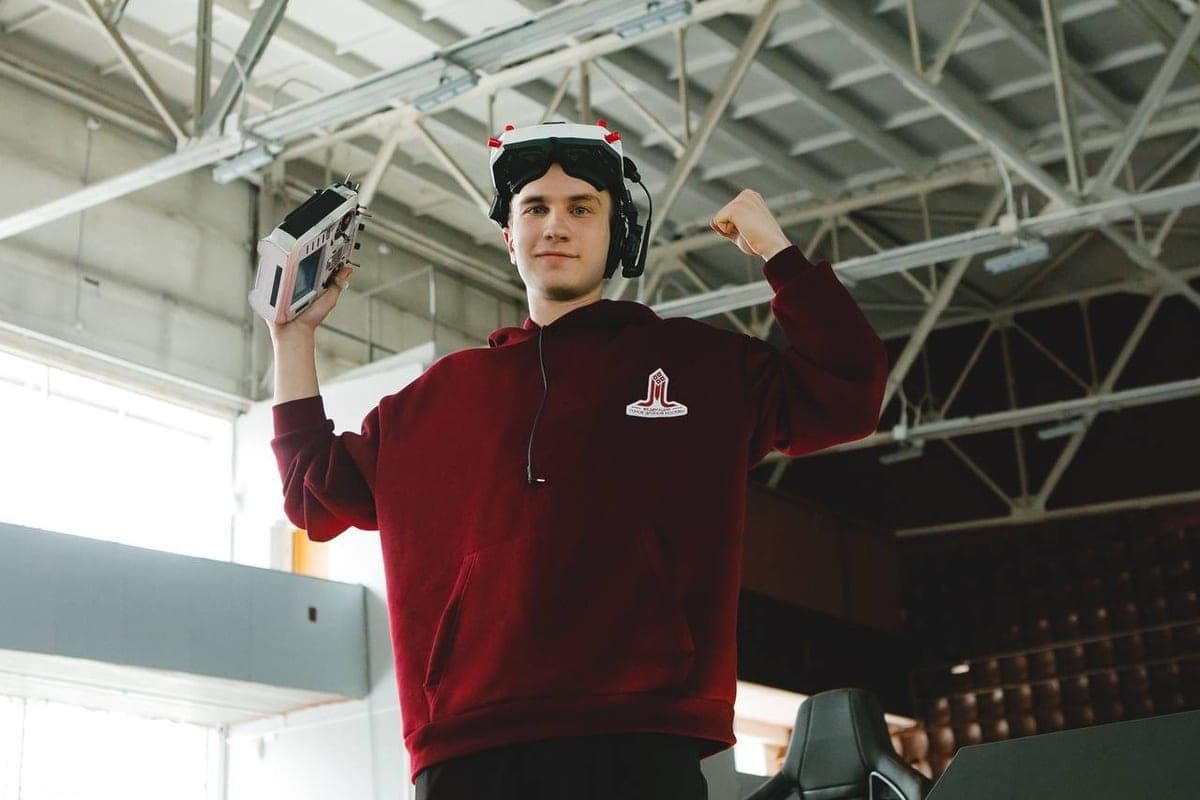
Krasnoyarsk drone pilot Alexander Holkin - about speed, victories and participation in the show "At height "
From a toy helicopter in his parents' apartment to the World Cup - so began the story of 22-year-old Krasnoyarsk drone pilot Alexander Holkin
Children's dream and the first competitions
How did you get into drone racing?
It all started with a childhood dream – I was always drawn to the sky. I loved airplanes, helicopters, everything that flies. My mom once gave my dad a toy helicopter, and I loved watching him launch it in our house. But Dad always broke it.
Then his mother gave him a simulator with a remote control so that he could fly on a computer and not break anything. Dad didn't have time, so I got the remote. I first flew airplanes and helicopters in a simulator, then learned about drones and gradually moved to real quadcopters.
What was the hardest thing at the start?
It was hard. I started in 2018: there were no detail stores, no instructors, and my friends weren’t particularly interested. But I was lucky to find a teacher Dmitry Vladimirovich from Krasnoyarsk institution of additional education. He explained what a drone is made of, how it flies and how to learn how to fly it.
Thanks to him, I assembled the first drone and competed in the first competition. Then I met Matvey Nikitin - we are still close friends. He became one of the best drone video operators in Russia. And the piloting skills came to me quite quickly: I spent a lot of time in the simulator.
You started in Krasnoyarsk. What opportunities does the city offer for development in this sport?
Krasnoyarsk, if not the capital of drone racing, is definitely one of the most active cities. There are a lot of strong athletes out there. Dmitry Savinovsky shows good results both in Russia and abroad. Alexander Ganin is the champion of Russia and the first athlete who represented our country at the World Drone Championships.
So in Krasnoyarsk there are both role models and opportunities for development.
Training, speed and cost of errors
What does your training day look like?
Preparation begins three to four hours before the training. I come to the flight test complex, fix everything that broke last time, charge the batteries, adjust the drones. Then I prepare the platform: tables, charging, chairs, track.
The training itself lasts about two and a half hours. I write down the results, keep a diary, and then analyze the statistics. Another half an hour is spent on training — a total of six to seven hours.
With the simulator is easier: I come to the drone club and train at the computer for two to two and a half hours.
Which is more important for the result: reaction, experience, engineering instinct or psychological stability?
Everything is important, from technical training to psychological training. But at the start, I would pay special attention to technology. Something was always breaking, and it prevented me from training.
At the moment, I feel the psychological pressure. I have the skills, I can fly fast and show good results. But if you don’t set your mind or put unnecessary thoughts into your head, serious mistakes begin, and the competition ends for me.
What do you feel when you fly, adrenaline or complete control?
At speed, the pilot feels nothing. It's completely empty in my head. As soon as a thought appears, an error immediately occurs. Even the thought of not thinking about anything gets in the way.
Euphoria occurs only during the first flight. And in competitions and training - only calm and control.
Are there frequent falls? Were there any serious setbacks?
Falls happen at every training session: at best one, at worst dozens. I broke a lot of drones and changed a lot of parts. But this is a technical sport, there is no other way.
As for the setbacks, last year was not the best: it failed to fulfill the tasks set. This year I have strengthened my preparations and I hope to show a decent result at the championship and the Cup of Russia.
Drones break down, but how much risk does the pilot take? What are the injuries in this sport?
It would seem that drone racing is safe: the pilot is not sitting in a quadcopter, but far from the track. But this is a technical sport, and people make mistakes when assembly: touch a hot soldering iron, get burns, sometimes batteries light up.
I once had a drone fly into my head and almost got a concussion. The sport is generally safe if you follow the rules.
From sports to television shows
How did you find out about the invitation to the TNT show "At the height"?
I was told about this show by the coach of the Russian national team on drone racing. He explained the concept: a star who can’t fly teamed up with an athlete, and together they competed.
To be honest, I was a bit skeptical of the idea initially. But on set, everything looked super cool. And the program itself turned out beautiful and spectacular.
How is this format different from the usual competition?
I participated in regular races, and in demonstrations, held master classes. But the show is different. Here you need to work on the camera: show not only fast, but also beautiful, understandable to the viewer flight.
And also to express emotions. We athletes, especially in drone racing, are not used to this. Plato and I, the pilot of another team, were unusual. And here, the more emotions, the better.
Your partner was Mikhail Bashkatov. How was the work going?
It was a pleasure working with Michael. He listened carefully and tried to do as I said. And he did pretty well, by the way, especially for the man who first held the drone remote.
Did you manage to surprise yourself? Like a moving ring test?
In the test with the ring was very difficult: it not only swung from side to side, but also turned. Plus the wind blew. On the race track, all the gates are stationary, and I have never flown through moving objects before.
A couple of times I managed to fly, but then the ring was very twisted, I did not hit it and fell on the asphalt. Interesting experience, but difficult.
Michael said he admired your flights. Did his support help or hinder his focus?
To be honest, I hardly heard anything. And if he did, he asked him to keep quiet, no matter how rude it sounds. During the flight, it is important that there are no thoughts in your head.
Our own school and a new generation of pilots
Besides competitions and shows, you have a school and a club. How did this direction come about?
When I was almost the best driver in Russia and approaching the World Cup, all my time was spent on training – both free and unfree, even skipping school. But I consider sports more of a professional hobby.
My father said several times: Think about what you will do when your sports career is over. In 2022, he proposed opening an online school to teach people from across the country how to assemble, customize and pilot drones. That’s how it appeared – over four years we have trained more than a thousand people.
In 2024, we opened an educational and entertainment club in Moscow. That's the development of the school, the club and the popularization of drones I consider my work.
What does Drone Sport teach you besides piloting? What skills will be useful in ordinary life?
First of all, technical: the device must be assembled, configured, programmed. Plus, motor skills, reaction, concentration and discipline develop. It helps in everyday life, not just on the road.
What does it take for drone racing to become a mass sport?
We need more people to know about him. Now there are many programs that introduce children and adults to drones and help you choose a direction.
After all, it is not only sports, but also programming and project activities. There are many opportunities, and this direction is supported and developed in our country.
What goal do you set for yourself now?
There are no dreams, there are goals and tasks that I try to accomplish. I want to be an example for the younger generation, to motivate children to come to this sport. Show that you can develop your skills and achieve results.


