
Lakshari on Sukhodol Lake: where landscaping ends and questions begin
In the Priozersky district of the Leningrad region, it seems, again flared up land scandal. Some time ago, tourists who arrived at Cape Chalka discovered that access to it was blocked by an iron gate with the inscription “Private Territory”. This time, fishermen who went out to relax on the shores of Lake Sukhodol, saw that the coastline plowed with heavy equipment, and capital piers were being built in the lake.
Sukhodol Lake is a 30-kilometer reservoir into which the Vuoksa River flows on one side, and the Burnaya River flows on the other, carrying water to Lake Ladoga. If you have ever come to the Losevo station, then, leaving the train, you saw just the Dyatel Bay of Sukhodol Lake. Fishermen love this reservoir: in the waters of Suwanto (the former name of the lake) live bream, pike, pour, perch, roach, eel, perch, tar, chekh, chekh. There are also banned salmon here, as well as Vuoxin and grayfish, for which a license is required. In general, an expanse for an amateur to sit with a fishing rod.
Therefore, it is quite logical that residents of houses standing in numerous villages near the coastline, built non-capital piers. Some have floating pontoons, others have wooden bridges. According to them, fishermen get to their boats and decrease to rest from the grayness of everyday life, but to get delicious fish for lunch or dinner.
But the uniform life of summer residents and local residents was violated.
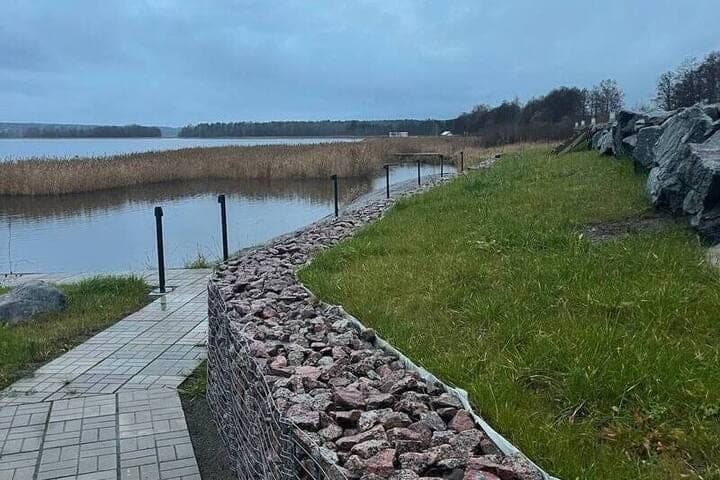
As the fishermen told our editorial staff, near the suburban non-commercial partnership (DNP) and the suburban non-commercial partnership (DNT) “Silent Bay” an active construction began: someone, apparently, decided to equip the coastline, turning it into a promenade with paved sidewalks, lamps and distant granite exits to the water. The signal about this came to the editorial office at the end of September. But when exactly the transformation of the coastline began, it is difficult to find out.
“There excavators change the coastline, artificially creating lagoons, sand, which is brought by trucks, level the site, along the embankment everything is covered with stones. They say there will be a public area. And who will guarantee that when the work is completed, all this will not be closed with fences? But now they artificially change the shoreline of the lake, creating marinas, a man outraged by the course of work told our publication.
The editors of MK in St. Petersburg got acquainted with orthophotoplanes of the coastline on the Public cadastral map of the Leningrad region and satellite images on Yandex and Google maps. They show that from the shore in the water leaves a considerable number of platforms. When the picture increases, they turn out to be wooden flooring, and in some places and pontoon piers. Some have boats and boats. Much more interesting information and pictures on real estate sales sites. Ready-made houses on the first line with plots of 20-35 acres sell for 65-80 million rubles.
“A closed village with security and a barrier,” the author of one of the ads said.
"Ideal for lovers of water, boats, fishing and quiet country life," another ad read.
And in all cases, the buyer is guaranteed his own access to the water “with the possibility of installing a personal pier” or “the possibility of launching boats into the water.” In several pictures there is already a finished structure - with paved tiles a fairly wide pedestrian road, lanterns and a pier.
Realizing that the data of eyewitnesses, maps and announcements vary, we went to the scene to see with our own eyes what was happening (and is happening) with the coastline.
In general, the cadastral division here is quite interesting. Near the village of Portovoe there are fields for agricultural production. And a strip of land with a width of 250 meters along the shore of the lake is “cut” into neat rectangles and given for “dacha construction” and for “divac farming”. In one of the "Quiet Bays" there are lands intended for "maintenance of personal subsidiary farming." At the same time, about a dozen areas surrounded by agricultural lands belong to the lands of settlements.
Upon arrival at the place, it immediately turned out that the shore of the lake is still open to everyone and everything: you can drive to the shore by car, unload an inflatable boat with a motor and rush over the horizon in search of the king-fish. We really didn't have a boat with us. So we did not look at the shore from the water, but from the land. They saw the same thing as people who turned to the editorial office: a sand pillow rammed along the lake, on which granite stones are superimposed and a grid is stretched, paths under pavement slabs, neat lagoons. Different levels of the embankment and their well-groomedness do not hint, but literally shout about the artificial nature of the appearance. And the arrangement is in several places. Some had already been completed, while others were in active preparation.
We cannot say that at the moment someone is violating people’s right to access water. But the obvious transformation of the shoreline of the reservoir and the construction of capital piers is no longer a joke, but fraught with sanctions flirting with the law.
Putting a chair on the shore or a tourist table does not in itself mean starting a major construction. However, after rest, it is necessary to remove the equipment and not limit the general access to water: the coastal strip of public water bodies is intended for public use, and its standard width is 20 meters (Water Code of the Russian Federation dated 03.06.2006 No. 74-FZ, article 6).
The arrangement of the capital pier, berth or improvement of the embankment requires other preparation. First of all, it is necessary to determine the legal regime of the land and water area: for the use of the water area, including for recreational purposes, a water use contract may be required (Water Code of the Russian Federation dated 03.06.2006 No. 74-FZ, article 11).
If we are talking about the placement of a berth, a ship-lifting or ship-repairing structure, a hydraulic structure or work related to changing the bottom and banks of the reservoir, a decision is required to provide a water body for use. It is issued by the authorized body at the place of intended water use (Water Code of the Russian Federation dated 03.06.2006 No. 74-FZ, Article 11).
In addition, it may be necessary to coordinate with the territorial body of the Federal Agency for Fishery if construction, reconstruction or other activities can affect aquatic biological resources and their habitat. This is not a universal requirement for any pier, but a condition that depends on the nature of the work and its impact (Explanation of the Federal Agency for Fishery, 07.03.2024).
The status of construction also matters. For an object that is not a capital structure, a building permit is not required; however, even in this case, it is necessary to comply with the requirements for the use of the land, water body and the established restrictions. If the pier is recognized as a capital structure, project documentation, examination and construction permit may be required - depending on the characteristics of the object and applicable standards (Urban Planning Code of the Russian Federation dated 29.12.2004 No. 190-FZ, Article 51).
The construction or placement of a pier without the required contracts, decisions, approvals and permits may lead to the recognition of the construction unauthorized. According to Article 222 of the Civil Code of the Russian Federation, such a building is subject to demolition or bringing into compliance with the established requirements; the decision on demolition can be taken by the court, and in cases established by law - by the local government (Civil Code of the Russian Federation, part one, dated 30.11.1994 No. 51-FZ, article 222).
For lakes, the water protection zone is usually 50 meters. But there is also such a thing as a coastal strip: it is a 20-meter zone directly along the water, intended for public access (Water Code of the Russian Federation dated 03.06.2006 No. 74-FZ, articles 6 and 65).
A special regime of economic activity operates in the 50-meter water protection zone. And already within it may operate additional restrictions of the coastal protective strip (Water code of the Russian Federation of 03.06.2006 No 74-FZ, article 65).
Journalists of “MK in St. Petersburg” sent official requests to the Environmental Prosecutor’s Office of the Leningrad region and the administration of the Priozersky district of the Leningrad region to clarify the situation with the legality of the buildings. The supervisory authority, which is actively fighting the illegal sale and lease of land in the region, responded first.
We were informed that the acting environmental prosecutor had already gone to the country village. It turned out that the work is carried out by a private person. Since the prosecutor's office does not supervise individuals by law, the materials of the inspection were transferred to the police and the district administration to initiate administrative proceedings. With the initiator of these works on the shore of the lake will be further engaged Rosprirodnadzor. The violator may face sanctions under part 1 of article 8.42 of the administrative code of the Russian Federation — “Use of the coastal protective strip of a water body, water protection zone of a water body with violation of restrictions on economic and other activities”.
However, the administrative fine for this offense is small and reaches 4.5 thousand rubles.
At the request of the editorial office, the head of the administration of the Priozersky district Alexander Soklakov also responded. He said that the site indicated by us is within the boundaries of the Priozersk forestry and the water area of Lake Sukhodolskoye, which is the property of the Russian Federation.
“The administration of the Priozersk municipal district did not issue permits for the use of these territories / lands / water areas due to the lack of legislatively fixed powers,” Alexander Soklakov explained the lack of interest in what is happening on the shore of the lake. Issues of the organization of the use and conduct of economic activity on the lands of the forest fund are not related to local issues. The Administration has no authority to control forest lands.”.
It should be noted that the editorial office received an almost identical answer in response to a request for Cape Chalka, the land on which a private company leased and builds a base for hunters and fishermen. The official answers are dry and clear: “Not our responsibility, not allowed, not done.” Problems are mentioned only within the framework of what is required by law in correspondence with the media.
However, the head of the district can be understood humanly. A little more than a week ago, on October 29, it became known that Alexander Soklakov is a witness in the case of fraud on an especially large scale. According to the portal 47news, we are talking about the scheme of theft of dozens of hectares of forest fund: state-owned land was transferred to municipal ownership and sold through a controlled company.
However, in his response, Alexander Soklakov said that he forwarded our request to three recipients:
► Chairman of the Committee on Natural Resources of the Leningrad Region Fedor Stulov;
Head of the Committee of State Environmental Supervision of the Leningrad Region Ramila Agayeva;
The head of the administration of Gromov rural settlement Alexei Kutuzov.
The editorial board, in turn, sends requests to the regional offices of Rosrybolovstvo, Rosvodresursov and Rosprirodnadzor to find out whether anyone was issued permits for the construction of the embankment and capital pier near the Quiet Bays.


