
Only planes live in flight. Historical sketches with Vyacheslav Bondarenko
The screw! A good old team that you can’t hear at the airports anymore. Well, maybe that's what they say on the Dossaaf training grounds, where they fly.
The screw! A good old team that you can’t hear at the airports anymore. Well, maybe that's what they say on the Dosaaf training grounds, where sports Yaki and old An-2 fly, - they really have a screw. And in our “passenger” sky has long reigned almost exclusively jet aircraft. But it wasn't always that way. The era of jet aviation for Belarus opened on April 18, 1964, when a jet liner, the handsome Tu-124, landed at Minsk-1 airport for the first time. This car was driven by the deputy head of the Belarusian Civil Aviation Administration Dmitry Glushchenko and Nikolai Zakharovich Pasko.
By then, jet passenger planes were no longer as thrilling as they were in the late 1950s. The Soviet first-born Tu-104 became a familiar attribute of the era, and in itself, air travel was felt as a fairly ordinary form of it - high-speed and comfortable. In many directions, the aircraft began to actively displace trains: tickets for them cost about the same, and the widespread advertising “Fly with Aeroflot aircraft!”, in general, was no longer very necessary. But the Tu-104, which debuted in 1955, had two unpleasant features: first, it required long runways, which were far from all Soviet airports. Therefore, in small air ports, such as Minsk, continued to operate piston Li-2, IL-12 and IL-14 machines are excellent, but already obsolete. And secondly, in the late 1950s, the Tu-104 suffered a number of resonant disasters related to the poor quality of its engines. Passenger confidence in the aircraft began to decline, the reputation of jet passenger aviation was urgently needed to improve.
That is why in 1960 the Tu-124 appeared - a kind of reduced twin brother of the "hundred-four". Externally, these two aircraft are really very similar, their engines are built into the wings, except that the 124th is smaller. But in fact, the differences were much more serious: the 124th took on board not 70-100 people, as the 104th, but 44-56. This capacity is ideal for operation on relatively short routes. And the new aircraft did not require such a long acceleration during takeoff and run during landing, respectively, could land on small airfields. And most importantly - it was fundamentally new turbojet twin-circuit engines D-20P, they were much more reliable than those that were equipped with "hundreds".
Since the Tu-124 was originally developed for the needs of regional airfields, it was this machine that opened the era of jet aviation in Belarus. We had one of the largest parks of "hundred-twenty-four" in the Soviet Union - 15 cars. It was possible to ride them in 1964-1979. In the first year of operation of the "hundred-and-twenty-four" flights were relatively few, and they were not long: Minsk - Zaporozhye, Minsk - Kharkiv - Krasnodar, Minsk - Mineral Waters, Minsk - Odessa and Minsk - Kharkiv. However, it quickly became clear that the Tu-124 perfectly "pulls" and long-distance flights. The longest route was Minsk-Alma-Ata with intermediate landings in Kazan, Chelyabinsk and Karaganda. This flight lasted 9 hours 35 minutes. And on August 16, 1970, the jet liner first flew from Minsk abroad: the Tu-124 began to serve the Minsk-Warsaw-Berlin line. The best crews of the Belarusian Civil Aviation Administration G. Grachev, E. Corneto, V. Osipovich, A. Khoroshilova, A. Koleznev worked on this route.
What would the “hundred-and-fourth” look like now? Probably very noisy: because of the engines built into the wings, their roar in the cabin was heard perfectly. Strange would seem and open luggage nets above the seats – locking plastic boxes then was not in sight. The windows are not oblong, but round, like on a ship. Smoking was allowed on board (this seems like a wild thing now, but the fight against smoking on airplanes didn’t begin until the late 1970s). And in general, everything is about the same as in modern liners: comfortable seats with armrests, smiling flight attendants in beautiful shape, “fasten your seat belts”, takeoff, landing ...
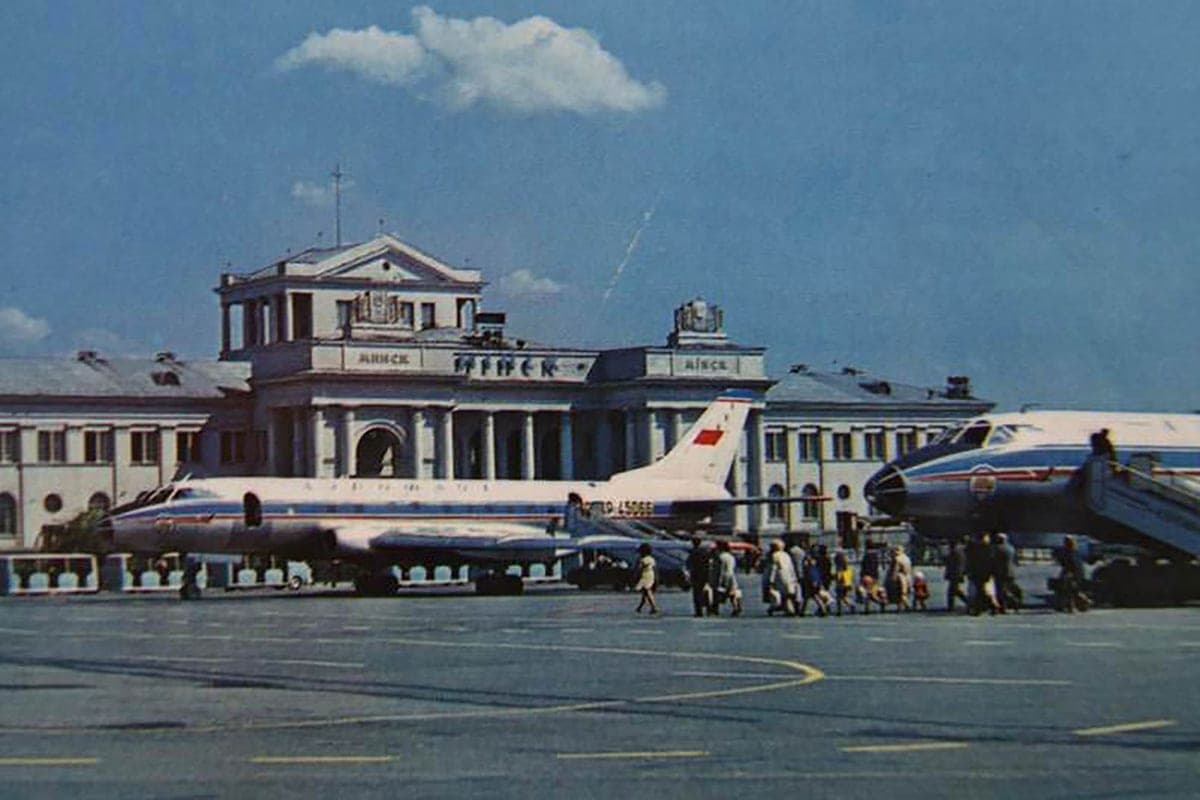
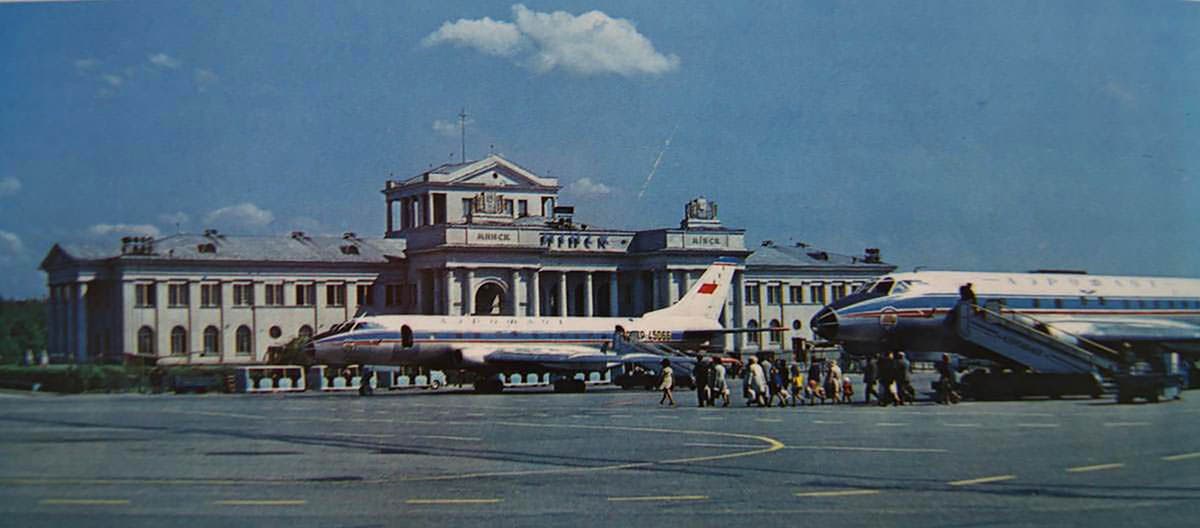
From that time and color photography, which we are now considering. Nice compact building "old" airport Minsk-1 - then, of course, it was not "old", but just an airport. Summer blue skies, clouds. A string of people who just got off the plane and walked to the airport building. Now you will not see this, special buses are taken from the ladder of passengers, and then people often walked along the field on foot, even if you had to walk a lot. And two Tu-124s in the frame. Both aircraft are in the “old” livery, that is, the signature color of “Aeroflot”. This was how Soviet passenger planes looked until 1973, when they received a recognizable blue stripe on a white background. At the "hundred-and-twenty-four" that is closer to the terminal building, the number on the fuselage is visible: USSR-45065.
Can we find out his fate? Sure. This particular Tu-124 was produced by the Kharkiv plant in 1964 and made its first flight on July 18 of the same year. It held 56 passengers. Until 1966, it was assigned to the North Caucasus Civil Aviation Administration, more precisely to the Volgograd airport, and in December 1966 it was transferred to Mineralnye Vody. So in the picture, the plane either arrived from there or is preparing to fly there. The Minsk-Mineralnye Vody flight operated from May 15 to November 14, flew three days a week, departed at 13:30 and landed at its destination at 17:20. The return plane landed in Minsk at 11:55.
The Tu-124 flew without incident until 1976. On September 28 of this year, it was written off by the order of the Ministry of Civil Aviation of the USSR with the wording “for the development of the assigned landing resource” and disposed of, that is, cut into metal. The fate of Minsk Aircraft Repair Plant No. 407 was closely connected with the Tu-124. For the first time, the "hundred-and-twenty-four" in Minsk was transferred for repair from Moscow in May 1964, it was an aircraft number USSR-45012. Its repairs lasted until Dec. In 1964-1978, 497 repair works on the Tu-124 were carried out in our capital.
Unfortunately, there were “hundred-and-twenty-four” disasters. You will be at the Eastern cemetery of Minsk, bow to the grave of the crew of the Belarusian Tu-124 number USSR-45037, which on January 3, 1976 crashed near the village of Sanino near Moscow. Immediately after takeoff from Vnukovo airport, the aircraft entered low cloudiness, the instruments failed and the crew lost spatial orientation. Five crew members and 56 passengers were killed.
From operation these machines began to withdraw in the mid-1970s. By that time, the aircraft appeared almost perfect replacement - the legendary Tu-134. By the way, it was actually an elongated “hundred-and-twenty-four”, in which the engines were shifted back to the tail. However, the 124s continued to fly, and it wasn't until the early 1980s that the last such machines were taken off the lines.
In Minsk, you could see the Tu-124 not only at the airport, but also in the heart of the city. It was the USSR-45029, an early 44-seat version released in November 1962. Until December 1965, the aircraft was assigned to Moscow, then transferred to Minsk. Since the end of 1976, the decommissioned liner was exhibited on the open area of VDNKh of the BSSR, next to BelAZ and tractors "Belarus". However, he stood there for a short time - already in 1980, the "carcass" was taken to Grodno and made of it a children's cinema "Flight". In 1993, the veteran was moved to Ivye, where they planned to equip a recreation area around him. But, unfortunately, none of this worked out, and a unique, memorable to many since childhood, the plane was cut for scrap.
Few people remember that one Tu-124 was installed in Minsk and as a monument near the airport Minsk-1, where the first such machine arrived in 1964. It was the liner number USSR-45097, in 1964-1973, flying in the Czechoslovak airline CSA. In August 1973-February 1978 he worked in Minsk, then flew to Novosibirsk, where until 1983 he served at the local aircraft factory. When exactly was it installed at the Minsk airport and when was it dismantled? Historians of the national aviation...
Well, today in Belarus on the Tu-124 can be seen in Chechersk, Gomel region. This is one of the rarest versions of this aircraft - 124Sh. It trained navigators of military aviation. A total of 68 such aircraft were built. Apart from Belarus, few Tu-124s have survived in Russia, China and India.
The time when the roaring “hundred-and-twenty-four” took off in the center of Minsk has long passed. On the site of the former summer field are skyscrapers. Old planes have been cut into metal. But a summer day still lives on color photography, and Minsk Tu-124s are still ready to go on their way. What was the fate of the first Tu-124 that flew to our capital in April 1964? His number was USSR-45056. From February 1966 to November 1978, this aircraft was assigned to Minsk, after which it was transferred to Kazan and decommissioned in July 1980.


