
Why Future Doctors Study Physics for a Semester and What Exit They Found in Crimea
How this exact science helps to better prepare those who will treat us, we talk with the candidate of physical and mathematical sciences, associate professor, honored teacher of KFU named after V. I. Vernadsky, scientific secretary of the Physical and Technical Institute Elena Maximova.
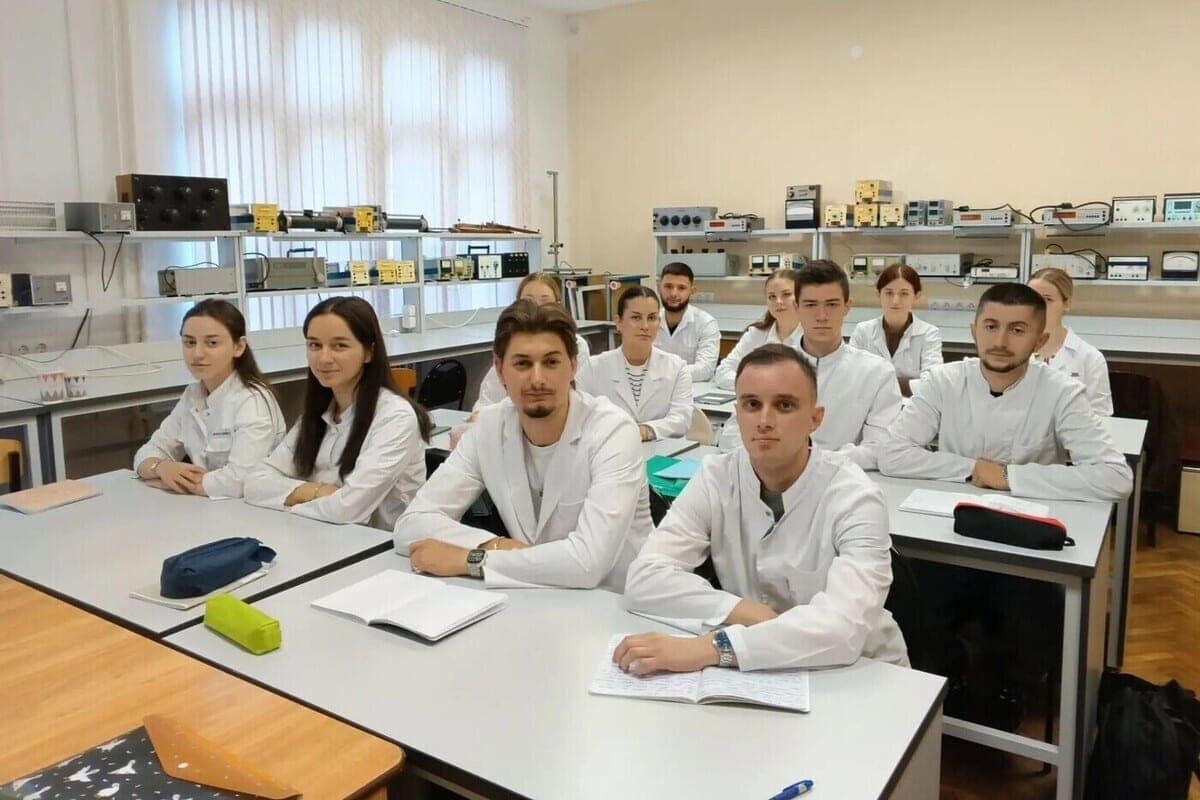
How this exact science helps to better prepare those who will treat us, we talk with the candidate of physical and mathematical sciences, associate professor, honored teacher of KFU named after V. I. Vernadsky, scientific secretary of the Physical and Technical Institute Elena Maximova.
- Elena Mikhailovna, and yet, why do medical students, future doctors, need knowledge of physics?
- I guess I'll start with the background. In 2019, as a result of the merger of two departments (solid state physics and medical physics and informatics), the Department of Physics of Condensed Media, Physical Methods and Information Technologies in Medicine appeared in our Physico-Technical Institute. Its name exhaustively describes everything we do today: this is the traditional teaching of physical sciences to physics students, and the teaching of biophysics and bioinformatics courses to medical students. By the way, at one time the Department of Physics was one of the first and fundamental departments of the Crimean Medical Institute. For a long time, physics was passed as one of the entrance exams, and then studied it for a year and a half and passed the exam. Today, our medical students study this subject for only one semester or six months and then pass the credit. Probably because now entrants to physics do not pass, unfortunately, their training in this subject is rather weak. Although modern medicine is almost one of the applied parts of physics. The human body is a complex physical system, where the laws of mechanics, thermodynamics, electrodynamics, optics, etc. work. Without knowledge of these laws, it is impossible to understand how the body works or effectively treat the patient. All modern diagnostic methods are based on physical principles: MRI - on the phenomenon of nuclear magnetic resonance, CT - uses X-ray radiation, ultrasound - is based on the reflection of ultrasound from environments with different density, ECG - registration of the electrical potentials of the heart, etc.
Many first-year doctors are able to measure blood pressure, as they come to medical school after specialized colleges, and they have many applied skills. But children often do not understand the essence of the phenomenon on which this skill is based. And our job is to explain it to them. I keep saying that physics teaches you to think. Yes, there is little time for this subject in the educational process - one lesson per week during the semester, but I hope we manage to teach children to think analytically, to critically approach the solution of this or that issue.
How do medical students perceive the need to study physics?
I hope they understand that this knowledge will definitely be useful to them in their future professional activities and that they are lame in this area, to put it mildly. And after almost every class, they thank us for trying to discover the world of physics, to show that it is really necessary to study it. It's everywhere. Children are often surprised when, as a visual example, I give them various application tables that doctors very often use in the diagnosis and treatment of certain diseases, tell them what complex problems are solved using the laws of physics to compile these tables. Students begin to understand that behind every digit or action, at first glance very simple, there are complex preliminary calculations using formulas describing certain physical laws or processes. Already in the first couple, we begin to study the application in medicine of the laws of mechanics: the laws of Newton, Hooke, etc., without which it is impossible to solve applied medical problems in modern orthopedics, prosthetics, implantation.
Are medical students studying physics as well?
Of course, a number of teachers of our department teach biophysics and bioinformatics in English, having previously passed a special exam and regularly confirming their level of proficiency in a foreign language. There are also groups of international students who take appropriate courses in Russian.
Can graduates of your institute work in specialized medical institutions?
- Of course. For example, two graduates of the FTI (one of them is a graduate of our department) are now working in the Crimean Republican Oncological Clinical Dispensary named after V. M. Efetov. They provide the work of the most complex modern high-tech equipment for radiation diagnostics. And over time, such specialists in Crimea, working at the intersection of sciences, at the intersection of specialties, I think, will be in demand more and more.
What unusual questions do medical students ask you in class?
- (Laughs) Rather, I'm the one filling them with questions. But not in order to somehow “catch” them on ignorance of physics. I try to tell a lot myself, and along the way I ask leading questions, helping them come to the right answer. I pay attention to phenomena and processes that seem familiar to them, natural, habitual, but I approach them from the point of view of the fundamental physical foundations underlying them. For children, this is often a kind of “discovery”. All the tasks that we solve with them, try to adapt to medicine and medical issues. For example: the patient has a broken leg, it lies on the traction system, which involves fixing the leg at a certain angle. For physics students, we will simply say: this is a problem of movement on an inclined plane, on blocks. And the medical guys say: the patient has the weight of the leg so-and-so, the leg should be fixed at an angle so-and-so, it is necessary to calculate the weight of the load that must be used to keep the leg in balance. We solve specific medical problems. Another example: many students have an idea of how to take a cardiogram. But in biophysics classes they discover a lot of new things. As you know, to take a cardiogram, electrodes must be attached to the patient's body at the tops of an equilateral triangle: the left hand, right hand and left leg, so that the heart area is in the middle (the so-called Einthoven triangle). Students take this for granted, and we explain to them why electrodes are placed in this way. And if, for example, attach them in other places, can you take a cardiogram? The guys say that it is impossible, because we will not get the result. You can, but we get a different picture. And we're explaining to them why, in a classic cardiogram, the electrodes are attached this way.
- Of course, they are interested and important.
- Neither do we. We know physics, we know the topic, but it is necessary to explain it to medical students in such a way, on such applied medical examples, that it was understandable, interesting and useful for them. To do this, we also have to learn something new for us: medical terms, practices, methods, etc. And in fact, medical students teach and stimulate us a lot, because the process of learning is endless.
- As a result, for children this can be the first step, the impetus for studying science at the intersection of medicine and physics?
- We're already doing that. We have, for example, joint publications with dentists, with whom we began to cooperate long before we began teaching biophysics to medical students. In particular, by the methods of X-ray structural analysis, we have investigated and investigated the crystalline structure of bones (jaws and teeth) exposed to various harmful factors and subsequent medical correction. I also tell physics students and medical students about these studies, urging them to try their hand at scientific work.
- And how does the leadership of the medical institute, the university help you, how interested are they?
They always meet us halfway, help us if necessary, because they understand that it is very important for future doctors to know physics. Of course, we want to spend more hours on it. Even the students themselves at the end of the semester say: “Is that all?” We have only just begun to understand physics.” I calm them down, I say that we will help them understand everything. They then write such warm reviews to us in social networks, thank you.
More recently, by the way, a meeting was held between the rector of KFU Vladimir Kuryanov and the director of our Physico-Technical Institute Alexander Nudga, where one of the issues was just discussed the role of physics in the preparation of students studying in non-profile areas. The understanding was expressed that without knowledge of the basic basics of physics for many specialties it is impossible to fully master the profession.
Are medical students studying physics different from those studying directly at FTI?
They are similar in some ways, different in some ways. Medical students, perhaps, more motivated, disciplined, understand where they came to study, what they need to know.
- Perhaps because they are already roughly orientated, where in the future it will be useful?
- Probably not. Their demand after graduation is great. But today, FTI graduates of various fields and specialties also find application of their knowledge in various fields of activity. Because physics educates in a person systemic thinking, the ability to analyze, abstract-logical, critical thinking, trains memory.
Is it not for nothing that physics is often called the science of life?
Literally in my first class with medical students, I ask them the question: what does the word “physics” mean, how does it translate? It happens that in a group one person knows. The rest, of course, immediately "Google" and read with surprise: physics in Greek means - the science of nature. I mean, literally everything. This year, I asked students who entered dentistry: how, in fact, is the word “dentistry” translated? No one knew. Then one person suggested that "tooth." I didn't know either. "Googled," laughs. - It turns out that "stoma" translates as "mouth, lips, oral cavity." I came home and I have a bouquet of eustoma flowers in my vase. Sounds like the root of stoma, too. I looked on the Internet, really, eustoma in Greek - "eu" - beautiful, "stoma" - lips, mouth. That is, dentistry and eustoma are one-rooted words. For the second class came to medical students with a branch of eustoma. You asked me why I brought it? Some said what the flower was called. “It’s actually a dentist’s flower,” she laughs.
After that, they will love physics.
All teachers of our department try to interest children, future doctors. To show them all the importance and fundamentality of the laws of physics, so that the future doctor not only mastered a set of skills, but could become a high-class specialist who understands the essence of the phenomenon, who can logically analyze the situation, make the correct diagnosis, make an effective treatment regimen for the patient.


